Vegetable · Rosaceae
Strawberry
Fragaria × ananassa
Give it full sun, steady water, and clean straw mulch, and the strawberry rewards you with sweet fruit year after year.
Full sun
Every 2–4 days
59–77°F · 15–25°C
90–120 days
Overview
Among home fruit crops, the strawberry is one of the least demanding to establish. A member of the rose family, it grows as a low, spreading perennial that clones itself through runners to occupy a bed. A single planting remains productive for several seasons before crown decline calls for renewal.
Fruiting habit divides the crop into distinct types, and that choice governs the harvest window. June-bearers set a single concentrated crop over a couple of weeks in early summer, whereas day-neutral and everbearing plants fruit from late spring into fall irrespective of day length. June-bearers also invest heavily in runners while day-neutrals produce few, which dictates how the bed is managed.
The crop is undemanding but responds directly to conditions. Supply full sun, consistent soil moisture, and clean straw beneath the fruit, and the berries develop sweet and unblemished. Allow the canopy to crowd or the fruit to rest on wet soil, and the humid microclimate favors gray mold and soft, ruined berries.
Care
The short version: full sun, evenly moist soil delivering roughly an inch to an inch and a half of water a week, rich sandy loam held on the acidic side, and clean straw mulch to keep the fruit off bare ground.
Light
Strawberries require full sun, ideally 8 or more hours a day, because high light drives the sugar accumulation that makes fruit sweet. They tolerate light partial sun, but genuine shade reduces yield and leaves the berries pale and watery.
Water
Hold the soil evenly moist but never waterlogged, which equates to about 1 to 1.5 inches (2.5 to 4 cm) of water a week. Attend to it during flowering and fruiting, when demand peaks, and irrigate at the base so foliage and fruit stay dry and disease-free.
Soil
Grow them in well-drained sandy loam amended with organic matter. A pH of 5.8 to 6.5, on the acidic side, optimizes nutrient availability, and the free drainage is what suppresses the root rots discussed below.
Temperature
The optimal range is 59°F to 77°F (15°C to 25°C). The crown is hardy enough to overwinter in the ground, but flower and fruit development decline once summer heat pushes well past that band.
Humidity
Average humidity of 40% to 70% is adequate, so there is no target to manage for. Air movement matters far more, because the still, saturated air around a crowded canopy is the microclimate in which gray mold and leaf fungi establish.
Feeding
Apply a balanced 10-10-10 in spring at planting and again after summer renovation. Restrain spring nitrogen on fruiting June-bearers, since excess nitrogen promotes soft vegetative growth at the expense of firm fruit.
Pruning
Pinch the first-year blossoms from June-bearers to divert energy into crown development, and thin runners to prevent the canopy from self-crowding. Renovate June-bearing beds after harvest by mowing the old foliage and thinning the stand, and remove every runner on day-neutral types.
Repotting
Refresh or pot up container plants every 1 to 2 years and renew in-ground beds every 3 to 4 years. Declining fruit size, rapid drying between waterings, and roots circling the pot indicate the roots have outgrown their volume.
Size & spacing
The plants remain low, at 6 to 12 inches (15 to 30 cm) tall, and spread 12 to 24 inches (30 to 60 cm) wide as runners fill in. Allowing that spacing maintains airflow through the canopy and keeps the fruit clean.
When to plant
Strawberries establish best under cool soil conditions, so plant early. Set dormant crowns or transplants in early spring as soon as the ground can be worked, and expect harvest from early summer through fall according to the type grown.
Northern hemisphere
Southern hemisphere
Typical months for a temperate climate: start earlier in warm zones, later where spring frosts linger.
- Plant: Early spring, as soon as the soil can be worked; set dormant crowns or transplants 2 to 4 weeks before the last frost.
- Harvest: June-bearing: harvested over 2 to 3 weeks in early summer; day-neutral and everbearing: harvested from late spring through fall.
Hardiness
USDA hardiness zones: 3–10
Temperature: down to -40°C
Troubleshooting
Most strawberry disorders present on the fruit, the foliage, or the roots, and free moisture is the common driver behind them. Recognizing the early symptoms lets you intervene before a pathogen spreads through the planting. Match the description below, then act while treatment still influences the outcome.
Stunted, drought-sensitive plants that stop producing new leaves
A soilborne rot, either red stele or Verticillium wilt, has invaded the root system, and once the vascular core is destroyed the plant cannot recover. Lifting a declining plant and sectioning a root lengthwise confirms the diagnosis, after which infected plants should be removed and destroyed to reduce inoculum. Well-drained ground, resistant cultivars, and rotation away from recent tomato or potato sites break the disease cycle that sustains these pathogens.
Fix:
- Remove and destroy affected plants
- Improve soil drainage and avoid waterlogging
Soft brown patches and fuzzy gray sporulation on ripening berries
The cause is gray mold, the fungus Botrytis cinerea, which colonizes ripening fruit when wet, humid weather keeps the surface damp long enough for spores to germinate. Frequent harvest of ripe berries and prompt removal of any already infected cuts the spore load that drives secondary spread. Clean straw mulch, generous spacing, and dry fruit deny the pathogen the free moisture it depends on.
Fix:
- Remove and destroy infected berries promptly
- Harvest ripe fruit frequently
- Improve air circulation and keep fruit off bare soil
Purple foliar lesions with reddened, scorched margins
The agents are leaf scorch and leaf spot, two fungi that colonize the upper leaf surface and necrose the margins to reddish-brown. Because the pathogens attack mature foliage rather than the fruit, yield loss is usually minor. Removing infected leaves at renovation strips out overwintering inoculum, dry foliage denies infection, and a labeled fungicide is warranted only when disease pressure runs high.
Fix:
- Remove and destroy old infected foliage at renovation
- Apply a labeled fungicide if infection is severe
Toxicity
For households with pets, strawberries present no toxicological concern from root to runner to fruit. The leaves, stems, and berries contain no toxic principle, so a cat, dog, or rabbit that samples the plant is in no danger. The fruit is a wholesome treat for animals and people, best given in modest amounts.
Safe for
People · Cats · Dogs · Horses · Rabbits · Livestock · Birds
Cats None
The foliage, runners, and fruit contain no compound toxic to cats, so ingestion carries no risk of poisoning. A cat that browses the plant is in no danger.
Dogs None
Dogs face no toxic hazard from the plant and can be given a ripe berry. Because the fruit is high in sugar and fiber, a large quantity may cause transient digestive upset rather than any toxic effect.
Horses Safe
Horses may graze near strawberries without risk, as the entire plant is free of toxic principles.
Rabbits Safe
Neither the foliage nor the fruit is harmful to rabbits, and an occasional slice of berry is a suitable treat.
Livestock Safe
Cattle, goats, and sheep can browse the foliage with no toxic consequence.
Birds Safe
Birds consume ripe strawberries without harm, though their feeding pressure can strip a planting before harvest.
People Safe
The berries are edible raw or cooked and pose no toxic risk, and the remaining plant tissue is likewise harmless.
No toxic principle is present in the plant; the ripe fruit is edible and safe for pets and people.
Varieties
Strawberries fall into three broad fruiting classes and a long roster of named cultivars. The following are the selections most worth knowing before planting.
June-bearing (Junebearer)
Concentrates a single heavy crop into 2 to 3 weeks in early summer and produces abundant runners to establish a matted row.
Day-neutral
Fruits continuously through the season independent of photoperiod, and produces comparatively few runners.
Honeoye
A very cold-hardy June-bearer that yields reliably and carries large, firm, bright-red fruit.
Albion
A day-neutral valued for large, conical, sweet fruit paired with strong disease resistance.
Seascape
A heat-tolerant day-neutral that adapts across a broad range of climates.
Ozark Beauty
A widely grown everbearer that produces two principal crops, one in spring and one in fall.
Companions
Strawberries do best beside low crops and pollinator plants that share the bed without crowding them, and worst beside relatives and heavy feeders that pass along wilt or steal nutrients.
Plant near
Bush beans: Legumes fix nitrogen and compete little with shallow strawberry roots.
Spinach: Low-growing leafy crop that uses bed space efficiently without shading strawberries.
Borage: Attracts pollinators that improve strawberry fruit set.
How to propagate
Strawberries are among the simplest crops to multiply, largely because their stoloniferous habit generates rooted daughter plants with no intervention.
Offsets & pupsEasy
Summer to early fall · 4 to 8 weeks
Runner propagation is the natural and most efficient method, since the parent clones itself vegetatively. From summer into early fall, daughter plants differentiate along the stolons; pegging one to the soil to root before severing it from the parent yields an independent plant. Establishment takes 4 to 8 weeks, and a single vigorous June-bearer can generate roughly 120 runner plants across a season.
DivisionModerate
Early spring or after renovation · 4 to 6 weeks
A mature plant that has produced multiple crowns can be lifted and divided to rejuvenate a declining planting. Carry this out in early spring or immediately after renovation, separate the rooted crowns by hand, and reset them at the correct depth. Each division reroots and establishes in roughly 4 to 6 weeks.
SeedDemanding
8 to 10 weeks before the last spring frost, indoors · 2 to 3 months to transplant size
Seed propagation is reserved mainly for breeding work and alpine types, because hybrid garden strawberries are heterozygous and will not come true from seed. Sow indoors 8 to 10 weeks before the last spring frost and expect slow development, as seedlings require 2 to 3 months to reach transplant size.
Myths
The strawberry is a true berry.
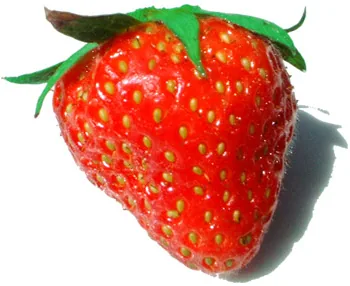
Botanically the common name misleads, since the structure is classed as an accessory fruit. The edible red flesh develops from the enlarged receptacle, while the real fruits are the tiny achenes, the seed-like structures embedded across the surface.
Let June-bearing plants fruit heavily in their first year.
First-year fruiting diverts carbohydrate reserves before the crown has developed, weakening the plant. Pinch off the first-year blossoms on June-bearers so that energy is redirected into crown and runner development, which underwrites substantially larger yields in subsequent seasons.