Tree · Rosaceae
Apricot
Prunus armeniaca
Site it for full sun, sharp drainage, and shelter from late frost, and an apricot tree will set sweet golden fruit by early summer.
Full sun
Every 7–14 days
USDA 5–8
15–20 ft · 4.6–6.1 m
Overview
Few trees break dormancy as early as the apricot, which often flowers while the surrounding garden remains bare. A member of the rose family along with plums and cherries, it originates in the cold, arid highlands of central Asia, and that ancestry is written into its physiology: the tree withstands hard winter cold down to -13°F (-25°C) yet still requires long, warm, sunny summers to ripen its crop.
That precocious bloom is both an advantage and a liability. Opening in late winter gives the flowers first claim on pollinators, but it also places them directly in the path of a late frost, which can destroy an entire season's fruit in a single cold night. The planting site and the cultivar you select determine how often that loss occurs.
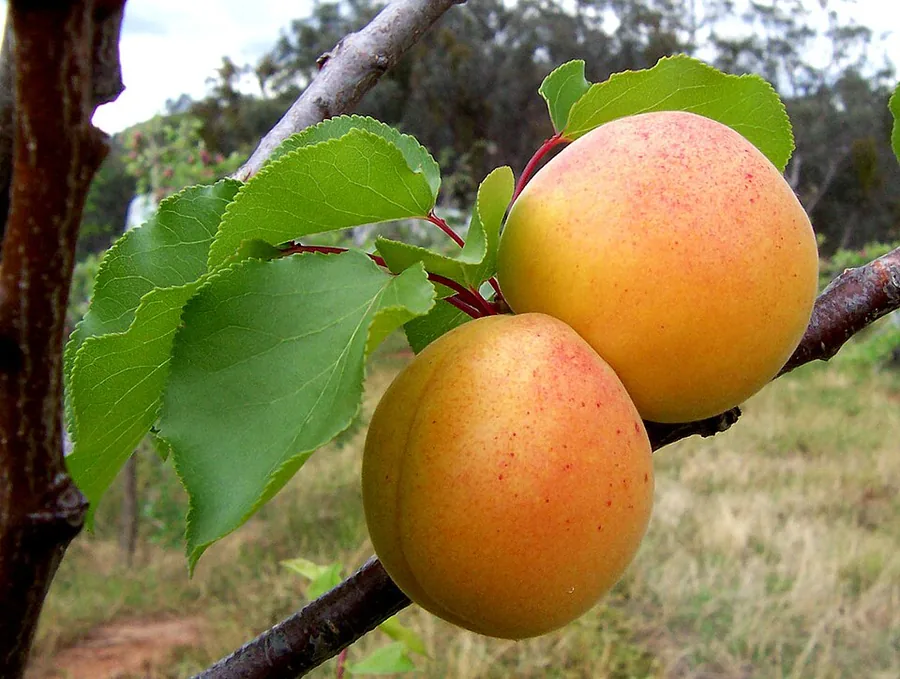
Supplied with deep, well-drained soil and ample room, an apricot develops into a broad, open-headed tree. Its fruit arrives early, sweet and abundant enough for fresh eating, drying, or canning. The flesh is yours to eat, but the pits and leaves are not safe for pets or livestock, so decide in advance where prunings and dropped stones will go.
Care
The short version: full sun, deep well-drained loam, and a frost-safe position away from the low pockets where cold air settles. Water deeply through establishment and fruit fill, feed once in early spring, and confine pruning to dry summer weather to keep disease from gaining a foothold.
Light
Give an apricot full sun, as much as the site allows, both to ripen sweet fruit and to keep the tree healthy. An unshaded position also dries the canopy quickly after rain, which is what checks the fungal diseases this species is prone to.
Water
Water deeply and regularly while a young tree is establishing and again as the fruit fills, soaking the full root zone every 7 to 14 days rather than wetting the surface often. A mature apricot tolerates drought reasonably well, yet a thorough watering through a dry summer still translates into better fruit.
Soil
Set the tree in deep, well-drained loam, since waterlogged roots are the fastest route to failure for this species. A soil pH between 6.0 and 7.0 suits it, and free drainage counts for far more than fertility.
Temperature
The tree is hardy across a broad span, holding from roughly -13°F to 95°F (-25°C to 35°C). Midwinter cold is rarely what limits it; the true vulnerability is an early bloom colliding with a late spring frost.
Humidity
Average humidity in the range of 40% to 70% is comfortable for an apricot. The condition to avoid is damp, stagnant air, because wet, crowded foliage creates exactly the environment brown rot and canker exploit.
Feeding
Apply a single feeding in early spring with a balanced nitrogen fertilizer to drive the coming season's growth. One seasonal application suffices, and excess nitrogen merely produces soft, succulent wood that disease colonizes readily.
Pruning
Prune in late summer or dry weather, never during cool, wet spells, so the pathogens that cause bacterial canker and Eutypa cannot enter through fresh cuts. Train the tree to an open center, which admits light and moving air to the interior of the canopy.
Repotting
An apricot reaches full tree size and belongs in the ground, so it is rarely potted at all. Plant it once in a carefully chosen position and allow it to establish for the long term.
Size & spacing
A standard apricot reaches 15 to 20 feet (4.6 to 6 m) in height and spreads roughly 12 to 20 feet (3.7 to 6 m) across. Allow that much open space so the canopy stays well ventilated and the roots have room to extend.
When to plant
The apricot keeps an early schedule. Plant bare-root trees during dormancy in late winter to early spring, expect bloom that opens almost before winter releases its grip, and harvest the fruit from early to midsummer.
Northern hemisphere
Southern hemisphere
Typical months for a temperate climate: start earlier in warm zones, later where spring frosts linger.
- Plant: Plant bare-root trees during dormancy in late winter to early spring.
- Harvest: Blooms very early, late winter to early spring; fruit ripens early to midsummer.
Hardiness
USDA hardiness zones: 5–8
Temperature: down to -29°C
Troubleshooting
The bulk of apricot problems concentrate on the blossoms and fruit, and the most damaging of them coincide with cold or wet spring weather. Identify the symptom below, trace it to its cause, and intervene early while action still changes the outcome.
Blossoms and fruit going brown and soft under a tan dust of spores
What you are seeing is brown rot, a Monilinia fungus that exploits wet spring weather to colonize blossoms and fruit through the same tissue. Strip off every mummified fruit, because each one overwinters as a spore reservoir that reinfects the next crop; open the canopy by pruning so the foliage dries quickly and denies the fungus the moisture it needs; and apply a fungicide at bloom whenever conditions stay damp.
Fix:
- Remove mummified fruit, prune for airflow, and apply fungicide at bloom
Amber gum weeping from sunken bark wounds as limbs die back
These gummy, sunken lesions are bacterial canker, the work of Pseudomonas syringae, which enters through wounds and thrives in cool, wet spells. Confine pruning to dry summer weather so cuts seal before the bacterium can colonize them; protect the bark from accidental injury that would open new infection courts; and excise affected wood well below the visible canker to reach clean tissue.
Fix:
- Prune only in dry summer weather, avoid injuries, and remove infected wood
Blossoms turning black with no fruit forming
Because apricots open so early, a late frost routinely catches the exposed flowers, killing the tissue that would have set fruit, which is why a blackened blossom yields nothing. Site the tree on a north-facing slope, where cooler exposure delays bloom past the worst frost dates; avoid low ground where cold air drains and pools overnight; and select later-blooming cultivars in regions prone to erratic spring weather.
Fix:
- Site on a north-facing slope, avoid frost pockets, and choose later-blooming cultivars
Crescent scars on the fruit followed by early drop
Crescent scars paired with premature drop are the signature of the plum curculio, a weevil whose larvae develop inside the young fruit and trigger it to abort. Clear fallen fruit from the ground promptly to interrupt the larvae before they complete their cycle, scout the tree as the season turns, and time any control to petal fall, the window when adults are most active laying eggs.
Fix:
- Practice sanitation and monitor, applying controls at petal fall
Toxicity
Handle this tree with caution around animals. The stems, leaves, and seeds contain cyanogenic glycosides that release cyanide, and a swallowed pit can additionally obstruct an animal's digestive tract. The ripe flesh is safe for people, but keep prunings, fallen leaves, and discarded stones well away from pets and livestock.
Toxic to
Cats · Dogs · Horses · Rabbits · Livestock · Birds · People
Cats Mild
A cat that nibbles leaves, stems, or a split seed may drool, vomit, or develop dilated pupils. The dose a cat actually takes in is seldom serious, but keeping the trimmings out of reach removes the risk entirely.
Dogs Mild
Drooling, vomiting, or labored breathing can follow a dog chewing foliage or a seed. The greater concern is a swallowed pit, which is hard enough to lodge in the digestive tract and cause an obstruction.
Horses Moderate
Wilted leaves and stems are the genuine hazard, because wilting concentrates the cyanide they release. A poisoned horse breathes hard, weakens, and shows bright red gums, so prunings should never be left in or beside the paddock.
Rabbits Toxic
The cyanogenic compounds in the leaves and stems are more than a rabbit's small body can process. Keep every part of the tree off limits and provide only safe greens in its place.
Livestock Toxic
Cattle, sheep, and goats are acutely sensitive to the cyanide held in wilted apricot leaves, and a hungry animal can consume a lethal amount quickly. Fence stock well clear of the tree and remove any fallen branches after storms or pruning.
Birds Toxic
Seeds and foliage are hazardous to birds, since even a trace of cyanide carries far in such a small body. Serve only the ripe flesh, and never the pit or the leaves.
People Caution
The ripe flesh is a fine fruit and entirely safe to eat, but the kernel inside the pit holds cyanide and must never be cracked open and swallowed. Discard the stones and keep them away from children.
Keep pruned twigs, leaves, and discarded pits away from pets and livestock.
Helpline numbers

United States
ASPCA Animal Poison Control: (888) 426-4435 (fee applies)
Poison Control: (800) 222-1222



Canada
Poison Centres: 1-844-764-7669
Varieties
Many apricot cultivars are available, chosen for flavor, hardiness, or drying quality. A handful worth recognizing by name follow.
Moorpark
A long-established English selection that ripens late and pays off with large, deeply flavored fruit.
Blenheim (Royal)
The benchmark California apricot, equally valued fresh and dried.
Tilton
A reliable choice for canning and drying that tolerates light frost better than many.
Goldcot
A cold-hardy selection developed for colder regions, bearing firm golden fruit.
How to propagate
Apricots are nearly always purchased as grafted trees rather than raised from seed, because seedlings fail to reproduce the parent. The two methods and what each yields are set out below.
GraftingModerate
Apricots are propagated chiefly by grafting, typically T-budding a scion onto a compatible rootstock. The technique guarantees fruit identical to the named variety while the rootstock governs the tree's eventual size and vigor.
SeedModerate
Seed will germinate once given a period of cold stratification, but the resulting seedlings do not reproduce the parent's traits. Because of that variability, apricot seed is used mainly to raise rootstock rather than fruiting trees.
Myths
The whole apricot is poisonous.
The ripe flesh is wholesome and safe to eat. The cyanide is confined to the seeds, pits, leaves, and stems, not the fruit you cut away and enjoy.