Tree · Rosaceae
Bradford Pear
Pyrus calleryana
Fast and adaptable, the Bradford pear pairs storm-prone branch unions with aggressive invasive spread, which is why it no longer belongs in the landscape.
Full sun
Every 7–14 days
USDA 5–9
30–50 ft · 9.1–15.2 m
Overview
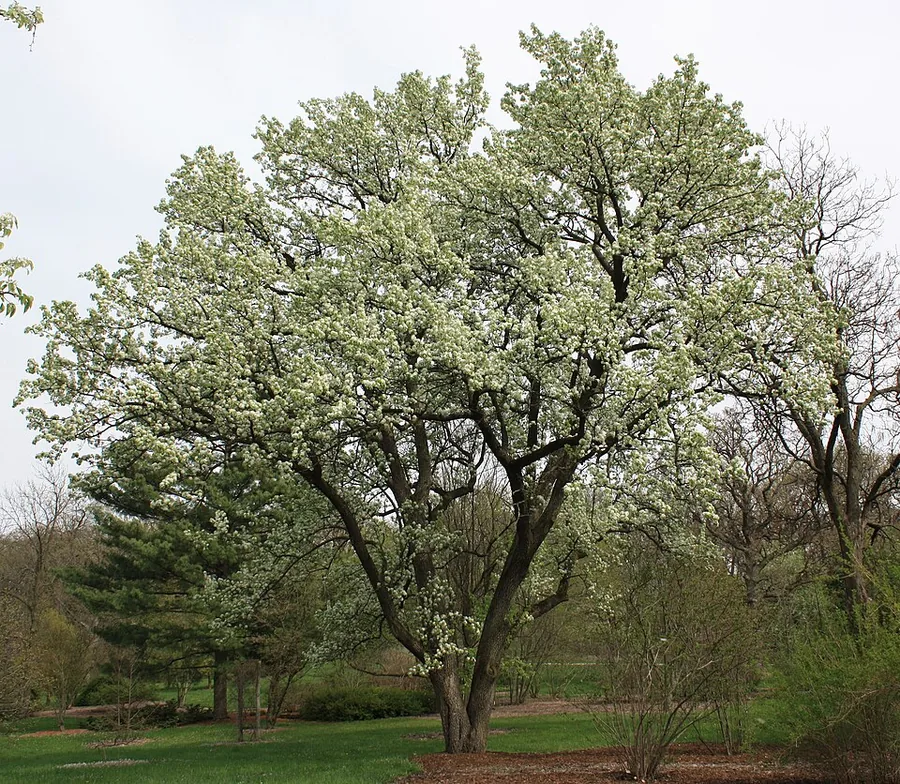
The Bradford pear is a selection of Callery pear, an ornamental valued for fast growth, a tidy crown, and the mass of creamy white flowers it produces in early spring. Its tolerance of compacted soil, drought, and urban air pollution explains its former ubiquity in yards and parking lots. The flowers carry a sour, disagreeable odor, a trait that surprises most people on first encounter.
Two serious defects sit beneath that adaptability. The branches form at acute, structurally weak angles prone to tearing apart under wind, snow, or ice, so mature trees commonly split within 15 to 25 years. The graver issue is reproductive: the cultivars cross-pollinate and set fertile seed that birds disperse into wild ground, where it forms dense thorny thickets that displace native vegetation.
That ecological cost has now shaped policy. Several states have banned its sale, and the horticultural consensus directs gardeners toward native flowering trees instead. The guidance that follows addresses management of an established Bradford pear, but planting a new one is no longer defensible practice.
Care
The short version: full sun and almost any soil, minimal water once established, and little to no fertilizer, with the real work being structural pruning and managing the limb failure that comes with age.
Light
Site it in full sun, where it develops the densest crown and the heaviest flowering, though it will accept partial shade. The relationship is direct: more incident light yields a fuller, more uniform canopy.
Water
Young trees require consistent moisture through establishment, after which a mature Bradford pear becomes drought-tolerant and performs on dry to medium water. Irrigate only during genuine drought, otherwise allowing the top half of the root zone to dry, which discourages shallow rooting.
Soil
Soil adaptability is a defining trait. It establishes in clay, loam, or sand across a broad pH range of 5.5 to 8.0, prefers good drainage yet tolerates heavy clay, intermittent wet soils, drought, and urban pollution.
Temperature
Cold and heat hardiness span roughly -20°F to 100°F (-29°C to 38°C), covering the winters of zone 5 and the summer extremes of the South. This wide thermal tolerance is one factor behind its range.
Humidity
Ambient outdoor humidity is sufficient, so no management is required. The relevant variable is air movement rather than atmospheric moisture, because stagnant air over wet foliage favors leaf spot and fire blight.
Feeding
An established tree in average soil seldom requires fertilizer. Where growth is genuinely poor, a balanced slow-release tree fertilizer in early spring suffices, while excess nitrogen drives the succulent shoot growth that fire blight preferentially colonizes.
Pruning
Prune in winter during dormancy, removing crossing, weak, and narrow-angled limbs to develop a sounder framework. Such pruning lowers the probability of failure but cannot eliminate the cultivar's inherent splitting tendency, so siting away from high wind exposure remains essential.
Repotting
none
Size & spacing
This is a large tree, attaining 30 to 50 feet (9 to 15 m) in height with a spread of 20 to 35 feet (6 to 11 m). Allow ample open space clear of structures, overhead lines, and walkways, given the propensity of aging limbs to fail.
When to plant
Across zones 5 through 9 the Bradford pear follows a defined annual cycle. Set out balled-and-burlapped or container stock in early spring or fall, expect the malodorous white bloom in April, and watch the small brown pomes mature in fall, the stage at which birds carry the seed.
Northern hemisphere
Southern hemisphere
Typical months for a temperate climate: start earlier in warm zones, later where spring frosts linger.
- Plant: Plant balled-and-burlapped or container trees in early spring or fall.
- Harvest: Creamy white flowers in early spring (April), before or with the leaves; small round brownish pomes mature in fall.
Hardiness
USDA hardiness zones: 5–9
Temperature: down to -29°C
Troubleshooting
The problems of this tree resolve into two categories: the structural failure intrinsic to the cultivar and the foliar and shoot diseases common to the genus Pyrus. Recognizing the early diagnostic signs of each allows intervention before a defect becomes a hazard or a pathogen advances through the canopy.
Sudden trunk splitting or limb failure in storms
The signature failure of this cultivar traces to its architecture: narrow, included-bark crotches form a wedge of bark rather than continuous wood between stems, leaving the union without the structural strength to hold under wind, snow, or ice loading, so a mature specimen can fail in half, commonly within 15 to 25 years. Co-dominant upright leaders of equal diameter compound the problem by concentrating end weight on those weak unions. Inspect for tight V-shaped forks and multiple equal leaders, and engage an arborist to reduce or remove a compromised tree.
Fix:
- Remove damaged or hazardous limbs promptly with proper cuts
- Have a certified arborist assess and reduce or remove the tree if structurally compromised
- Replace failing trees with a structurally sound, non-invasive species
Blackened, crook-bent shoots from bacterial infection
Blackened shoots that wilt and curl into a shepherd's crook indicate fire blight, caused by the bacterium Erwinia amylovora, which enters through blossoms and tender shoots and moves through the vascular tissue toward the trunk under warm, wet spring conditions. Oozing cankers on the branches mark its progress. Excise the infected wood 8 to 12 inches below visible symptoms in dry weather, disinfecting tools between cuts because the pathogen transfers readily on contaminated blades.
Fix:
- Prune out infected wood at least 8-12 inches below visible symptoms during dry weather
- Disinfect pruning tools between cuts
- Remove and destroy pruned material; do not compost
Coalescing reddish-purple spots and defoliation
Reddish to purple lesions that enlarge and coalesce across the foliage are the diagnostic sign of Entomosporium leaf spot, a fungal disease that establishes when prolonged leaf wetness lets the spores germinate and infect. Severe infection drives premature defoliation, though it seldom poses a real threat to a tree's survival. Remove and destroy fallen leaves to break the spore cycle, open the canopy to speed drying, and keep irrigation off the foliage.
Fix:
- Rake up and destroy fallen infected leaves
- Improve air circulation and avoid overhead wetting of foliage
- Apply a labeled fungicide in spring if the problem is recurring and severe
Toxicity
On toxicity the record is reassuring: the Bradford pear is not a poisonous tree. It carries no listing on the ASPCA toxic-plant references, and the small hard pomes pose no recognized poisoning risk to pets or grazing animals. The single legitimate qualification is that, as with apple and pear, the pips contain trace cyanogenic compounds, which is reason to clear heavy fruit falls rather than permit an animal to consume them in quantity.
Safe for
People · Cats · Dogs · Horses · Rabbits · Livestock · Birds
Cats None
Because the species carries no listing on the toxic-plant references, a cat that samples a leaf or a dropped pome is at no real risk. The pips within the fruit do contain trace cyanogenic compounds, a trait shared across the rose family, which is reason enough to clear fallen fruit from the area.
Dogs None
The foliage and the small hard pomes present no genuine poisoning hazard to a dog. Ingesting a large volume of windfall can provoke transient gastrointestinal upset, and the seeds hold the same trace cyanogenic compounds found in cultivated pears, so a dog should not be allowed to consume them in quantity.
Horses None
In ordinary amounts a horse can browse the leaves and fruit without ill effect. The cyanogenic glycosides reside in the seeds, as in any pear, so the only situation that warrants attention is a horse accessing a large accumulation of dropped fruit.
Rabbits None
The leaves and twigs are non-toxic and serve as acceptable occasional browse for rabbits. The seeds carry trace cyanogenic compounds that are best kept out of reach, since the dose tolerance of a small animal is correspondingly low.
Livestock None
Cattle, goats, and sheep can graze the foliage and windfall fruit safely under normal grazing pressure. The standard rosaceous caveat applies, in that the seeds contain trace cyanogenic compounds, so a heavy fruit fall should be cleared before stock are given access.
Birds None
Birds consume the small pomes without any adverse effect, and that very palatability is the dispersal mechanism behind the tree's wide spread. No avian hazard exists here.
People Safe
The tree presents no toxic risk to people. The hard pomes are not a culinary crop and offer no eating value, and the pips, like those of apple and pear, contain trace cyanogenic compounds, so there is no sound reason to chew them.
No special handling needed for toxicity. Wear gloves and eye protection when pruning, as escaped seedlings and rootstock sprouts can bear sharp thorns.
Varieties
Several named Callery pear selections have reached the trade over the decades, most bred for improved form or autumn color. All of them remain cross-compatible, however, so each contributes to the invasive seedling pool.
'Bradford'
The original and most notorious selection presents a dense pyramidal-to-oval crown whose characteristically narrow crotch angles predispose it to storm failure, and although it is self-incompatible it still drives the invasive seedling problem by cross-pollinating with neighboring cultivars.
'Cleveland Select' / 'Chanticleer'
This more upright, narrowly pyramidal form reaching roughly 35 feet tall and 16 feet wide offers somewhat improved branch attachment and greater fire-blight resistance, yet remains a Callery pear capable of crossing with others to spread.
'Aristocrat'
Selected for stronger, more open branch architecture than 'Bradford', it nonetheless proves more susceptible to fire blight and continues to contribute to the invasive seedling pool.
'Autumn Blaze'
Bred for reliable red-purple autumn coloration and sound cold hardiness, it cross-pollinates with the other cultivars and produces fertile, bird-dispersed seedlings in the same way they do.
How to propagate
This tree propagates by two routes, neither suited to a home garden. Nurseries reproduce the named cultivars vegetatively by grafting, while the species reproduces by bird-dispersed seed, the very mechanism that drives its invasiveness.
GraftingDemanding
Late winter to spring (bench grafting) or summer (budding) · 1-2 growing seasons to establish the graft union
Because named cultivars such as 'Bradford' are clonal and will not reproduce true from seed, nurseries propagate them vegetatively, bench grafting onto Pyrus calleryana rootstock in late winter to spring or budding in summer. The graft union requires one to two growing seasons to form a sound vascular connection. The technique is exacting, and given the cultivar's invasive tendency and structural failings, there is little justification for attempting it in a home setting.
SeedEasy
Fall, after fruit ripens · 1-2 growing seasons to a seedling
The species reproduces readily by seed, with birds depositing it from the autumn fruit and a seedling establishing over one to two growing seasons. The complication is that cross-pollination among cultivars yields invasive offspring, which is precisely why deliberate seed propagation is discouraged and increasingly prohibited by law.
Myths
Bradford pear is sterile and cannot spread, so it is safe to plant.
Self-incompatibility prevents 'Bradford' from fertilizing its own flowers, but it readily cross-pollinates with other Callery pear cultivars and with rootstock sprouts, producing viable seed that birds disperse over long distances into dense, thorny thickets. Several US states have now banned its sale outright.