Tree · Rosaceae
Asian Pear
Pyrus pyrifolia
Provide full sun, a pollination partner, and an open framework, and the Asian pear delivers crisp, juicy fruit for decades.
Full sun
Every 7–14 days
USDA 5–8
20–40 ft · 6.1–12.2 m
Overview
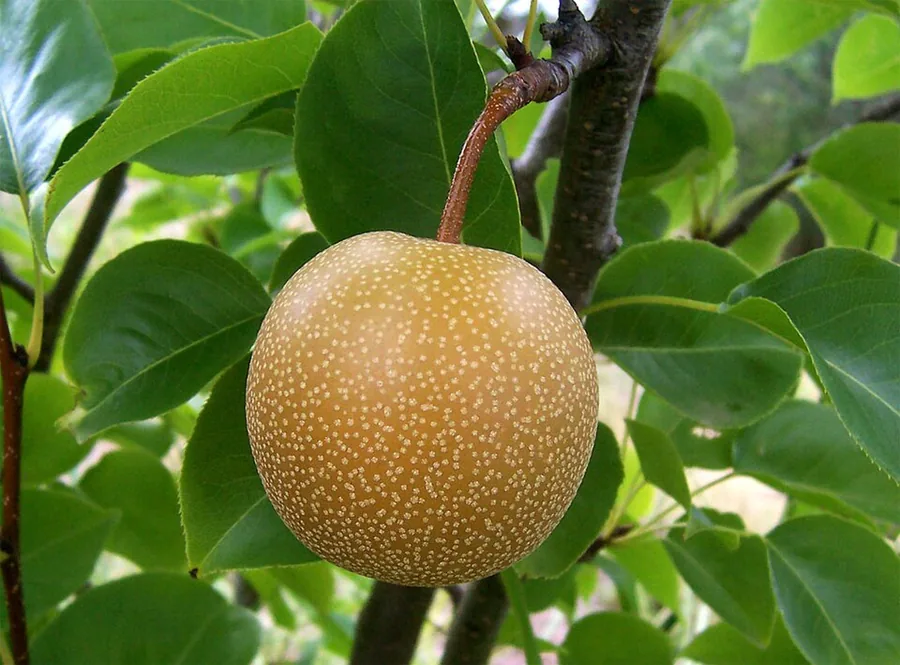
The Asian pear is a cold-hardy member of the rose family, cultivated across East Asia long before it entered Western orchards. It answers to several names, nashi and apple pear among them, and the latter is apt: the fruit is round and stays crisp and juicy instead of softening as a European pear does, so it is eaten firm, straight from the branch.
Treat this as a long-lived tree rather than a quick harvest. A young specimen establishes quickly, then fruits for decades once settled. It withstands serious cold, to roughly -20°F (-29°C), and tolerates summer heat, which makes it suited to much of the temperate world.
Its one real requirement is a partner. Because nearly every variety is self-incompatible, a second compatible cultivar must flower at the same time for fruit to set, so plan on two trees from the outset. Given sun, spacing, and an open canopy, they largely manage themselves.
Care
The short version: full sun, deep well-drained soil, and a second compatible variety nearby for cross-pollination. Water deeply while the tree establishes and the fruit swells, prune to an open multi-trunk framework in late winter, and thin the young fruit so heavy loads cannot break the limbs.
Light
Give Asian pears full sun, which produces the best fruit and the fewest disease problems, since good light and air movement keep foliage dry and discourage infection. A little afternoon shade is tolerated, but a tree in deep shade grows weak and crops poorly.
Water
Water deeply and regularly during establishment and through the period when the fruit is swelling, provided the soil drains freely. Ease back as the pears mature and again once the tree enters winter dormancy and stops actively growing. Deep, infrequent soakings reach the roots better than a shallow daily sprinkle.
Soil
Plant in deep, well-drained ground, whether loam, sand, or even clay, so long as water moves through it freely; standing water suffocates roots. A slightly acidic pH of 5.9 to 6.5 suits the tree, but drainage carries more weight than hitting an exact number.
Temperature
This is a tough, cold-hardy tree, enduring winters to about -20°F (-29°C) and summer heat to roughly 95°F (35°C). The genuine threat is not deep cold but a late spring frost striking the open blossom, which destroys that year's potential crop.
Humidity
Ordinary outdoor air in the 40% to 70% range is sufficient, so there is no figure to manage. The condition to watch is warm, wet weather at bloom, because those are precisely the conditions under which fire blight bacteria spread fastest.
Feeding
Feed in spring with a balanced 10-10-10 fertilizer, divided into a couple of doses. Scale the quantity to the tree's age, roughly a third to a half cup per year up to about 8 cups, and apply sparingly, since surplus nitrogen drives soft, sappy growth that fire blight readily invades.
Pruning
Prune in late winter while the tree is dormant, removing about 10 percent of the terminal spurs each year to keep fruit well sized. Train to several trunks in an open form rather than a single central leader, so that one fire blight strike cannot claim the whole tree. Hand-thin the young fruit 14 to 40 days after petals drop, to one fruitlet per spur or about 6 inches apart, because an unthinned load will snap the limbs.
Repotting
not applicable - grown outdoors in the ground
Size & spacing
Expect a large tree, reaching 20 to 40 feet (6 to 12 m) tall and nearly as wide. Give it generous open ground so air circulates through the canopy, which keeps foliage drier, and so the roots have room to spread.
When to plant
Asian pears follow the seasons closely. Set dormant trees out in late winter to early spring, choosing the most frost-free location you have, because a late freeze at bloom destroys the flowers and the crop with them. Flowering comes in April, and the fruit ripens on the tree from about mid July through fall, varying by cultivar.
Northern hemisphere
Southern hemisphere
Typical months for a temperate climate: start earlier in warm zones, later where spring frosts linger.
- Plant: Plant dormant bare-root or container trees in late winter to early spring in a site as frost-free as possible to avoid late spring frosts at bloom.
- Harvest: Blooms April to early May; fruit ripens on the tree from about mid July through fall depending on cultivar.
Hardiness
USDA hardiness zones: 5–8
Temperature: down to -29°C
Troubleshooting
Nearly all trouble with Asian pears traces to one disease and a handful of pests. Fire blight deserves the most attention, because it can kill the tree outright, whereas the insects chiefly cost you fruit or vigor. Identify the symptom below, then act before it spreads.
Blackened shoots bending into a shepherd's crook
What you are seeing is fire blight, an infection by the bacterium that spreads fastest through warm, wet weather during bloom. Soft, sappy growth from excess nitrogen gives the bacterium more entry points, which is why heavy feeding makes it worse. Remove the dead shoots by cutting well below the discolored tissue, cut back on nitrogen, and grow the tree on several trunks so losing one limb does not end the tree. Resistant cultivars remain the most dependable safeguard.
Fix:
- Choose resistant cultivars, avoid heavy nitrogen, prune out blackened shoots well below the infection, and train to multiple trunks so one strike does not kill the tree
Bored tunnels and brown crumbly trails inside the fruit
Those tunnels are the work of the codling moth, whose eggs hatch into larvae that burrow directly into the developing pears. Because the damage happens from the inside, timing matters: hang traps to detect when adults are on the wing, then thin or bag the fruit and apply labeled controls keyed to that flight period. The aim is to intervene before larvae reach the core, where they are out of reach.
Fix:
- Monitor with traps and use fruit thinning, bagging, or labeled controls during the season
Sticky foliage carrying a black sooty film
Pear psylla are small sap-feeding insects, and the stickiness is the honeydew they excrete as they feed. That sugary residue is what sooty mold colonizes, hence the black film over the leaves. Sustained feeding drains the tree's vigor. Support the natural predators that keep them in check, apply dormant oil before growth resumes to smother overwintering stages, and turn to labeled controls only once populations climb.
Fix:
- Encourage natural predators, apply dormant oil, and use labeled controls when populations build
Orange leaf spots with aphids crowding the new shoots
Two separate problems are at work. Rust is a fungus that prints orange-brown spots across the foliage and fruit, and it cycles through nearby junipers as an alternate host, so removing those hosts breaks the cycle where you can. Aphids gather on the tender new growth and feed on the sap, weakening it. Treat the aphids with horticultural oil or insecticidal soap, which work by smothering the insects rather than poisoning the tree.
Fix:
- Remove nearby juniper hosts for rust where practical and treat aphids with horticultural oil or insecticidal soap
Toxicity
The ripe flesh is a crisp, sweet fruit and safe to eat, but the rest of the tree is another matter. Seeds, bark, and wilting leaves hold cyanogenic compounds that release cyanide when chewed in quantity, the same chemistry that makes other pip fruits hazardous. Keep pets and livestock away from the seeds and from prunings, especially bruised or frost-killed foliage, since damage raises the cyanide load.
Toxic to
Cats · Dogs · Horses · Rabbits · Livestock · Birds · People
Cats Mild
When a cat works on seeds or wilted prunings, the released cyanide shows up as brick-red gums, widened pupils, and labored panting. Larger doses cause genuine distress, though the ripe flesh carries no such risk.
Dogs Mild
Gnawing bark, prunings, or a mouthful of seeds is what triggers trouble in dogs, signaled by heavy panting, dilated pupils, and reddened gums. A dog that simply eats a slice of ripe pear has nothing to fear, since the hazard lives in the seeds and woody parts.
Horses Toxic
Despite their size, horses are highly sensitive to cyanide, and the usual source is a heap of wilting prunings tossed over the fence. Labored breathing, staggering, and collapse can develop quickly, so never let trimmings reach them.
Rabbits Toxic
A rabbit's small body needs only a little cyanide to be harmed, so seeds, bark, and wilted leaves must be kept out of reach. The single safe portion is a thin sliver of ripe flesh given occasionally.
Livestock Toxic
Cattle, goats, and sheep can be poisoned by fallen branches or wilted leaves that drift into a pasture. Bruising or frost-kill is the key factor, because damaged foliage is exactly when cyanide concentration peaks.
Birds Toxic
Pet birds and backyard poultry must never reach the seeds, which hold the same cyanide as the rest of the pip fruits. Limit any offering to seedless pieces of ripe flesh.
People Caution
The ripe flesh is crisp, juicy, and good to eat. The one rule is to avoid chewing or swallowing the seeds, since crushing a large quantity of pips releases cyanide.
Keep pets from chewing large amounts of seeds, bark, or wilting prunings; the ripe fruit flesh itself is safe.
Helpline numbers

United States
ASPCA Animal Poison Control: (888) 426-4435 (fee applies)
Poison Control: (800) 222-1222



Canada
Poison Centres: 1-844-764-7669
Varieties
Dozens of Asian pear cultivars exist, distinguished mostly by skin color, ripening date, and disease resistance. The ones below are the most commonly encountered, and choosing two that bloom together settles your pollination requirement in the same decision.
Hosui
Regarded as one of the best, bearing large, juicy, low-acid bronze fruit that ripens in mid to late August; thinning pays off here with noticeably bigger pears.
Shinseiki (New Century)
An early, round, yellow-green pear with sweet, creamy white flesh; it carries some fruit alone but sets a far heavier crop when a second cultivar is planted nearby.
Nijisseiki (Twentieth Century)
The most widely planted cultivar anywhere, valued for its yellow-skinned fruit, though it is among the quickest to succumb to fire blight.
Chojuro
Among the earliest Japanese cultivars to harvest, ready around mid July with large, brown, russeted fruit.
How to propagate
Two methods will start an Asian pear, but only one returns the fruit you intend to grow. Grafting reproduces a named variety exactly, while seed is a gamble best left to breeders and rootstock growers.
GraftingModerate
This is the method that keeps named cultivars true to type. A bud or scion of the chosen variety is joined onto a pear or Asian pear rootstock, so the resulting tree fruits identically to its parent. It demands a steady hand, but it is the only dependable way to reproduce a named pear exactly.
SeedModerate
Seeds germinate without much trouble, yet the seedlings do not come true to the parent and need years before they fruit. For those reasons seed is reserved mainly for raising rootstock or breeding new varieties, not for producing a tree of known quality.
Myths
Asian pears have to be picked hard and ripened off the tree, the way European pears are.
That after-ripening step belongs to European pears, not these. Asian pears develop their best flavor when left to ripen on the tree, growing sweet and juicy in place. You eat them crisp and apple-textured, never soft and buttery.
One Asian pear tree on its own will set a full crop.
Nearly every cultivar is self-incompatible, meaning its own pollen cannot fertilize its flowers, so a lone tree yields little or nothing. Plant a second compatible cultivar that blooms at the same time and let bees move pollen between them. Cross-pollination is what produces a real crop.