Tree · Rosaceae
Apple
Malus domestica
Provide full sun, a pollination partner, and an annual prune, and an apple tree will feed you for decades.
Full sun
Every 7–14 days
USDA 3–8
8–30 ft · 2.4–9 m
Overview
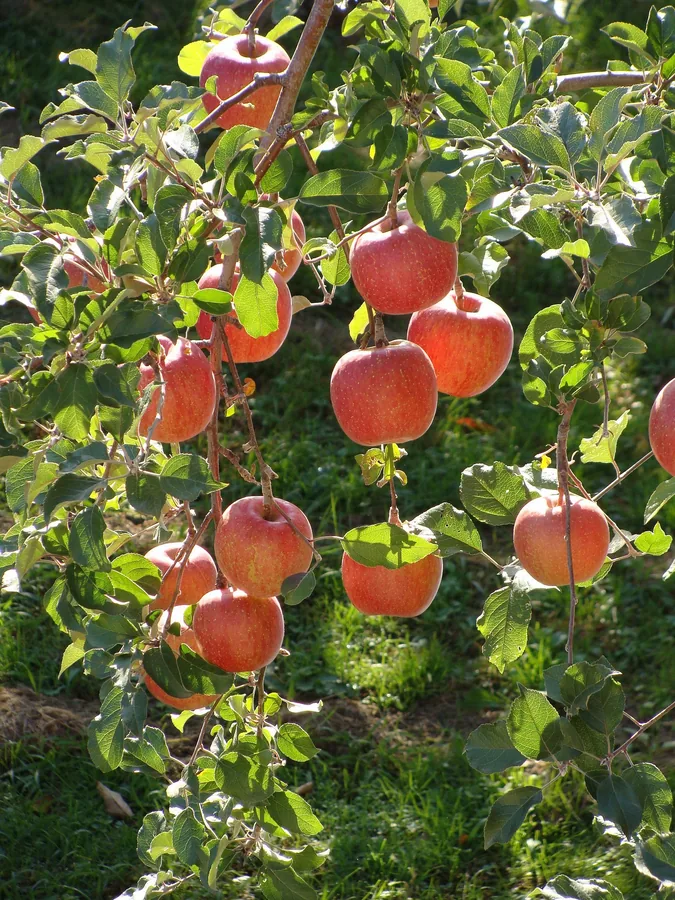
An apple is a tree you plant for the long term. A member of the rose family, it has been selected and grafted across thousands of years into the named varieties stocked in markets. Sited in sound ground, a tree can keep producing for 30 years or more, becoming a permanent part of the yard rather than a single season's effort.
The point that surprises most first-time growers is pollination. Most apple cultivars cannot fertilize their own blossom, so a solitary tree may flower freely and still set next to nothing. Producing a crop calls for a second compatible variety flowering at the same time within reach of the bees, or a crabapple filling that role close by. Plan on two trees from the outset, or confirm that a neighbor's tree can supply the pollen.
One further factor decides whether an apple suits your location at all: chill hours. The tree requires a span of winter cold to break dormancy and flower come spring, and cultivars differ in how much they demand. Pair the variety to your zone, supply sun and a yearly prune, and the rest is simply the unhurried business of letting a tree come into its own.
Care
The short version: full sun throughout the day, deep well-drained soil near a pH of 6.0 to 7.0, and a second compatible variety close by for pollination. Water young trees regularly, prune each winter, and hold nitrogen in check so the new growth stays firm.
Light
An apple tree demands full sun, meaning 6 or more hours of direct light each day, with no meaningful tolerance for shade. That light drives flower-bud formation and ripens the fruit, so a shaded tree responds with weak growth, heavier disease pressure, and a sparse crop.
Water
Young and newly planted trees require steady water as their roots establish, so soak deeply every 7 to 14 days through dry spells. An established tree is fairly drought tolerant, yet even moisture still improves fruit size and crop set. Allow the top half of the root zone to dry between waterings.
Soil
Site the tree in deep, well-drained loam carrying ample organic matter, and avoid waterlogged or compacted ground, where standing water deprives the roots of oxygen and rots them. A pH of 6.0 to 7.0, close to neutral, suits apples well.
Temperature
Apples are resilient, withstanding a span from roughly -40°F to 95°F (-40°C to 35°C) through the year, and they perform in hardiness zones 3 to 8. They also require a period of winter chill to flower, so fit the cultivar to your zone.
Humidity
Ordinary outdoor air in the 40% to 70% band is fine, leaving nothing to monitor on that front. Airflow is the variable that counts, because still, crowded branches that stay damp are how scab and other fungal diseases take hold.
Feeding
Feed once in early spring ahead of new growth, with a balanced or nitrogen-based fertilizer. Keep a light hand on nitrogen, though, because the surge of soft tissue it triggers is exactly the growth fire blight colonizes.
Pruning
Prune each year in late winter while the tree is dormant, training it to a strong central leader or an open center. Take out dead, diseased, or crossing wood and open the canopy so light and air reach the fruit. A light summer cut helps curb a tree growing too vigorously.
Repotting
Apples are ground-grown rather than potted, so most trees never call for repotting. The exception is a dwarf tree in a large container, which benefits from a refresh or a move to a larger pot every 2 to 3 years to keep the root system in good order.
Size & spacing
Mature dimensions vary widely with the rootstock, from a dwarf near 8 feet (240 cm) to a standard approaching 30 feet (9 m) tall and nearly as wide. Spread ranges from about 8 to 25 feet (2.4 to 7.5 m), so allow each tree the room to reach full size without crowding its neighbors.
When to plant
An apple's seasonal cycle moves at a measured pace. Plant bare-root trees in early spring once the ground has thawed and the tree remains dormant, and watch for bloom in mid to late spring. Fruit then ripens from late summer into fall, roughly August to October according to the cultivar.
Northern hemisphere
Southern hemisphere
Typical months for a temperate climate: start earlier in warm zones, later where spring frosts linger.
- Plant: Early spring while dormant, after the ground thaws, for bare-root trees; container trees can go in from spring to early summer.
- Harvest: Blooms mid to late spring; fruit ripens late summer to fall (about August to October) depending on cultivar.
Hardiness
USDA hardiness zones: 3–8
Temperature: down to -40°C
Troubleshooting
Apple problems tend to surface on the foliage, the blossom, or within the fruit, and much of the trouble is triggered by the cool, wet conditions of spring. Reading the earliest signs lets you intervene before a disease establishes for the season. Match what you observe below, then act while action still pays off.
Blossoms and shoot tips turn black and hook over like a shepherd's crook
This is fire blight, a bacterial infection that moves fast through warm, humid bloom weather and leaves shoots looking scorched. Because the pathogen advances internally ahead of the visible symptoms, cut infected wood 8 to 12 inches below the damage to stay ahead of it, and sterilize tools with disinfectant after every cut so you do not transfer bacteria from one wound to the next. Restraint with nitrogen matters here, since the soft, rapid growth that excess feeding produces is precisely the tissue the bacterium colonizes.
Fix:
- Prune out infected wood at least 8 to 12 inches below visible symptoms.
- Disinfect pruning tools between every cut to avoid spreading the bacteria.
Velvety dark lesions across foliage and fruit, followed by premature defoliation
What you are seeing is apple scab, caused by the fungus that overwinters in the leaf litter from the previous season and releases spores once cool, wet spring conditions arrive. Because the inoculum starts at ground level, removing and binning every fallen leaf in autumn breaks that cycle directly. Open the canopy by pruning so foliage dries faster, and begin a protectant fungicide at bud break during a wet spring. Choosing scab-resistant cultivars sidesteps most of the work.
Fix:
- Rake and remove fallen leaves to reduce overwintering spores.
- Apply a labeled fungicide on a protectant schedule starting at bud break in wet springs.
Vivid orange leaf spots with curious tube-shaped structures below
This points to cedar-apple rust, a fungus with a two-host life cycle that shuttles between your apple and any juniper or red cedar in the vicinity. Because the disease cannot complete itself without the alternate host, removing nearby junipers where practical interrupts it at the source. Treat from pink bud through early fruit set in spots that recur, but the most durable approach is to set out a rust-resistant cultivar and keep junipers at a distance.
Fix:
- Remove nearby juniper or red cedar hosts where practical.
- Apply a labeled fungicide from pink bud through early fruit set in problem areas.
Apples tunneled to the core with crumbly brown frass inside
The culprit is the codling moth, whose larvae bore directly toward the core and produce the familiar wormy apple. Since the damage happens after eggs hatch, pheromone traps let you monitor adult flight and time sprays to that hatch window rather than guessing. Thin the developing fruit, and collect every dropped or infested apple so the next generation has no overwintering site. On a single backyard tree, bagging the fruit individually is also effective.
Fix:
- Thin fruit and remove and destroy dropped or infested apples.
- Use pheromone traps to time labeled insecticide or kaolin sprays, or bag individual fruit.
Toxicity
The ripe flesh of an apple is a healthy food for people and a sound treat for many animals. The hazard sits in the seeds, leaves, twigs, and bark, which contain cyanogenic compounds that release cyanide when the tissue is chewed and broken down. Keep prunings and wilted leaves clear of pets and livestock, and do not allow animals to overindulge on whole apples or cores.
Toxic to
Cats · Dogs · Horses · Rabbits · Livestock · Birds
Safe for
People
Cats Caution
Cats seldom take an interest in the fruit, but the seeds, foliage, and bark all liberate cyanide as the tissue breaks down. Store cores and prunings where an inquisitive cat cannot get at them to chew.
Dogs Caution
A taste of ripe flesh poses no problem, yet the seeds, core, leaves, and bark do, because each releases cyanide. Do not allow a dog to work over a whole apple or any windfalls.
Horses Caution
Horses relish a slice of flesh, and a few cause no harm. The hazard lies in wilted leaves and large quantities of seeds, so keep prunings and fallen fruit clear of the paddock.
Rabbits Caution
A small portion of ripe flesh is a perfectly good treat, but never the seeds, and keep rabbits well clear of the leaves and twigs.
Livestock Moderate
For cattle, goats, and sheep, wilted apple leaves are the genuine threat, releasing cyanide as they dry out. Keep prunings and branches out of the pasture entirely.
Birds Caution
The flesh causes no trouble, but apple seeds carry cyanide and birds tolerate it poorly. Take out every seed before offering a piece.
People Ripe fruit safe
Ripe apple is a healthy snack. The seeds do contain a cyanide compound, but reaching a harmful dose would take a large mouthful of chewed seeds, so simply discard the cores.
The danger is the wilting leaves, stems, and chewed seeds (cyanide), not the flesh. Keep pets and livestock away from prunings and wilted leaves and do not let them chew large numbers of seeds; sliced ripe flesh with the core and seeds removed is a safe treat in moderation.
Helpline numbers

United States
ASPCA Animal Poison Control: (888) 426-4435 (fee applies)
Poison Control: (800) 222-1222



Canada
Poison Centres: 1-844-764-7669
Varieties
Apple cultivars number in the thousands, yet a small set turns up in most backyards and most nurseries. These are the names worth knowing, and bear in mind that you will want two compatible varieties to handle pollination.
Honeycrisp
Prized for its loud, juicy crunch and notably cold hardy, though it asks for careful management to grow well and to hold in storage.
Gala
Sweet and mild with red-and-yellow striping, it ripens early and serves as a dependable pollinizer for neighboring trees.
Granny Smith
Tart and firm with green skin, it requires a long warm season, performs superbly when baked, and keeps for months.
Fuji
Dense and very sweet with excellent storage life, it depends on a long growing season to ripen fully.
Red Delicious
The familiar heart-shaped, deep-red dessert apple, mild in flavor beneath a markedly thick skin.
How to propagate
Because apples do not come true from seed, nearly every tree worth eating from is grafted. Here is how the methods compare and how long each takes before it brings you fruit.
GraftingModerate
Late winter to early spring while both scion and rootstock are dormant. · Bears fruit in roughly 2 to 4 years on dwarfing rootstock, longer on standard.
This is the standard method for holding a named cultivar true to type, uniting scion wood with a rootstock while both partners are dormant in late winter or early spring. The rootstock governs the tree's eventual size, how quickly it comes into bearing, and how well it copes with your soil. Look for fruit in roughly 2 to 4 years on dwarfing rootstock, with a longer wait on standard.
GraftingModerate
Late summer, when bark slips and buds are mature. · Bud grows out the following spring; fruiting follows in a few years.
This is the efficient nursery form of grafting, setting a single mature bud onto a rootstock in late summer while the bark separates cleanly. The bud rests dormant through winter, breaks the following spring, and the young tree begins fruiting a few years on. Because it uses just one bud per rootstock, this technique extends limited scion wood far further than a full graft does.
SeedModerate
Cold-moist stratify seeds about 6 to 8 weeks, then sow in spring. · Several years to fruit, and not true to type.
Raising apples from seed calls for a cold, moist chill of about 6 to 8 weeks to satisfy dormancy before spring sowing. The seedlings need several years to reach fruiting and will not replicate the parent apple, which makes this approach suited to producing rootstocks or breeding new varieties rather than duplicating one you already enjoy.
Myths
Plant a seed from a tasty apple and the tree will grow that same apple.
Seedling apples do not reproduce the parent. Each seed recombines the genetics afresh, and the resulting tree usually bears small, sour fruit bearing no resemblance to the apple you ate. Named cultivars are reproduced by grafting scion wood onto a rootstock, the only method that holds the variety true.
A single apple tree will reliably set a full crop on its own.
The majority of apple cultivars are self-unfruitful, meaning their own pollen cannot fertilize their flowers. You usually need a second, compatible variety nearby that flowers in the same window, or a crabapple within reach, before the tree will carry a genuine crop.