Tree · Rosaceae
Kwanzan Cherry
Prunus serrulata
A tree grown for one unforgettable week of double pink bloom each spring, sound care carrying it through the rest of the year.
Full sun
Every 5–10 days
USDA 5–9
25–36 ft · 7.6–11 m
Overview
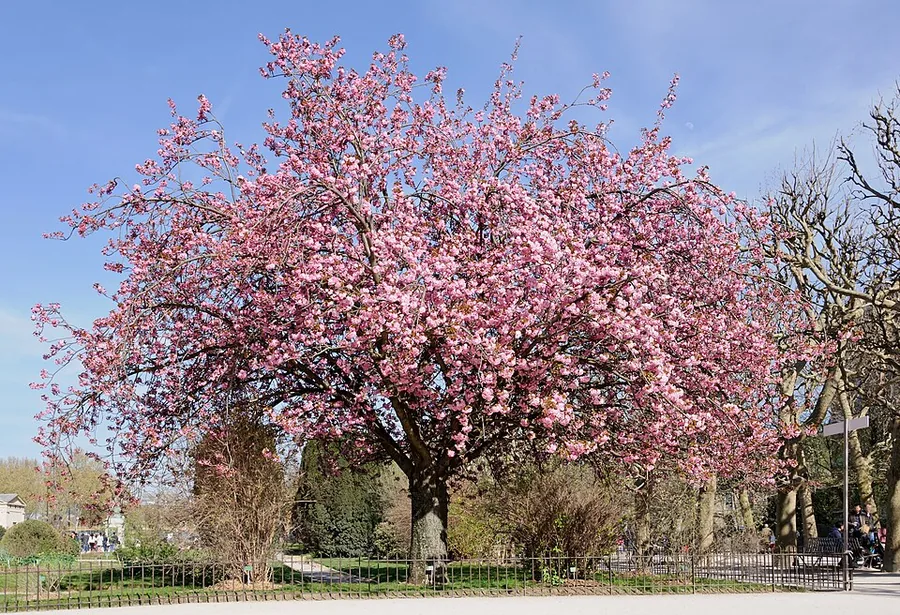
Kwanzan ranks as the most floriferous of the Japanese flowering cherries, the selection that saturates a street with pink for a week in mid-spring. Each blossom is a double pompom of 20 to 30 deep-pink petals, and the tree bears them in dense clusters that open just before or as the leaves expand. It sits within the rose family and was bred solely for that concentrated display of flower.
Under suitable conditions it performs strongly. Growth proceeds at a moderate rate toward a vase-shaped form 25 to 36 feet (8 to 11 m) tall, and the season closes in orange-bronze fall color. The cultivar is sterile and essentially fruitless, which eliminates fruit litter and any harvest and leaves only the bloom and foliage.
The limiting factor is longevity. Most specimens decline within 15 to 25 years, undermined by borers, cankers, and weak wood prone to storm breakage. Site it as a brilliant but brief feature rather than a long-term shade tree, and its performance meets expectations set on that basis.
Care
The short version: full sun, moist but well-drained loam, and consistent water during establishment. Prune lightly and only just after bloom, protect the trunk from injury, and do not expect the longevity of a durable shade tree.
Light
Site Kwanzan in full sun to maximize both flower load and fall color, since flower-bud initiation and pigment development both respond to high light. It tolerates light partial shade, but bloom thins and the damp, poorly lit foliage becomes more susceptible to the leaf diseases the tree is already prone to.
Water
Hold the soil moist but well-drained, irrigating every 5 to 10 days while the tree is young and the root system is still extending. An established Kwanzan withstands moderate drought, yet consistent moisture supports better growth than intermittent dry periods.
Soil
Grow it in fertile, well-drained loam, whether sandy, clay, or silt textured. A pH of 6.0 to 7.0 is suitable, but drainage is the decisive factor, because the tree fails on wet or coastal ground where the roots stay saturated.
Temperature
Kwanzan is cold-hardy and heat-tolerant across a broad range, from roughly -20°F (-29°C) up to 95°F (35°C), corresponding to zones 5 through 9. It requires genuine winter chilling to flower reliably and endures summer heat provided the roots remain moist.
Humidity
Ambient outdoor humidity suffices, so no target value applies. Air movement is the operative variable, because stagnant, humid air around the canopy prolongs leaf wetness and favors leaf spot and brown rot.
Feeding
Apply a light feeding of balanced slow-release tree fertilizer in early spring before bloom. Restrict nitrogen, since excess promotes soft, succulent growth that attracts borers and disease to an already vulnerable tree.
Pruning
Prune sparingly, removing only dead, damaged, or crossing branches. Time the work just after flowering, cut cleanly without stubs, and avoid wet weather, because Prunus wounds are ready entry points for cankers and borers.
Repotting
As a landscape tree rather than a container subject, repotting does not apply once it is planted. While a nursery tree is held, monitor for circling roots and water running straight through the pot, and plant it before it becomes rootbound.
Size & spacing
Expect a mature specimen 25 to 36 feet (about 8 to 11 m) tall with a spread of 25 to 30 feet (about 8 to 9 m). Allow that full width of open ground so the vase-shaped crown can develop and air can circulate through the canopy.
When to plant
Kwanzan is set out while dormant rather than raised from seed. Establish a balled-and-burlapped or container tree in early spring or fall, and it produces its double pink bloom in mid-spring, before or as the leaves break, in step with a temperate northern-hemisphere season.
Northern hemisphere
Southern hemisphere
Typical months for a temperate climate: start earlier in warm zones, later where spring frosts linger.
- Plant: Plant balled-and-burlapped or container trees in early spring or fall while dormant.
- Harvest: Showy double deep-pink pompom-like flowers (about 20-30 petals each) in mid-spring, typically before or as leaves emerge; essentially fruitless.
Hardiness
USDA hardiness zones: 5–9
Temperature: down to -29°C
Troubleshooting
Kwanzan's decline typically registers in the bark and branches before the leaves, which is one reason the tree is short-lived. Reading the early evidence of borers, disease, and black knot lets you intervene before losses compound. Match the symptom below, then act while the tree retains the reserves to recover.
Branch dieback with frass deposits and gummosis near the trunk
Sawdust-like frass and oozing sap signal borers mining the cambium and vascular tissue beneath the bark, which is why the branches above the damage wilt and die back. The insects commonly follow cankers that colonize wood already stressed or wounded, so the two problems compound each other. Excise and burn the dead or heavily infested limbs, then defend the tree by sustaining vigor through sound watering and mulch, because a healthy cambium resists attack that an injured one cannot.
Fix:
- Remove and destroy heavily infested or dead wood
- Keep the tree vigorous with proper water and mulch to resist attack
- Avoid wounding the trunk with mowers or trimmers
Foliage skeletonized to the veins or silken tents in branch unions
Metallic green Japanese beetles feed between the veins and leave the leaf skeletonized, while eastern tent caterpillars build silken nests in the branch crotches and forage out from them in spring. Drop the beetles into soapy water, and prune the caterpillar tents at first or last light while the larvae are gathered inside where removal takes the whole colony. Because an established tree carries reserves that outpace this defoliation, light feeding rarely justifies intervention.
Fix:
- Hand-pick beetles or knock them into soapy water
- Prune out and destroy tent caterpillar nests in early morning or evening
- Tolerate minor feeding on established trees
Circular leaf lesions whose centers fall away as holes
When circular lesions abscise at the center, the leaf is left with the shot-hole perforations that mark fungal or bacterial leaf spot, an infection that establishes in damp, crowded canopies where spores stay wet long enough to germinate. Rake and destroy the fallen leaves that would otherwise overwinter the pathogen, and prune to open the canopy so foliage dries faster. Withhold overhead water for the same reason, since free moisture on the leaf surface is the medium the spores need to spread.
Fix:
- Rake and destroy fallen infected leaves
- Improve air circulation through proper spacing and pruning
- Avoid overhead watering that wets foliage
Elongated black galls encircling twigs and branch wood
The rough, coal-black swellings girdling the wood are black knot, a fungal gall that expands each season and constricts the vascular tissue until the twig or branch beyond it dies. Cut each knot out several inches below the gall during dormancy, ahead of the spring spore release, and destroy what you remove. Disinfect the blades between cuts, because the spores transfer readily on unclean tools and reinfect fresh wood.
Fix:
- Prune out knots several inches below the gall during dormancy
- Destroy pruned material
- Disinfect pruning tools between cuts
Toxicity
This tree poses a genuine hazard to animals. Its leaves, twigs, bark, and any rare seeds contain cyanogenic glycosides that release cyanide on chewing or wilting, and a wind-thrown branch left in a paddock can kill grazing horses or livestock within minutes. Because the tree sets little or no fruit, no edible portion exists for people either. Exclude pets and stock from prunings and fallen limbs, and remove them promptly.
Toxic to
Cats · Dogs · Horses · Rabbits · Livestock · Birds · People
Cats Toxic
A cat that chews the leaves, twigs, or bark liberates cyanide from the tissue and absorbs it. The clinical picture, brick-red gums, dilated pupils, panting, and labored breathing, warrants emergency care.
Dogs Toxic
A dog gnawing fallen twigs or wilted leaves faces the identical cyanogenic hazard. Drooling, dilated pupils, rapid breathing, and weakness can develop quickly, so veterinary intervention should not be deferred.
Horses Toxic
Horses are highly susceptible, and wilting concentrates the toxin, which makes fallen leaves the greatest danger. Cyanide can produce anxiety, staggering, gasping, convulsions, and collapse within minutes, at times before the downed branch is even noticed in the paddock.
Rabbits Toxic
The same cyanogenic glycosides render the foliage unsafe for rabbits. Exclude them from any trimmings or fallen leaves rather than gamble on the dose.
Livestock Toxic
Cattle, sheep, and goats face acute risk from wilted cherry leaves, which liberate cyanide and can kill within 15 to 20 minutes of grazing. Fence stock from the tree and clear storm-broken branches before the animals reach them.
Birds Toxic
Cyanide from the seeds, leaves, and bark endangers birds as well, so prevent cage birds and poultry from pecking any plant part.
People Caution
The tree sets little or no fruit, so no edible portion exists to consume. The leaves, twigs, bark, and any rare seeds hold cyanide, which is reason to keep children from chewing them and to never steep the foliage as tea.
Keep pets and especially horses and livestock away from fallen, pruned, or wilted branches and leaves, which are the most dangerous. Dispose of prunings promptly.
Helpline numbers

United States
ASPCA Animal Poison Control: (888) 426-4435 (fee applies)
Poison Control: (800) 222-1222



Canada
Poison Centres: 1-844-764-7669
Varieties
Kwanzan is one selection among many flowering cherries, and the alternatives exchange its dense double bloom for other forms, fragrances, and greater longevity. The following are the cultivars worth distinguishing.
'Yoshino' (Prunus × yedoensis)
The fragrant single pale-pink-to-white cherry responsible for much of the Washington DC display, it grows more spreading in habit and lives somewhat longer than Kwanzan.
'Shirofugen'
Its double flowers open pink-tinged, pass through white, and blush pink again as they age, and it flowers later than most flowering cherries.
'Amanogawa'
A narrow, columnar cultivar bearing semi-double fragrant pale-pink flowers, it suits confined sites that a spreading cherry would outgrow.
Weeping Higan cherry (Prunus subhirtella 'Pendula')
Its pendulous branches carry early single pink flowers, and it substantially outlives Kwanzan.
'Mount Fuji' / 'Shirotae'
A wide, flat-topped cultivar whose fragrant white semi-double flowers are borne along low, sweeping limbs.
How to propagate
Kwanzan is not raised from seed. The cultivar is sterile, so every tree is a clone produced by skilled grafting, a process that lies well beyond casual backyard propagation.
GraftingDemanding
Late winter to early spring (bench grafting) or summer (budding) · 1-2 years to a saleable grafted tree
Kwanzan is sterile and double-flowered, so seed will not reproduce the cultivar, and growers instead unite scion wood with compatible cherry rootstock to preserve it exactly. Bench grafting is carried out in late winter to early spring and budding in summer, and the union then needs 1 to 2 years to grow into a saleable tree. The technique demands real skill and sits well outside casual propagation.
Stem cuttingsDemanding
Early summer from softwood · Several months to root, then 1-2 years to establish
Softwood cuttings taken in early summer under mist with rooting hormone are possible, but rooting is erratic and the failure rate is high. A cutting that does strike still requires several months to root and a further 1 to 2 years to establish. For dependable results, grafting remains the commercial standard.
Myths
Ornamental cherries such as Kwanzan bear an edible crop.
Kwanzan is a double-flowered ornamental selected for display rather than production. Being essentially sterile, it seldom sets fruit at all, so the flowers, not any crop, are the entire reason to grow it.
Cherry toxicity to animals is confined to the pits.
The leaves, twigs, and bark hold the same cyanogenic glycosides found in the seeds. Wilting is the classic trigger of rapid livestock and horse poisoning, which is precisely why a branch broken off in a storm poses more risk than any pit.