Tree · Rosaceae
Medlar
Mespilus germanica
A slow, cold-hardy fruit tree of modest demands that ripens only after the first frosts.
Full sun
Every 7–14 days
USDA 5–8
15–20 ft · 4.6–6.1 m
Overview
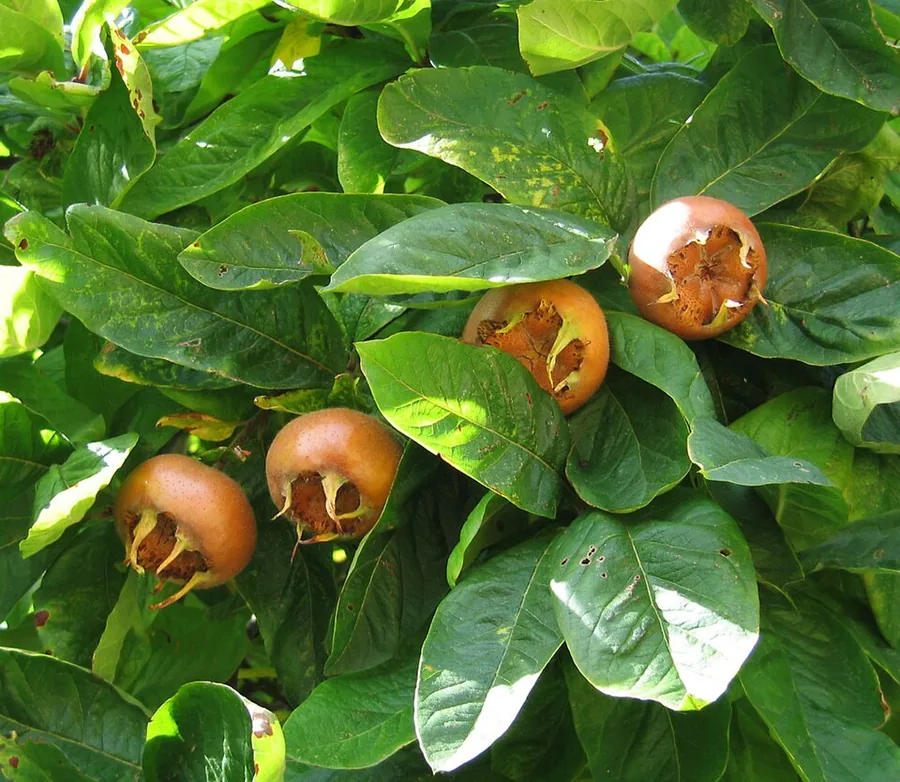
Medlar is an ancient orchard tree of the rose family, cultivated in Europe for centuries and now grown far less than its qualities merit. It sits taxonomically beside apples and pears and matures into a small, spreading tree of 15 to 20 feet (4.5 to 6 m), opening large white-to-pink blossom in late spring. The russet-brown pome that follows resembles a small, flat-bottomed apple finished with a persistent open calyx.
Its defining trait is a delayed edibility. Fruit taken from the tree is firm and sharply astringent from its tannin content, and becomes palatable only after bletting, a controlled softening driven by frost or storage that browns and sweetens the flesh as starch converts to sugar, yielding a texture and taste near spiced apple butter or dates. The tree therefore imposes its own physiological timetable on the grower.
In cultivation it is undemanding. Rated hardy down to -20°F (-29°C), self-fertile so a single specimen sets a full crop, slow in growth, and notably resistant to pests and disease, it repays little more than a sunny site and reasonable soil with decades of productive life.
Care
The short version: site the tree in full sun on moist, fertile, well-drained loam, irrigate deeply during drought and through fruit development, and confine pruning to a light late-winter cut. Once established it performs as a low-input, cold-hardy tree.
Light
Flowering and fruiting are maximised in full sun, though the tree tolerates part shade. Because low light suppresses flower initiation, insufficient sun is a leading reason a young tree remains shy of blossom, so select the brightest available position.
Water
An established tree requires moderate, even moisture and accommodates a fair range of soils once rooted. Irrigate deeply through drought and during fruit swell, when demand peaks. Between applications allow the top half of the soil to dry, since sustained saturation is not tolerated.
Soil
The optimum is moist, fertile, well-drained loam, but medlar performs on less favourable ground. It succeeds across a soil pH of 6.0 to 7.5, spanning slightly acidic to slightly alkaline reactions.
Temperature
The species is markedly cold-hardy, withstanding winter minima of -20°F (-29°C) and summer maxima to 95°F (35°C). Frost is functional rather than harmful here, as it is the trigger that begins bletting.
Humidity
Ambient outdoor air near 40% to 70% is entirely adequate, with no target to regulate. Persistently damp, still air matters only insofar as it predisposes the foliage to leaf spot, so airflow is the operative concern.
Feeding
A single balanced feed in spring, applied seasonally, meets the tree's needs. Restraint is warranted, because excess nitrogen promotes vegetative growth at the expense of flower and fruit.
Pruning
Prune in late winter during dormancy, removing dead, damaged, or crossing wood to maintain an open framework. Since medlar fruits on spurs, only light pruning is warranted once the tree is established, and hard cutting is counterproductive.
Repotting
As a field tree, medlar is rarely repotted. Where a young specimen is held in a container, pot it on when roots circle, water passes straight through, or growth stalls.
Size & spacing
Anticipate a small, spreading tree of 15 to 20 feet (4.5 to 6 m) in height and comparable width. Allocate space for the full 15 to 20 foot (4.5 to 6 m) canopy to develop unimpeded.
When to plant
Medlar follows an extended, unhurried phenology. Establish bare-root or container trees during dormancy, from late autumn into early spring. Blossom breaks in late spring, and the fruit persists well beyond leaf drop, ready for harvest in late autumn once the first frosts have initiated bletting.
Northern hemisphere
Southern hemisphere
Typical months for a temperate climate: start earlier in warm zones, later where spring frosts linger.
- Plant: Plant bare-root or container trees in late autumn to early spring while dormant.
- Harvest: Blooms in late spring (about May to June); fruit is harvested in late autumn after leaf drop and first frosts, then bletted before eating.
Hardiness
USDA hardiness zones: 5–8
Temperature: down to -29°C
Troubleshooting
Medlar presents few problems in cultivation, and most of what does arise stems from the fruit's unusual ripening rather than from disease. Identify the closest match below and correct it through timing or a modest adjustment in culture.
Sparse flowering and cropping on a young tree
The usual explanation is immaturity, because a self-fertile medlar typically begins cropping in its second year and yields more heavily as the framework fills out. Insufficient light is the secondary cause, since flower initiation drops in shade. Reposition the tree into full sun and withhold heavy nitrogen, which favours vegetative growth over flower buds, then allow it time.
Fix:
- Be patient and allow the tree to mature
- Site or move the tree to a position with full sun
- Avoid heavy nitrogen feeding that favours leaves over flowers
Firm, pale, astringent fruit that resists eating
Unbletted fruit reads firm and pale and dries the mouth because its tannin load is still high and the flesh has not yet converted starch to sugar. Bletting resolves it. Harvest in late autumn after leaf fall and the first frosts, then hold the fruit in a cool, dark, airy store for two to three weeks, during which softening browns and sweetens the flesh.
Fix:
- Harvest in late autumn after leaf fall and the first frosts
- Store fruit in a cool, dark, airy place for two to three weeks until the flesh turns soft and brown
- Eat or process only once the flesh is soft and sweet
Circular brown lesions and premature defoliation
Because medlar carries strong resistance to pests and disease, extensive foliar spotting most likely indicates a fungal leaf spot, a pathogen favoured by wet, crowded canopies where humidity lingers on the leaf surface. Collect and dispose of fallen leaves to break the overwintering inoculum, thin the crown to raise airflow, and withhold overhead irrigation that wets the foliage.
Fix:
- Rake up and remove fallen leaves
- Prune to improve air circulation
- Avoid overhead watering
Toxicity
Medlar is a safe tree in a domestic setting. Its bletted flesh is eaten by people and is harmless to pets and grazing stock, and neither the foliage nor the sap is toxic. The single qualification, shared with apple, pear, and other rose-family fruit, is that the seeds contain a cyanogenic compound and should not be crushed and ingested in quantity.
Safe for
People · Cats · Dogs · Horses · Rabbits · Livestock · Birds
Cats Safe
Cats seldom approach the fruit, and the soft flesh is harmless if tasted. The single point of caution is a cat crushing a quantity of the hard seeds in its teeth.
Dogs Safe
A portion of bletted flesh is a benign treat for a dog. The concern is confined to mouthfuls of crushed seeds, which hold the cyanogenic compound common to the rose family.
Horses Safe
Neither the tree nor its ripe fruit presents a genuine hazard to horses. Monitor only for consumption of large quantities of chewed seeds.
Rabbits Safe
Rabbits may take the foliage and a little soft flesh without adverse effect. Fruit should remain a minor component of the diet, as with any supplemental treat.
Livestock Safe
Cattle, goats, and sheep graze in the vicinity of medlar without toxicity. The lone caveat is the seed within windfall fruit, and only where large numbers are crushed and ingested.
Birds Safe
Garden birds take the ripe fruit readily, and the flesh poses no risk to them. The hard seeds are left untouched.
People Safe
Bletted medlar is a sweet, wholesome food, soft and brown with the character of spiced apple butter. As with apple and other rose-family fruit, discard the seeds rather than crushing and consuming them.
The soft, bletted flesh is edible; avoid letting pets or children chew or swallow large numbers of crushed seeds.
Helpline numbers

United States
ASPCA Animal Poison Control: (888) 426-4435 (fee applies)

United Kingdom
Animal PoisonLine: 01202 509000 (fee applies)

Australia
Animal Poisons Helpline: 1300 869 738
Varieties
Few medlar cultivars remain in cultivation, yet they span a useful range from small and intensely aromatic to giant-fruited. The following names are the ones to seek.
Nottingham
An old selection of fairly upright, compact habit, valued for smaller fruit of concentrated aroma.
Royal
A dependable, heavy-yielding cultivar carrying medium-sized fruit of sound flavour.
Breda Giant
A Dutch selection within the giant-fruited group, grown for large fruit and strong autumn foliage colour.
Large Russian
A vigorous form that yields some of the largest fruit recorded in the species.
How to propagate
Medlar is not readily increased. Named clones are grafted to preserve their identity, and seed offers only a slow, unpredictable route that demands considerable patience.
GraftingDemanding
Late winter to early spring for bench grafting, or summer for budding · 1 to 2 years to a young, sellable tree
Named cultivars are propagated almost exclusively by grafting or budding onto quince, pear, or hawthorn rootstocks, which reproduces the clone faithfully and moderates scion vigour. Bench graft in late winter to early spring, or bud in summer, allowing 1 to 2 years to raise a young tree fit for planting out.
SeedDemanding
Autumn, after prolonged cold stratification · Several years to first fruiting
Seed propagation is a protracted route. The seed requires a prolonged period of cold stratification, best met by an autumn sowing, then germinates slowly and erratically, and the resulting seedlings do not reproduce the parent. Reckon on several years before an individual reaches flowering and fruiting.
Myths
Medlars are rotten or spoiled once they are soft enough to eat.
The softening is bletting, a physiological stage of ripening in which tannins decline and starch converts to sugar. Correctly bletted fruit is soft, sweet, and entirely safe, not decayed, despite an appearance suggesting it has passed its prime.
Two medlar trees are required for pollination and fruit set.
A solitary specimen crops without a partner. Medlar is self-fertile and commonly begins bearing in its second year, so a dedicated pollinator tree is unnecessary.
Medlar fruit can be eaten straight off the tree like an apple.
Fruit taken directly from the tree is firm and dries the mouth from its tannin content. Bletting is a prerequisite, achieved by frost exposure or several weeks in storage, before the flesh browns and becomes palatable.