Tree · Rosaceae
Almond
Prunus dulcis
Match it to full sun, deep well-drained soil, and a frost-free bloom, and the almond returns decades of kernels.
Full sun
Every 7–14 days
180–240 days
USDA 7–9
Overview
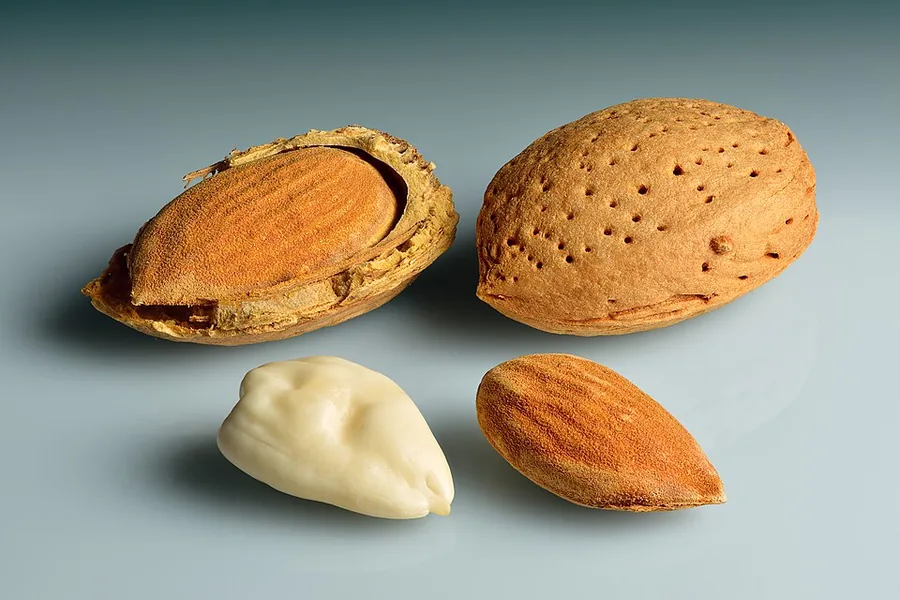
Prunus dulcis is a deciduous member of the rose family closely allied to peach and apricot, cultivated for the seed within its stone rather than for edible flesh. Its center of origin lies in western Asia and the eastern Mediterranean, regions whose dry, sunny conditions match its requirements. The edible portion is the kernel of a drupe, which places it outside the category of true nuts.
As a Mediterranean-climate species, the almond performs across USDA zones 7 to 9. Its defining trait is an exceptionally early bloom, frequently in February or March, ahead of nearly every orchard tree, and this earliness is also its chief vulnerability: a late frost striking the open flowers can eliminate the season's crop, which makes a frost-free bloom the limiting factor on most sites.
The almond's exacting requirements place it at the demanding end of the difficulty scale. Most named cultivars are self-incompatible and depend on a second, synchronously blooming tree for pollination and nut set. Supplied with deep, well-drained soil, full sun, and steady summer water, a young tree enters bearing within a few years and remains productive for decades.
Care
The short version: site it in full sun on deep, well-drained sandy loam, with regular deep irrigation through spring and summer to develop the kernels. Prune to an open vase in winter, establish a pollinizer, and protect the early bloom from frost.
Light
The almond requires full sun and performs best on an open, south-facing aspect that receives light throughout the day. It tolerates limited partial sun, but shade reduces both vegetative vigor and kernel yield.
Water
Irrigate deeply on a regular interval through spring and summer, approximately every 7 to 14 days, to support kernel fill. The established tree is drought tolerant, yet it is intolerant of saturation, so waterlogged ground must be avoided because it predisposes the tree to root and crown rot.
Soil
Establish the almond on deep, well-drained sandy loam, where it grows vigorously. It performs poorly in heavy or impeded soils, so target a loose, free-draining medium with a pH of 6.0 and 7.5.
Temperature
The species withstands a broad thermal range, roughly 5°F to 104°F (-15°C to 40°C). The operative risk is not midwinter cold but frost coinciding with the very early bloom, which can destroy the open flowers.
Humidity
This tree is adapted to dry air, in the region of 30% to 50% humidity, which accounts for its suitability to Mediterranean climates. Humid conditions during bloom promote brown rot and other fungal pathogens.
Feeding
Fertilize across the growing season, from early spring into summer, with a nitrogen-based orchard fertilizer supplemented with potassium. Divide the applications over the season and calibrate the rate to leaf or tissue analysis.
Pruning
Prune during winter dormancy, developing the canopy toward an open-center vase form. Eliminate dead, crossing, and weak wood, and thin to admit light to the interior fruiting wood.
Repotting
The almond is not suited to container culture, and field trees are not repotted. A tree started in a pot should not be held too long, since the roots circle and the tree subsequently stalls and dies back once it is set out.
Size & spacing
Allow for a full-sized tree attaining 10 to 30 feet (3 to 9 m) in height and a comparable spread. Provide ample open space so the canopy can develop and air can circulate through it.
When to plant
The almond operates on an early phenological cycle. Establish dormant bare-root trees in late winter to early spring, anticipate a February or March bloom exposed to frost, and harvest from late summer into fall as the hulls split.
Northern hemisphere
Southern hemisphere
Typical months for a temperate climate: start earlier in warm zones, later where spring frosts linger.
- Plant: Late winter to early spring as dormant bare-root, grafted nursery trees
- Harvest: Blooms very early (Feb-Mar) and is frost-prone; nuts harvested Aug-Oct when hulls split
Hardiness
USDA hardiness zones: 7–9
Temperature: down to -18°C
Troubleshooting
The almond's principal disorders concentrate on the developing nuts at hull split and on the flowers during the early bloom. Identified at the correct phenological stage, a fungicide or a sanitation pass is effective; outside that window the loss is largely fixed. Match the symptom below, then intervene while the timing permits.
Bored kernels carrying webbing and frass at harvest
The navel orangeworm ranks as the single most damaging pest of the crop. Its larvae enter through the splitting hull and feed on the kernel, and the population each spring traces back to mummy nuts that overwintered in the canopy, which is why winter sanitation breaks the cycle at its source. Remove those mummies, then treat at hull split and follow with a second application 2 to 3 weeks later where pressure is high.
Fix:
- Treat at the start of hull split and again 2-3 weeks later in moderate-to-high pressure orchards
- Harvest promptly once hulls split to limit exposure
Frost-killed blossoms browning and dropping after a cold snap
The almond's exceptionally early bloom exposes open flowers to late freezes, which kill the pistil and leave the interior browned or blackened, eliminating that flower's contribution to nut set. Mitigation works on two fronts: active protection through wind machines or irrigation on high-risk nights, and site and cultivar selection, since cold air drains off well-chosen ground and later-blooming varieties escape the most dangerous window.
Fix:
- Use frost protection (wind machines or irrigation) during high-risk nights
- Avoid the earliest-blooming cultivars in frost-prone sites
Abrupt spur and shoot strikes at hull split
These strikes are the signature of hull rot, caused by fungi that colonize the opening hull and release toxins that translocate into and kill the adjacent spur or shoot. The mechanism is moisture-driven, so a fungicide at hull split combined with reduced late-season nitrogen and water hastens hull desiccation and starves the pathogen of the wet tissue it exploits.
Fix:
- Apply an effective fungicide (DMI or QoI) at hull split
- Reduce late-season nitrogen and water to speed hull drying
Blighted flowers and gumming twig cankers during bloom
Wet conditions at flowering favor brown rot blossom blight, whose spores infect the open bloom, collapse it to a browned husk that adheres to the spur, and extend into small gumming twig cankers. Because infection tracks the flower stage, fungicide timed to pink bud and full bloom gives the best protection, and excising blighted spurs and mummies removes the inoculum that would carry the disease forward.
Fix:
- Apply a bloom fungicide at the appropriate flower stage (e.g., pink bud and full bloom)
- Remove blighted spurs and mummies
Toxicity
Regard this tree as a real hazard to animals. The foliage, bark, green hulls, and the kernels of bitter almond all contain amygdalin, which releases cyanide, and the kernel's high fat content together with whole nuts adds choking and pancreatitis risk in pets. The sweet almonds consumed by people are safe, but livestock, horses, and pets must be excluded from the foliage and prunings.
Toxic to
Cats · Dogs · Horses · Rabbits · Livestock · Birds · People
Cats Mild
In a cat, a handful of sweet almonds tends to produce vomiting, diarrhea, and gastric upset. The graver exposure is to the bitter kernels and foliage, where the cyanogenic load can drive drooling, pupil dilation, and respiratory distress.
Dogs Mild
Dogs typically swallow nuts whole, so the common outcomes are vomiting and diarrhea, a fat-induced episode of pancreatitis, or mechanical choking and obstruction. Ingestion of bitter almonds or green tissue shifts the case toward cyanide poisoning.
Horses Toxic
The cyanogenic glycosides in wilting leaves and bark act quickly in horses, producing rapid respiration, ataxia, bright red mucous membranes, and collapse. Exclude horses from all prunings and fallen branches.
Rabbits Toxic
A rabbit's low body mass leaves little tolerance for the amygdalin in almond leaves and twigs, so even a small browse can prove dangerous. Prevent any access to the foliage.
Livestock Toxic
Cattle, goats, and sheep that graze the leaves or strip the bark can ingest a cyanide dose sufficient to cause sudden, severe poisoning. Fence the trees off and remove dropped prunings from grazing ground.
Birds Toxic
Cyanide is acutely lethal to avian species, so the green hulls, foliage, and bitter kernels must stay inaccessible to backyard poultry and pet birds.
People Caution
Commercial sweet almonds carry only a trace of cyanide and are safe to consume. Bitter almonds differ, containing enough amygdalin to be genuinely poisonous raw, which is why they are excluded from sale for raw consumption.
Sweet (culinary) almonds sold in the U.S. are low in cyanide and edible; bitter almonds and the tree's foliage, bark, and green hulls are the cyanogenic hazard. Keep pets from chewing foliage, twigs, or fallen green hulls.
Helpline numbers

United States
ASPCA Animal Poison Control: (888) 426-4435 (fee applies)
Poison Control: (800) 222-1222



Canada
Poison Centres: 1-844-764-7669
Varieties
Almond cultivars are classified as much by bloom timing and shell character as by flavor, a consequence of their dependence on a pollination partner. The following are the cultivars worth knowing by name.
Nonpareil
The dominant California cultivar, valued for thin, smooth shells that crack readily, though its self-incompatibility means it sets no nuts without a cross-pollinizer nearby.
Carmel
A soft-shell cultivar whose bloom coincides with Nonpareil, the synchrony that explains its frequent use as a companion pollinizer.
Monterey
A late-blooming hard-shell cultivar grown to extend the bloom overlap across an orchard and sustain effective pollination.
All-in-One
A self-fertile semi-dwarf, the logical selection for a home garden with room for a single almond tree.
Mission (Texas)
A hard-shelled, late-blooming cultivar whose delayed flowering evades much spring frost, suiting it to colder sites.
Companions
Plant near
Pollinizer almond varieties (e.g., Nonpareil with Carmel/Monterey): Most cultivars are self-incompatible and need a different, overlapping-bloom variety nearby for bee cross-pollination and nut set.
Flowering bee-forage cover crops (clover, mustard): Support honey bee and native pollinator activity during the critical early bloom window.
Keep apart
Peach and other Prunus stone fruits planted close by: Share pests and diseases such as brown rot, peach twig borer, and navel orangeworm, increasing pressure on the almonds.
How to propagate
A named almond cannot be reproduced from its own seed, since it does not breed true. Trees are propagated by grafting onto a selected rootstock, with seed reserved for raising those rootstocks.
GraftingModerate
T-budding in late summer or bench/whip grafting onto rootstock in late winter · 3-4 years to first meaningful nut crop
Because a named almond does not breed true from seed, it is propagated vegetatively onto a peach, almond, or hybrid rootstock selected for the soil conditions and the vigor sought. The two standard techniques are T-budding in late summer and bench grafting onto rootstock during the late winter dormancy. The resulting tree then requires 3 to 4 years before producing a meaningful crop.
SeedModerate
Stratify seed over winter and sow in spring · 1 season to seedling, several years to bear
Seed propagation requires winter stratification followed by spring sowing, yielding a seedling within one season but a delay of several years to bearing. Owing to genetic segregation, seedlings don't match the parent, so they serve chiefly as rootstock rather than as a means of reproducing a named cultivar.
Myths
An almond is a true nut.
Botanically the edible almond is the seed enclosed within the stone of a drupe, the identical fruit type borne by peach and apricot. It is a seed, not a true nut at all.
Every almond is equally safe to eat.
Sweet almonds bred for food contain only a trace of cyanide and are safe to eat. Bitter almonds are distinct, carrying amygdalin that liberates cyanide, which is why they are never sold for raw eating in the U.S.