Ornamental · Rosaceae
Barren Strawberry
Waldsteinia ternata
A durable yellow-flowered groundcover that carpets dry shade where most plants give up.
Partial shade
Every 5–10 days
USDA 4–7
3–6 in · 8–15 cm
Overview
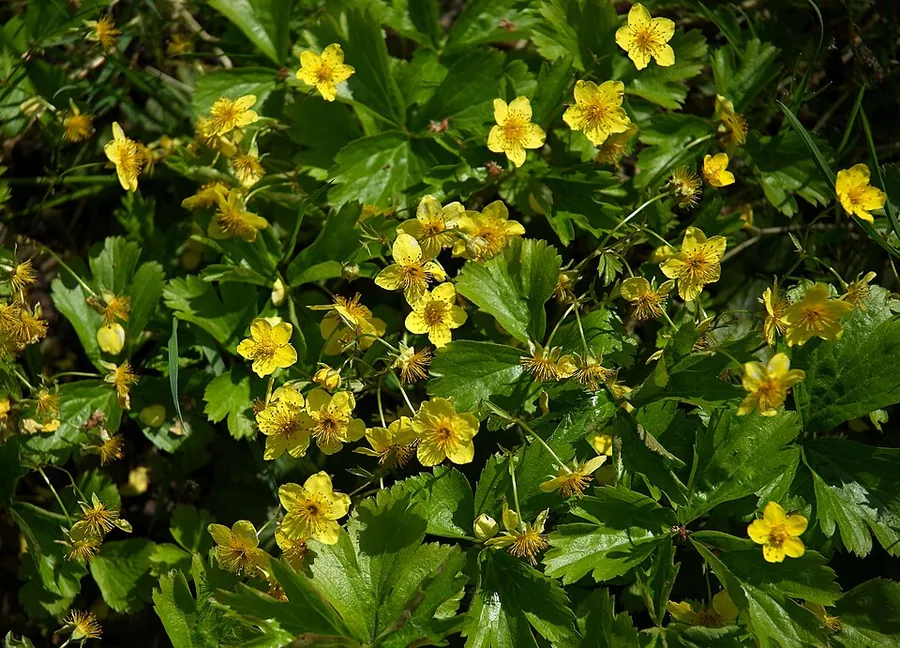
Barren strawberry is a low rose-family groundcover that mimics a true strawberry without being one. It builds a dense mat of glossy, three-part leaves standing just 3 to 6 inches (8 to 15 cm) high, dotted with small yellow flowers each spring. Its name points to the fruit, which stays dry and barren rather than ripening into a red berry.
Its appeal rests on how undemanding it proves. The plant tolerates dry shade beneath trees, anchors a slope against erosion, and substitutes for turf where grass falters. After it settles, it advances on its own through short surface runners and underground rhizomes, yet it never crosses into aggressive behavior.
Provide part shade and consistent moisture during its youth and it returns an evergreen to semi-evergreen carpet that shifts to bronze over winter. Deer tend to pass it by, and it endures cold to -29°F (-34°C), making it a steady, low-effort solution for awkward ground.
Care
The short version: part shade is its preference, paired with average to rich, well-drained soil and consistent water until it establishes, after which it tolerates drought and asks for next to no maintenance.
Light
Part shade is the ideal, though the plant adapts across the range from full sun to full shade. In warm regions, favor shade, because intense afternoon sun striking dry soil drives leaf scorch.
Water
Hold the soil evenly moist during establishment, watering every 5 to 10 days. Once rooted in, it becomes drought tolerant, yet a deep soaking during a heat wave keeps the foliage from browning as soil moisture falls behind the heat load.
Soil
It performs in nearly any well-drained soil, whether loam, clay, or sand, and thrives where compost has enriched the ground. A pH between 5.5 to 7.5 suits it, so most beds need no correction.
Temperature
A cold-hardy perennial, it endures down to -29°F (-34°C) and copes with summer heat to 86°F (30°C). Beyond that threshold, heat combined with dry soil is where the leaves begin to fail.
Humidity
Standard outdoor humidity meets its needs, so there is no level to manage. Far more decisive is consistent soil moisture through the heat of summer.
Feeding
Feeding stays minimal. One spring topdressing of compost or a balanced fertilizer per season keeps the mat in good condition.
Pruning
Pruning is nearly unnecessary. Shear or mow the mat lightly in late winter or early spring to clear winter-tattered leaves and encourage fresh growth.
Repotting
As a garden groundcover, it seldom needs lifting. Divide a clump only once the center begins to thin or crowded crowns rise out of the soil.
Size & spacing
Each plant holds low at 3 to 6 inches (8 to 15 cm) tall while spreading 6 to 18 inches (15 to 46 cm) across. Set them on the tighter side to close into a solid mat sooner.
When to plant
Barren strawberry tolerates cold well and follows its own seasonal rhythm. Plant new stock in spring or early fall while the soil stays cool and moist, and watch for its yellow flowers from mid to late spring.
Northern hemisphere
Southern hemisphere
Typical months for a temperate climate: start earlier in warm zones, later where spring frosts linger.
- Plant: Spring or early fall
- Harvest: Yellow flowers in mid to late spring (April to June)
Hardiness
USDA hardiness zones: 4–7
Temperature: down to -34°C
Troubleshooting
Trouble is rare with this groundcover, and what does occur traces to the planting site rather than to pests or disease. Catch the early signals below and you can correct the cause before the colony declines. Match the symptom to what you observe, then respond while action still pays off.
Browning, thinning foliage on hot, exposed sites
What you are seeing is sun scorch, which develops when the radiant heat load on the leaves outpaces what the dry soil can replace. The injury concentrates on the hottest, driest margins of the planting while shaded crowns hold their color. Step up watering through heat waves, spread a thin mulch layer to slow evaporation, and shade the bed from afternoon sun in warm regions.
Fix:
- Increase watering during hot, dry spells to keep soil evenly moist
- Provide afternoon shade in hot climates
- Mulch lightly to conserve soil moisture
Open gaps that persist for a season or two after setting plants
This reflects slow establishment rather than any fault in the stock. The plant closes ground by sending out short surface runners and rhizomes, and that lateral spread accrues over one to two seasons before the mat seals. Tighten your spacing for quicker coverage, keep competing weeds out, and allow the colony time to merge.
Fix:
- Be patient; allow one to two seasons for the mat to close
- Space plants closer together for faster coverage
- Keep evenly watered and weed-free while establishing
Toxicity
There is no safety concern here. Barren strawberry carries no toxic listing, so it stays safe around cats, dogs, and children. The small dry fruit is barren rather than poisonous, so a mouthful of leaves leaves a pet with nothing worse than a brief, mild stomach upset.
Safe for
People · Cats · Dogs · Horses · Rabbits · Livestock · Birds
Cats None
No concern around cats. Heavy chewing of the foliage might produce a short, mild bout of stomach upset at most.
Dogs None
Poses no real threat to dogs. The most a dog risks from gnawing the leaves is transient loose stool that resolves without intervention.
Horses None
Carries no toxicity for horses. A horse grazing the low mat suffers no recorded ill effects.
Rabbits None
Rabbits may browse the leaves freely, as the plant holds nothing harmful to them.
Livestock None
Presents no hazard to cattle, goats, or sheep that encounter this groundcover.
Birds None
Harmless to birds. The small dry fruit contains no toxins.
People None
Non-toxic to people, though the dry fruit is barren and offers nothing worth eating. No cause for concern with children.
Not poisonous. The small, dry fruit is barren (inedible) rather than a true edible berry, but it is not toxic. Pets nibbling foliage may at most have mild, self-limiting GI upset.
Varieties
Two distinct plants go by barren strawberry, one originating in Europe and Asia and one native to North America. The notes below show how to distinguish them.
Waldsteinia ternata (European/Asian barren strawberry)
The commonly cultivated groundcover species native to Europe and Asia, a vigorous mat-former bearing glossy three-part leaves and yellow flowers in spring.
Geum fragarioides / Waldsteinia fragarioides (Appalachian or Northern barren strawberry)
The North American counterpart, a low woodland wildflower of eastern Canada and the United States that carries the same yellow flowers and evergreen, strawberry-like foliage.
Companions
Barren strawberry pairs well with plants that share its love of shade, and it makes a clean backdrop for anything that needs its bare lower stems hidden.
Plant near
Spring-blooming bulbs (such as daffodils and crocus): Barren strawberry combines well with spring bulbs, whose foliage is masked by the dense low mat after bloom.
Shade trees and woodland shrubs: Tolerates dry shade and makes an excellent durable groundcover or lawn alternative under trees and on shaded slopes.
How to propagate
Increasing barren strawberry is straightforward, whether you divide an established clump or take the slower path from seed.
DivisionEasy
Spring or early fall · One to two growing seasons to knit into a dense mat
Division is the dependable route to increase this groundcover. In spring or early fall, lift a mature clump, or separate rooted runners and rhizomes, and set the divisions back into prepared ground. Expect one to two growing seasons before the new pieces knit into a dense mat.
SeedModerate
Sow when ripe or in spring · Slower than division; plants take time to reach mat-forming size
Seed is workable but demands patience. Sow it when ripe or in spring, then wait, since seedlings develop more slowly than divisions and need time to reach mat-forming size. For that reason most growers turn to division.
Myths
Barren strawberry is a type of strawberry that produces edible berries.
It belongs to no true strawberry lineage. Its three-part leaves and runners create the resemblance, yet it opens yellow flowers rather than white, and what follows is a small, dry, barren fruit instead of a fleshy red berry. Its value lies in ornamental groundcover use, not in any harvest.