Ornamental · Rosaceae
Great Burnet
Sanguisorba officinalis
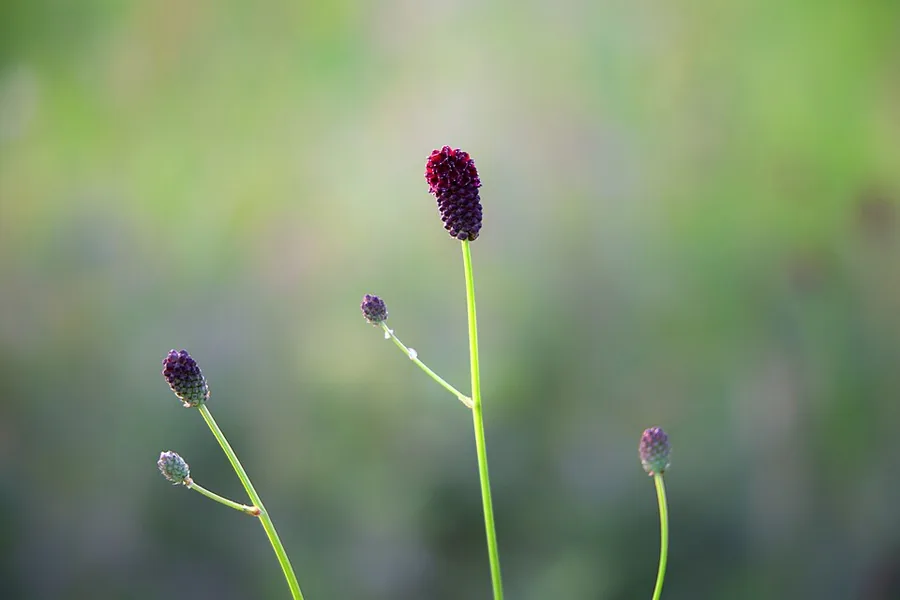
Tall wands of dark red bottlebrush flowers that sway over the back of a damp, sunny border all summer.
Full sun
Every 3–7 days
USDA 4–8
2–3 ft · 0.8–0.9 m
Overview
Great Burnet, Sanguisorba officinalis, is a clump-forming herbaceous perennial in the rose family, grown for the dark red, almost black-purple bottlebrush spikes it lifts above its foliage from late spring onward. It reads as an upright, airy plant, and the flower heads ride high on slender stems, which is the trait that shapes most of its care.
Its origins as a plant of moist meadows explain why it asks for consistently moist, well-drained soil and full sun. Give it those conditions and it builds sturdy stems and reliable bloom; starve it of either water or light and the growth turns soft and leans. It is hardy through zones 4 through 8 and counts as an easy, low-maintenance perennial.
Left to its own devices it self-seeds freely, so a little editing keeps it in bounds. Beyond deadheading and the occasional stake, it stays largely trouble-free, with no serious pest or disease problems on record. The genus sits among the edible, culinary burnets, so it carries no toxicity concern for a household with pets or children.
Care
The short version: site Great Burnet in full sun and keep the soil evenly moist, since dry roots brown the leaf edges and shade or rich feeding produces weak, floppy stems. Stake the tall flower wands early, deadhead to curb self-seeding, and cut the plant to the ground in late fall or early spring. It is hardy in zones 4 through 8, rarely needs lifting, and asks for only a light spring feed.
Light
Grow it in full sun for the sturdiest stems and the heaviest flowering, because sun drives the firm, self-supporting growth this tall plant needs. It will accept partial shade, but too much shade stretches the stems into weak, leggy growth that leans and sprawls.
Water
Keep the soil consistently moist and do not let the root zone dry out, especially through summer heat, since dry roots cannot supply the foliage and the leaf margins brown first. As a plant of damp ground it is comfortable on moist sites that would trouble drier-loving perennials. Check the soil every few days and water before it dries, adjusting to weather and conditions.
Soil
Average, medium-moisture, well-drained soil suits it, and there is no need to chase a particular pH. Work compost into poor ground to hold moisture, but avoid making the soil too rich, which pushes the soft, floppy stems that flop after rain.
Temperature
This is a tough, cold-hardy perennial for zones 4 through 8, taking winters down to about -29°F (-34°C) and summers up to roughly 86°F (30°C). Within that range it needs no special winter protection.
Humidity
Ordinary outdoor humidity is fine, and there is no figure to aim for. Steady soil moisture matters far more than the air, which is why dry roots show as browning leaf edges long before humidity ever becomes an issue.
Feeding
Feed lightly in spring, once a season, with a balanced general-purpose fertilizer or a topdressing of compost, which is plenty on average garden soil. Heavier feeding works against you, fueling the weak, leggy growth that cannot hold its flowers upright.
Pruning
Cut back spent flower stems to hold down self-seeding, and take the whole plant to the ground in late fall or early spring to reset it. Stake the taller stems early in the season, before they gain height, so they are supported and do not sprawl when rain or wind hits.
Repotting
As a garden perennial this is rarely lifted, and it grows best left in place to settle into a full clump. Divide only when crowding thins the flowering or the center of the clump starts dying out.
Size & spacing
Expect a clump 2.5 to 3 feet (76 to 91 cm) tall with a spread of 2 to 3 feet (61 to 91 cm). Allow each plant that much room so the airy, upright stems have space to stand and show.
When to plant
Start seed indoors from late winter to early spring, then move plants out after the last frost once the soil has warmed. The dark red flower spikes open from May into early summer, with some forms carrying the show later in the season.
Northern hemisphere
Southern hemisphere
Typical months for a temperate climate: start earlier in warm zones, later where spring frosts linger.
- Sow: Late winter to early spring
- Plant: Spring after last frost
- Harvest: May to June (into late summer for some forms)
Hardiness
USDA hardiness zones: 4–8
Temperature: down to -34°C
Troubleshooting
This is a clean perennial that stays free of serious pests and disease, so the few problems that do arise trace back to siting and water rather than infection. Reading the early signs and matching them to a quick fix keeps the planting looking its best.
Browning margins point to a thirsty root zone
Leaf margins and tips are the first tissue to dry out when the roots cannot pull enough water, so browning there signals that the soil has gone too dry rather than any pest. The pattern tracks the weather, worsening through hot, dry stretches and easing once steady moisture returns. Held evenly moist, the plant generally pushes clean new growth.
Fix:
- Water to keep soil evenly moist
- Apply mulch to conserve soil moisture
Why the flower wands lean and sprawl
The flowering stems carry their weight high, so a tall, unsupported stem becomes mechanically top-heavy and bends or lays over once rain or wind loads it. Soft growth driven by too much shade or overly rich feeding compounds the problem, since weaker tissue cannot hold the load. The crown itself stays sound, which tells you this is a structural issue rather than disease.
Fix:
- Install stakes or grow-through supports early in the season
- Site in full sun for sturdier stems
Where the surprise seedlings come from
Spent flower heads ripen viable seed, and this species drops it freely, so a ring of small plants tends to colonize the open ground near the parent crown. The flush always follows flowering, which points straight to the seed cycle as the cause. Catching the spent heads before the seed matures stops the supply at the source.
Fix:
- Deadhead spent flowers before seed sets
- Remove volunteer seedlings by hand
Toxicity
Great Burnet is not toxic. It belongs to the culinary burnets, and the closely related salad burnet is cleared as non-toxic to cats, dogs, and horses, so a stray nibble is nothing to worry about.
Safe for
People · Cats · Dogs · Horses · Rabbits · Livestock · Birds
Cats None
No toxic effects are on record for cats around this genus, so a curious bite is not expected to cause harm.
Dogs None
Dogs face no documented poisoning risk here, and the related salad burnet carries a clean non-toxic listing.
Horses None
Horses can graze near it without concern, since the genus shows no reported toxicity to them.
Rabbits Safe
Rabbits are not flagged for any reaction; the foliage belongs to the culinary burnets.
Livestock Safe
Grazing livestock have no recorded trouble with this plant.
Birds Safe
Birds are not listed as at risk, and nothing in the genus suggests a hazard.
People Safe
People share the garden with it safely, given its place among edible burnets.
No special handling precautions are required; the plant is not reported to be toxic.
Varieties
A couple of named selections deliver the same dark flowers in a tidier or a taller package, and both are worth seeking out if the straight species is too loose for your spot.
Tanna
A compact selection holding to roughly 12 inches (30 cm), carrying deep maroon-red bottlebrush heads on upright stems. The shorter stature keeps the flowers self-supporting where the species would need staking.
Red Thunder
A taller, strongly branching form that opens deep burgundy-red flowers from midsummer into late summer. The branching habit multiplies the bloom count and stretches the display well past the species window.
How to propagate
Great Burnet is easy to multiply: split an established clump for instant new plants, or simply let it sow itself.
DivisionEasy
Spring or early fall · One growing season
Lift an established crown whole in spring or early fall and cut it into sections, each keeping a share of healthy roots so it can draw water from the start. Replant into prepared, moisture-retentive soil, and each division settles in over a single growing season.
SeedEasy
Spring · One to two seasons to flowering size
Because the plant self-seeds freely, raising it from seed is straightforward. Sow collected or purchased seed in spring into average soil and it comes up readily, though young plants take one to two seasons to build the reserves needed for flowering size.
Myths
Great burnet and the salad burnet used in the kitchen are one and the same plant.
They share a genus and a common name, but they are different species. Great burnet is the taller ornamental perennial grown for its dark red flower spikes, while salad burnet, Sanguisorba minor, is the smaller cucumber-flavored kitchen herb. Read the species name before you plant if flavor is what you are after.