Shrub · Rosaceae
Black Chokeberry
Aronia melanocarpa
Cold-hardy, soil-tolerant, and edible from spring bloom through winter fruit, chokeberry makes minimal cultural demands.
Full sun
Every 5–10 days
USDA 3–8
3–8 ft · 0.9–2.4 m
Overview
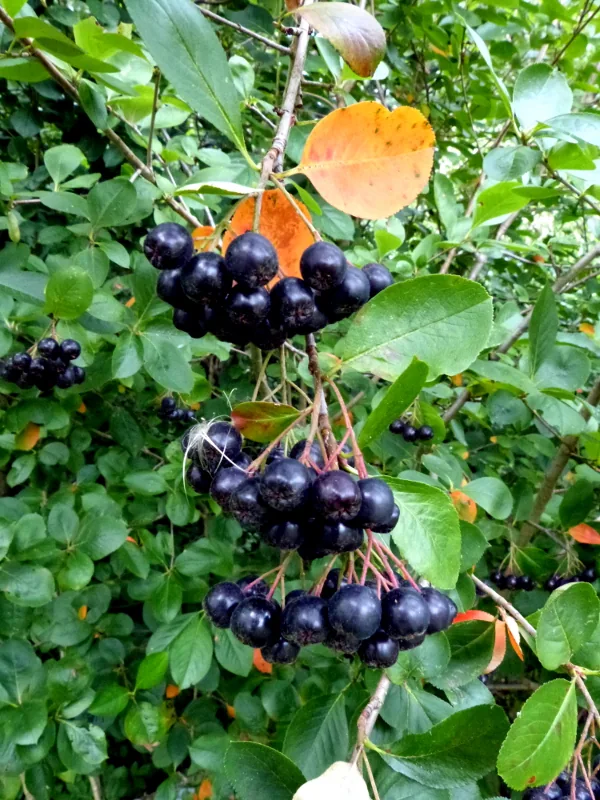
Black chokeberry is a native shrub valued for multi-season interest and dark, edible fruit. White corymbs open in spring, glossy foliage persists through summer, and the leaves develop strong red and purple autumn color. The blackish-purple pomes mature in late summer and remain on the plant well into winter.
It sits in the rose family, Rosaceae, and is unrelated to chokecherry despite the recurring confusion between the two. The distinction is significant, because chokecherry is toxic and chokeberry is not. Aronia fruit is edible and high in antioxidants, merely strongly astringent when raw, which is why it is generally processed into juice, jam, or jelly.
Few shrubs match its tolerance range. It withstands cold to -40°F (-40°C), accommodates both saturated and droughty conditions, and grows across sandy, loam, and clay soils. The one trait to anticipate at planting is its suckering habit, since the root system spreads to form a colony when left unchecked.
Care
The short version: full sun maximizes fruiting and autumn color, soil should be ordinary to moist and on the acidic side, and cultural input is minimal once the shrub is established.
Light
Site it in full sun to maximize fruit set and the intensity of autumn color, both of which are light-dependent. Partial shade is tolerated and the plant continues to grow, but flowering and the resulting berry crop decline as light diminishes.
Water
Provide consistent, medium moisture to optimize fruiting and bloom, since reproductive performance responds to steady water. Beyond that the species is highly adaptable, withstanding saturated, boggy ground and occasional drought once established, so an irrigation interval of every 5 to 10 days suits most plantings.
Soil
It performs across sand, loam, and clay, from poorly drained to well drained, and tolerates compacted and saline conditions. Its preference is acidic, around pH 5.1 to 6.5, but it accommodates higher values, so most garden soils are adequate.
Temperature
This is an exceptionally hardy shrub, rated for USDA zones 3 to 8 and unaffected across the range -40°F to 95°F (-40°C to 35°C). Cold tolerance is not a limiting factor for chokeberry.
Humidity
Ambient outdoor humidity suffices, so no target value applies. Air circulation is the more relevant variable, because congested, persistently damp foliage predisposes the plant to occasional leaf spot.
Feeding
It is a low feeder that frequently requires no supplementation. On nutrient-poor soils, a single spring application of balanced granular fertilizer meets its needs.
Pruning
Because it flowers on old wood, carry out shaping immediately after bloom to preserve next year's buds. Renewal-prune by cutting the oldest stems to the base periodically, and remove root suckers to contain colony expansion.
Repotting
Container specimens seldom require repotting. Pot on only when roots circle the container, water passes through with little uptake, or new growth becomes stunted.
Size & spacing
Mature dimensions are 3 to 8 feet (91 to 244 cm) in height and 2 to 6 feet (61 to 183 cm) in spread. Allow each shrub sufficient room to develop and to maintain air movement, with additional allowance where colony formation by suckering is intended.
When to plant
Chokeberry follows a predictable phenology. The white flowers open in May and June, the dark fruit matures from August into September and persists through winter, and the optimal planting windows are spring after the last frost or early autumn.
Northern hemisphere
Southern hemisphere
Typical months for a temperate climate: start earlier in warm zones, later where spring frosts linger.
- Sow: Late winter, after 2-3 months of cold moist stratification of cleaned seed
- Plant: Spring after last frost, or early fall
- Harvest: White flowers in spring (May to June); blackish-purple fruit ripens late summer to early autumn (August to September) and persists into winter
Hardiness
USDA hardiness zones: 3–8
Temperature: down to -40°C
Troubleshooting
Chokeberry presents few genuine problems, and the issue most often encountered is its own colonizing habit rather than any pest. Inspect foliage and twigs periodically for occasional fungal disease, and confirm the diagnosis below before pruning.
Twig tips and developing fruit blackening and dying back
Blackened shoot tips and shriveled berries, frequently with cankers at the point of dieback, signal a twig and fruit blight of fungal origin. Prune well into healthy wood below the affected tissue and destroy the prunings, since the cankers harbor the pathogen, and disinfect the blade between cuts to avoid transmitting it along the plant. A vigorous, adequately spaced specimen resists the disease most effectively.
Fix:
- Prune out and destroy blighted twigs well below affected tissue
- Clean pruning tools between cuts
- Remove and discard infected fruit
Colony of new stems forming around the parent shrub
The mechanism here is root suckering, an adaptive growth strategy rather than pathology. The species pushes out horizontal lateral roots that produce adventitious shoots at intervals, the same process that lets it colonize ground in the wild. Excise the suckers at the root when young, sever the lateral runners by mowing or shallow cultivation, or specify a reduced-suckering cultivar where a defined form is required.
Fix:
- Dig or cut out unwanted suckers at the root as they appear
- Mow or shallow-cultivate around the planting to sever spreading shoots
- Choose a reduced-suckering cultivar for formal landscapes
Brown to purple lesions developing on the foliage
These lesions indicate fungal leaf spot, which establishes where persistent leaf wetness and stagnant air inside the canopy give spores time to germinate. Lesions begin discrete and coalesce as the season advances, and heavily infected leaves abscise prematurely. Remove and dispose of the fallen leaves to break the inoculum cycle, thin congested stems to restore air movement, and irrigate at the root zone so the foliage dries.
Fix:
- Rake up and dispose of fallen infected leaves
- Improve air circulation by thinning crowded stems
- Avoid overhead watering that wets the foliage
Toxicity
The verdict is favorable: all parts of black chokeberry are non-toxic. The fruit is edible for people and a valued wildlife resource, with no toxic principle affecting pets or livestock. The single meaningful caution is nomenclatural, so the shrub should not be conflated with the unrelated, toxic chokecherry.
Safe for
People · Cats · Dogs · Horses · Rabbits · Livestock · Birds
Cats Safe
The tissues contain no compound toxic to cats. Ingestion may provoke transient drooling or mild gastric upset, the nonspecific response to any indigestible plant matter, but no toxic principle is involved.
Dogs Safe
Dogs face no toxic hazard from this shrub. The pronounced astringency of the fruit deters most ingestion, and a large quantity may produce a brief loosening of the stool, yet no poison is present.
Horses Safe
Equines can graze the foliage and fruit without adverse effect. The clinically important distinction is from chokecherry, an unrelated species whose wilted leaves and pits are genuinely hazardous to horses.
Rabbits Safe
Rabbits browse chokeberry without injury to themselves. They may remove young shoots and strip bark over winter, a horticultural concern for the shrub rather than a health concern for the animal.
Livestock Safe
Cattle, goats, and sheep can graze the plant safely. It lacks the cyanogenic glycosides that render its chokecherry namesake a documented risk to grazing animals.
Birds Safe
Avian foragers benefit from the fruit, which is nutritious. Because the berries persist on the plant into winter, species such as thrushes and waxwings draw on them when other forage is scarce.
People Safe
The ripe fruit is edible and valued for its antioxidant content. Its raw astringency is marked, which accounts for the usual practice of processing the berries into juice, jam, or jelly.
No special handling precautions are required. Do not confuse this plant with chokecherry (Prunus virginiana), an unrelated plant whose foliage and seeds are cyanogenic.
Varieties
Several named selections merit attention, distinguished by heavy fruiting, pronounced autumn color, or reduced stature for restricted sites.
Viking
A compact, heavy-yielding clone grown commercially for its abundant, large-fruited crop.
Autumn Magic
Selected for glossy foliage and an autumn coloration that develops intense red and purple.
Iroquois Beauty (Morton)
A dwarf cultivar maturing at roughly 2 to 3 feet in height, suited to confined planting positions.
Ground Hog (UCONNAM012)
An exceptionally low, spreading selection that functions effectively as a ground cover.
How to propagate
Chokeberry propagates readily, and the abundant rooted suckers make division the most straightforward method available.
Stem cuttingsModerate
Summer, taking softwood cuttings in about July · 4 to 8 weeks to root, then one season to establish
Softwood cuttings collected in midsummer, near July, root reliably, and treatment with rooting hormone improves rooting percentage. Held under high humidity to limit transpirational loss, they initiate roots within 4 to 8 weeks and then require the subsequent season to establish.
DivisionEasy
Early spring or fall · One growing season
Because the species suckers freely, those rooted suckers make division the most efficient method. In early spring or fall, detach a rooted sucker from the parent crown, replant it, and it establishes within a single growing season.
SeedModerate
Sow after cold stratification; outdoors in fall or indoors in late winter · Several weeks to germinate after stratification; 2 to 3 years to fruiting
Extract and clean the seed from ripe fruit, then satisfy its dormancy with 2 to 3 months of cold, moist stratification before sowing outdoors in fall or indoors in late winter. Germination follows the chilling period by a few weeks, but fruiting is delayed 2 to 3 years, making seed the slowest route to a productive plant.
Myths
Black chokeberry is poisonous like chokecherry, so the berries should never be eaten.
The confusion stems from nomenclature; black chokeberry is taxonomically distinct from chokecherry, a Prunus that does sequester cyanogenic compounds in its leaves and pits. Aronia fruit is edible, though strongly astringent, and is conventionally processed into juice, jam, and jelly. The common name refers to the puckering sensation of the raw fruit, not to any toxic property.