Shrub · Rosaceae
Common Ninebark
Physocarpus opulifolius
A cold-hardy native of the rose family, grown for exfoliating bark and pigmented foliage on a shrub that demands little.
Full sun
Every 7–14 days
USDA 2–8
5–8 ft · 1.5–2.4 m
Overview
Physocarpus opulifolius ranks among the most adaptable ornamental shrubs available to temperate gardeners. Native to eastern North America and placed in the rose family, it withstands winter cold to zone 2, tolerates drought once established, and grows across a broad range of soil textures. The common name derives from the bark that exfoliates in thin papery strips, a feature that gives the mature stems structural interest through winter.
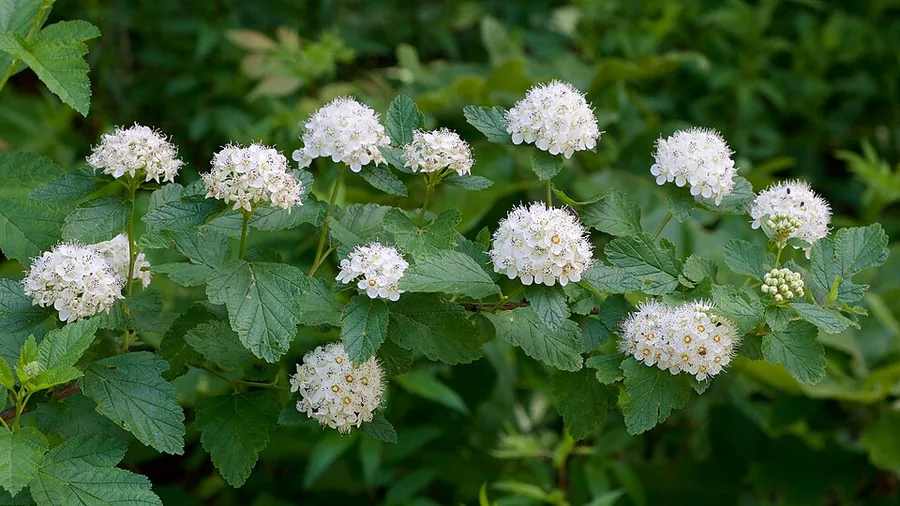
Modern demand rests on the foliage. Selection has produced cultivars in deep purple, gold, copper, and wine-red, complemented by corymbs of small white-to-pink flowers in late spring. In the darker and golden forms the pigmented leaves hold ornamental value from bud break to leaf fall.
The species is fast-growing and vigorous, and it performs best given space and direct sun. Sited with adequate air movement it is largely self-sufficient, whereas planting in damp shade predisposes it to powdery mildew. Correctly placed, it functions as a low-maintenance structural shrub that holds its position in a planting for years.
Care
The short version: site it in full sun to develop leaf pigment fully, plant in average well-drained soil it readily adapts to, and irrigate only through the establishment season. Thereafter it is drought tolerant, needs minimal feeding, and requires a single annual pruning timed immediately after flowering.
Light
Ninebark performs best in full sun, where the purple and gold cultivars develop and retain their pigment most fully. It will grow in partial shade, but reduced light dilutes leaf color and, by slowing the drying of foliage in still air, raises the likelihood of powdery mildew.
Water
Irrigate a newly set plant on a regular schedule through its first growing season to establish the root system. Once rooted it is genuinely drought tolerant and needs supplemental water only during extended dry periods. Allow the top half of the soil profile to dry between waterings, roughly every 7 to 14 days.
Soil
This shrub is indifferent to soil type. It grows best in average, well-drained soil but adapts to clay, loam, sand, rocky, dry, and even wet ground. It accepts a broad pH from 5.5 to 8.0, so most garden soils support it without amendment.
Temperature
Ninebark is exceptionally cold-hardy, tolerating winter minima near -51°F (-46°C) and summer maxima to 100°F (38°C). That envelope corresponds to hardiness zones 2 through 8, which accounts for its frequent use in cold-climate landscapes.
Humidity
Ambient outdoor humidity is not a limiting factor in itself, and no target range applies. Air movement is the operative variable, because crowded, stagnant conditions keep foliage damp and favor powdery mildew.
Feeding
As a tough native, this shrub seldom requires fertilizer. Where growth is genuinely weak, apply a light dose of balanced fertilizer in early spring and no more. Excess nitrogen forces soft, succulent shoots, precisely the tissue fireblight colonizes most readily.
Pruning
Prune immediately after flowering and no later than mid-August, because the next season's flower buds are set on old wood and a later cut removes them. To renovate an overgrown, leggy specimen, cut it close to the ground in winter and allow it to regenerate.
Repotting
Ninebark is a landscape shrub and rarely needs potting on. In the exceptional case of container culture, pot up when roots circle the container, emerge from the drainage holes, or water begins passing straight through.
Size & spacing
Allow for a substantial shrub, 5 to 8 feet (152 to 244 cm) in height with a spread of 4 to 6 feet (122 to 183 cm). Provide that full width so air circulates through the canopy, which reduces the leaf wetness mildew depends on.
When to plant
Ninebark is fully hardy and offers a wide planting window. Install new plants in spring or fall while temperatures are moderate, expect the white-to-pink flowers in late spring, roughly April through June, after which the pigmented foliage carries the ornamental interest for the balance of the season.
Northern hemisphere
Southern hemisphere
Typical months for a temperate climate: start earlier in warm zones, later where spring frosts linger.
- Plant: Spring or fall
- Harvest: Late spring (April to June)
Hardiness
USDA hardiness zones: 2–8
Temperature: down to -46°C
Troubleshooting
Ninebark is a low-problem shrub, and the issues that do arise are largely foliar rather than systemic. The few worth recognizing trace to crowding and stagnant, humid air. Match the symptom below and intervene before it establishes.
Shoot tips turn black and curl as if scorched
The cause is fireblight, the bacterial disease Erwinia amylovora, which kills shoot tips from the growing point down and leaves them blackened and bent into a shepherd's crook while still attached. Cut back well below the visible damage, since the bacteria travel ahead of the symptoms in the wood, and disinfect between cuts so the blade does not carry them to healthy tissue. Destroying the prunings rather than composting them removes the inoculum; withholding nitrogen and pruning in dry weather deny the pathogen the soft growth and moisture it exploits.
Fix:
- Prune out blighted wood well below visible damage
- Disinfect pruning tools between cuts
- Destroy removed material; do not compost
White, dusty film coating the leaves and shoot tips
The culprit is powdery mildew, a fungus that establishes where shade holds and air stagnates, which is why dark-leaved cultivars in still corners suffer most. Thinning crowded stems restores the air movement that dries leaf surfaces and denies the fungus its damp, sheltered footing. Removing the worst leaves and moving the shrub into full sun completes the correction; the infection is disfiguring but seldom does lasting harm.
Fix:
- Improve air circulation by thinning crowded stems
- Remove and dispose of badly infected foliage
- Site or move plants into full sun
Dark spots and blotches scattered across the leaves
These lesions are fungal leaf spots, whose spores need a wet leaf surface to germinate, so they build up where crowding keeps foliage from drying. The damage is confined to the leaf tissue and does not threaten the plant. Clearing fallen leaves removes the overwintering spores, wider spacing speeds drying, and watering at the base keeps the foliage dry enough to interrupt the cycle.
Fix:
- Rake up and dispose of fallen infected leaves
- Improve spacing and airflow
- Avoid wetting foliage when watering
Toxicity
The safety profile is clear. Ninebark is absent from the ASPCA poison lists and is regarded as non-toxic to pets, livestock, and people. The most that ingestion of a large quantity would produce is a brief, mild gastric upset, consistent with overconsumption of any leafy material.
Safe for
People · Cats · Dogs · Horses · Rabbits · Livestock · Birds
Cats None
Ninebark carries no toxin of concern to cats and is absent from the ASPCA poison list. Any reaction to a chewed leaf amounts to mild mechanical irritation, a little drool or a passing stomach upset, no different from ingesting other foliage.
Dogs None
Ninebark presents no poisoning hazard to dogs. A large quantity of foliage may loosen the stool for a short time through sheer bulk, but the shrub holds no compound that would cause true toxicity.
Horses Safe
Horses pastured beside ninebark are unaffected, as the shrub contains no toxin documented to harm them. Its woody stems also offer little to a grazing horse, which limits intake in practice.
Rabbits Safe
Ninebark is non-toxic to rabbits, domestic or wild. They commonly browse the soft young shoots, and the foliage is digested without adverse effect.
Livestock Safe
Cattle, goats, and sheep graze safely around ninebark because it contains no compound toxic to ruminants. A goat may strip the tender growth without consequence.
Birds Safe
Ninebark poses no toxic risk to birds. Many species take the dry seed capsules through winter and nest within the dense branching, using the shrub for forage and shelter.
People Safe
Ninebark carries no poisoning risk for people. It is not a culinary plant, so ingestion is unlikely, but an incidental taste produces no harmful effect.
No special handling precautions are required; wear gloves when pruning if you have sensitive skin.
Varieties
The trade is dominated by colored-leaf cultivars rather than the green species. The following are the selections most often encountered, grouped by the foliage character for which they are grown.
Diabolo
The original dark-leaved selection, its deep purple foliage the standard by which the others are judged, though it can shift toward green under prolonged summer heat.
Dart's Gold
Defined by bright golden-yellow leaves whose pigment develops most fully in full sun, fading in shade.
Summer Wine
A more compact selection bearing dark wine-red foliage that sets off its white-to-pink flowers.
Coppertina
Its emerging growth flushes a coppery orange, then matures to red as the leaves harden off.
Amber Jubilee
Cycles through gold, orange, and amber, its foliage tones shifting as the growing season advances.
How to propagate
Ninebark can be increased by three methods, and the choice turns chiefly on whether a cultivar's leaf color must be preserved in the offspring.
Stem cuttingsEasy
Late spring to summer using softwood cuttings · 4 to 8 weeks to root
Vegetative cuttings are the only route that reproduces a named colored-leaf cultivar true to type, since they are genetically identical to the parent. Softwood or semi-hardwood material taken from late spring into summer roots in 4 to 8 weeks. It is the most reliable of the three methods.
SeedModerate
Sow in fall or after cold stratification in spring · Several weeks to germinate; seedlings of cultivars vary
Seed reproduces the wild species dependably, sown in fall or given cold stratification before a spring sowing to break dormancy, with germination spread over several weeks. Because seed recombines the parent genetics, seedlings raised from a colored cultivar will not inherit its foliage color reliably.
LayeringEasy
Spring through summer · One growing season
Layering exploits the plant's low arching branches, which root readily where they contact moist soil. Pin a branch down any time from spring through summer, allow one growing season for roots to form, then sever the rooted section from the parent.
Myths
The name ninebark means the bark peels off in exactly nine separate layers.
The common name records the ornamental bark that exfoliates in thin strips along the stems, not an anatomical layer count. Nine functions here as an old figurative expression, denoting many layers rather than a literal nine.