Shrub · Rosaceae
Cotoneaster
Cotoneaster
Drought-hardy and reliably berried red through winter, cotoneaster rewards sound siting with years of low-input performance.
Full sun
Every 7–14 days
USDA 5–7
2–3 ft · 0.6–0.9 m
Overview
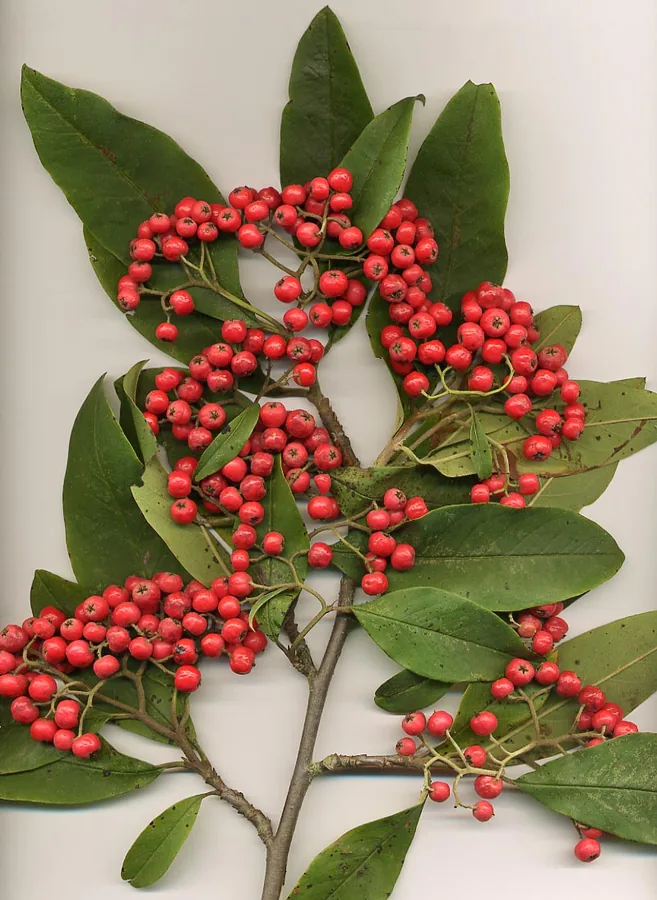
Cotoneaster is a hardy genus in the family Rosaceae, valued for its arching habit, small leaves, and the red berries that remain on the branches well after deciduous neighbors have shed their foliage. Habit ranges from prostrate groundcovers that drape a slope to upright forms exceeding human height, so a selection exists for almost any site. Small white-to-pink flowers open in late spring and attract heavy bee activity.
Its principal merit is low resource demand. It performs on poor, rocky, and dry soils, withstands cold to -20°F (-29°C), and once the root system is established it requires little supplemental irrigation. That tolerance recommends it for banks, hedging, and the difficult positions where more exacting species decline.
Two limitations qualify its reputation. Cotoneaster is highly susceptible to fire blight, and avian dispersal of the fruit has rendered several species invasive in mild-winter regions. Account for both at planting and the genus returns years of dependable color for minimal effort.
Care
The short version: site it in full sun to part shade on any free-draining soil, irrigate through the establishment season to develop the root system, and thereafter limit intervention to light formative pruning.
Light
Cotoneaster flowers and fruits most heavily in full sun, which drives the carbohydrate supply behind a dense berry set, though it accepts partial shade and partial sun with only a modest reduction in cropping. Greater light exposure yields a correspondingly heavier display.
Water
Irrigate consistently through the first growing season so the root system extends and establishes. Once established the plant is genuinely drought tolerant and draws little from supplemental water. It will not tolerate wet, poorly drained substrate, where root function fails.
Soil
Almost any free-draining soil suits it, and it accommodates clay, sand, and the impoverished or rocky ground that checks less adaptable shrubs. Target a pH of 6.0 to 7.5. Because waterlogging is the operative limitation, drainage governs success far more than fertility.
Temperature
This is a cold-hardy shrub, functional across roughly -20°F to 100°F (-29°C to 38°C). That amplitude spans a wide spectrum of climates, which accounts for its broad distribution in cultivation.
Humidity
Ambient outdoor air is adequate, so no humidity threshold applies. Air movement does matter, however, because stagnant, congested canopies favor fire blight and other foliar pathogens.
Feeding
These are vigorous shrubs that generally require little to no fertilizer on average soils. Where growth is plainly deficient, a balanced general-purpose feed in early spring suffices. Apply sparingly, since the soft, succulent tissue that excess nitrogen produces is precisely the substrate fire blight exploits.
Pruning
Cotoneaster demands only minimal pruning. Cut after flowering or in late winter to shape the plant, remove dead or crossing wood, and contain its spread. Excise any blight-infected wood as soon as it appears, disinfecting tools between cuts to prevent mechanical transmission of the pathogen.
Repotting
Cotoneaster is rarely repotted, since most specimens spend their lives in open ground. For a containerized plant, pot on when roots circle or emerge from the drainage holes, water passes through with little uptake, or growth slows, all indications of a constrained root zone.
Size & spacing
Final dimensions are taxon-dependent, but this form attains roughly 2 to 3 feet (61 to 91 cm) in height and spreads a substantial 6 to 8 feet (183 to 244 cm). Allow for that lateral extent, because crowding restricts air movement and predisposes the planting to disease.
When to plant
Cotoneaster is a long-lived woody subject established once rather than scheduled to a harvest, so timing concerns establishment, not cropping. Plant in spring or fall while the soil remains workable, after which flowering follows in late spring and red fruit develops from late summer, persisting through fall and into winter.
Northern hemisphere
Southern hemisphere
Typical months for a temperate climate: start earlier in warm zones, later where spring frosts linger.
- Plant: spring or fall
- Harvest: Flowers in late spring; red berries ripen in late summer and persist into fall and winter
Hardiness
USDA hardiness zones: 5–7
Temperature: down to -29°C
Troubleshooting
Cotoneaster is undemanding, yet a handful of disorders recur, and one of them progresses rapidly through living tissue. Inspect the current season's shoots and the foliage, because the earliest symptoms register there. Compare what you observe with the cases below and intervene early, above all where the pattern suggests blight.
Shoots blacken, die back, and hook into a shepherd's crook
The diagnosis is fire blight, a bacterial disease to which cotoneaster is highly susceptible and which advances through new growth from the apex downward. Affected shoots blacken, curl into the characteristic hook, and may exude bacterial ooze. Cut well below the visible margin into clean wood, disinfect tools between cuts, and incinerate or bin the prunings rather than composting them.
Fix:
- Prune out infected branches well below visible damage (at least 20-30 cm into healthy wood)
- Disinfect pruning tools between every cut
- Remove and destroy all infected prunings; do not compost
- Avoid heavy nitrogen fertilizing, which encourages susceptible succulent growth
Foliage stippled and bronzed with dark specks beneath
Two pests produce this symptom. Lace bugs deposit glossy black excrement on the lower leaf surface, while spider mites proliferate under hot, dry conditions and lay down fine webbing. Dislodge mites with a forceful hose, then treat the undersides with insecticidal soap or horticultural oil, repeating across the season as populations rebuild.
Fix:
- Hose down foliage to dislodge mites
- Apply insecticidal soap or horticultural oil to affected foliage, especially leaf undersides
- Repeat applications as needed during the season
Foliage webbed together and stripped to the veins
The cause is the cotoneaster webworm, whose larvae feed concealed within the silk they spin among the shoots. Prune out and destroy the webbed tips on detection. While the larvae remain small, an application of Bacillus thuringiensis or an appropriate insecticide achieves control before the population escalates.
Fix:
- Prune out and destroy webbed branch tips
- Apply Bacillus thuringiensis (Bt) or an appropriate insecticide while larvae are small
Toxicity
Regard cotoneaster as a plant to keep out of mouths. Its tissues, foliage through to the conspicuous berries, contain cyanogenic glycosides that liberate small amounts of cyanide on digestion. An isolated berry tends to provoke no more than mild gastric upset, whereas a substantial quantity can prove genuinely hazardous, so clear fallen fruit and keep pets, livestock, and young children away.
Toxic to
Cats · Dogs · Horses · Rabbits · Livestock · Birds · People
Cats Caution
In cats, a nibbled berry or leaf typically induces salivation and an episode of vomiting. Remain alert to a large ingestion, since a substantial quantity can reach cyanide concentrations that present as weakness and labored breathing.
Dogs Caution
Most dogs that take a few berries escape with gastric upset and some vomiting. The concern arises with a large ingestion, which can elicit the same cyanide effects and warrants veterinary contact.
Horses Toxic
Horses consume in bulk, which increases their exposure. A sufficient quantity of leaves or berries can liberate dangerous cyanide, manifesting as rapid respiration, ataxia, and collapse, so exclude them from the shrub.
Rabbits Toxic
The cyanogenic constituents of the foliage and fruit render cotoneaster an unsuitable and hazardous browse for rabbits. Withhold all plant parts and exclude it from areas rabbits frequent.
Livestock Toxic
Cattle, sheep, and goats can browse enough foliage or fruit to release a toxic cyanide dose. Watch for acute distress, dyspnea, and weakness, and keep the plant out of pasture and beyond reach.
Birds Caution
Wild birds consume the ripe fruit and disperse viable seed without harm, but caged companion birds are smaller and considerably more sensitive. Site cotoneaster away from them, as even a small intake can be excessive.
People Caution
No part of cotoneaster constitutes food, and the fruit is deceptively attractive. An incidental berry or two generally produces mild gastric upset, whereas a genuine quantity can elicit cyanide symptoms, so keep the fruit from young children.
Keep fallen berries picked up and discourage pets and children from eating berries or chewing foliage.
Helpline numbers

United States
ASPCA Animal Poison Control: (888) 426-4435 (fee applies)
Poison Control: (800) 222-1222



Canada
Poison Centres: 1-844-764-7669
Varieties
The genus spans a broad architectural range, from prostrate mats to tall, arching shrubs. The selections below are those most often encountered in cultivation.
Cotoneaster horizontalis (Rockspray Cotoneaster)
A prostrate spreader reaching only 2 to 3 feet in height yet extending 6 to 8 feet across, arranging its branches in the flat fishbone configuration from which its name derives.
Cotoneaster franchetii (Orange/Gray Cotoneaster)
An upright, largely evergreen shrub of 6 to 10 feet bearing orange-red fruit, noted for naturalizing beyond cultivation in mild-winter regions.
Cotoneaster salicifolius (Willowleaf Cotoneaster)
A larger, arching shrub distinguished by its elongated, narrow willow-like leaves and the dense clusters of red berries it produces.
Cotoneaster dammeri (Bearberry Cotoneaster)
A prostrate evergreen that roots adventitiously as it spreads across the ground, a trait that suits it to slope stabilization and soil retention.
How to propagate
Three accessible routes exist, and one proceeds without any intervention. Select according to how quickly you want an established plant and how much input you are prepared to commit.
Stem cuttingsModerate
Summer · Several weeks to root; one or more seasons to establish
Collect semi-hardwood cuttings in summer and root them under warm, humid conditions. Rooting occurs over several weeks, but allow a season or more before the young plant is fully established.
SeedModerate
Fall · One or more seasons; seed needs stratification and germination is slow
Birds accomplish most of this dispersal, consuming the berries and depositing seed widely. To propagate deliberately, sow in fall and supply a cold period, since stratification is the trigger that breaks dormancy. Anticipate slow, uneven germination and a season or more for a seedling to develop.
LayeringEasy
Spring to summer · One season or more to root where stems touch the soil
This is the lowest-effort method. The low, spreading branches root spontaneously wherever they contact moist soil, so from spring through summer a stem can be pinned down and left to root over a season or more before severance from the parent.
Myths
Cotoneaster berries are deadly, and a single one will seriously harm a pet.
The fruit is only mildly toxic. A cat or dog that ingests a few normally suffers nothing worse than gastric upset, and a considerable quantity is required before the cyanogenic compounds reach a hazardous concentration. Dose, not the individual berry, determines the risk.
Cotoneaster is pest- and disease-free, so it never runs into serious trouble.
Its low-maintenance standing is deserved but not absolute. Cotoneaster is highly susceptible to fire blight, and lace bugs, webworm, spider mites, leaf spot, and canker each affect it under the right conditions.