Shrub · Rosaceae
Flowering Quince
Chaenomeles speciosa
As one of the earliest shrubs into bloom, flowering quince colors bare branches before foliage breaks.
Full sun
Every 7–14 days
USDA 4–8
6–12 ft · 1.8–3.7 m
Overview
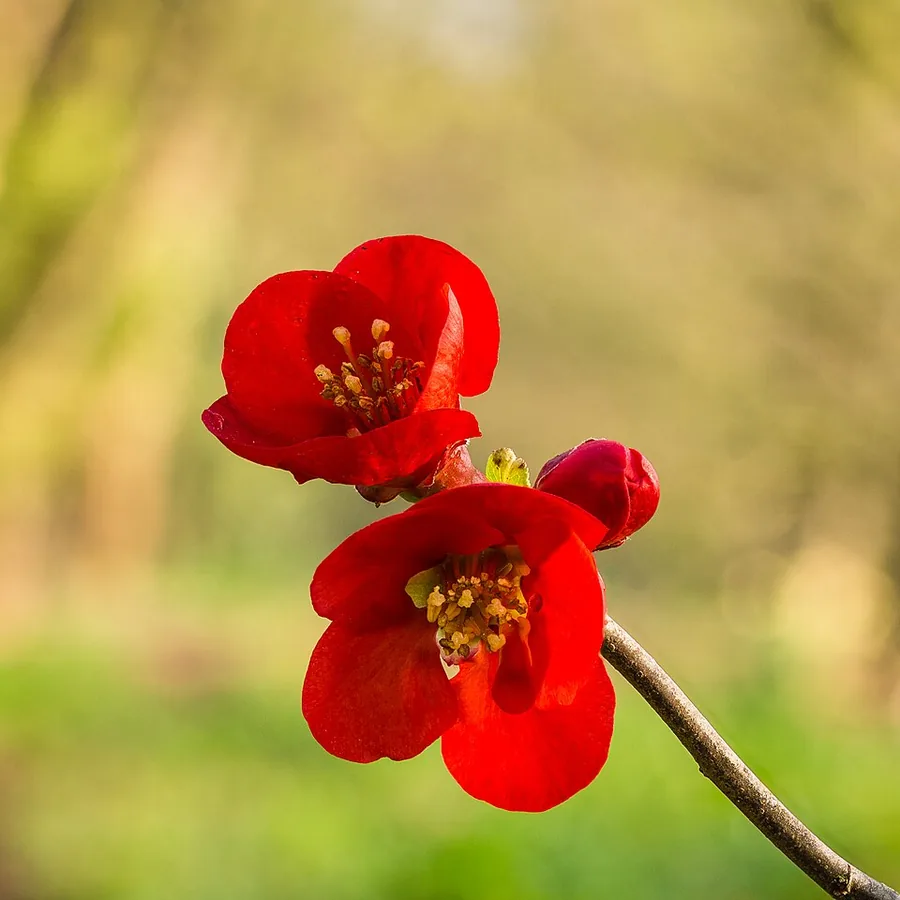
Flowering quince is a hardy deciduous member of Rosaceae that flowers in early spring, frequently ahead of leaf-out. Its red, pink, orange, and white blooms open along thorny stems with proven cold tolerance to -29°F (-34°C). Pollinated flowers give way to a hard, apple-like pome that matures through fall.
The shrub is undemanding because its tolerances are broad. Growth is moderate, building a dense, 6 to 12 foot (1.8 to 3.7 m) mound over time, and once the root system is established the plant is mildly drought tolerant. It accepts clay, sand, and rocky substrates, but alkaline soil is the limiting factor: a high pH locks up iron and produces chlorotic new foliage.
Those armed stems, the reason gloves are needed at pruning, also make flowering quince an effective barrier hedge, dense enough to deter foot traffic while offering nesting cover to birds. Site it with room to spread and away from circulation routes, and the only routine input it requires is a single prune as the flowers fade.
Care
The short version: full sun to part shade, well-drained soil held acidic to neutral, and supplemental water reserved for prolonged dry spells once established. Prune immediately after flowering, because the following season's buds are borne on old wood.
Light
Site it in full sun to maximize flower production, though it performs acceptably in partial sun or partial shade. Bloom density scales with light, so the sunniest position yields the heaviest spring display.
Water
During establishment, irrigate every 7 to 14 days to maintain medium soil moisture. Once the roots are established the plant becomes mildly drought tolerant and needs supplemental water only through extended dry periods.
Soil
Plant into well-drained loam, though clay, sand, and rocky soils are all tolerated. Hold the pH between 5.5 and 7.0, acidic to neutral, since alkalinity induces iron chlorosis and yellows the new foliage.
Temperature
This is a cold-hardy shrub functional across -29°F to 95°F (-34°C to 35°C). Its winter resilience is precisely why it refoliates and flowers so early each spring.
Humidity
Ambient outdoor humidity satisfies the plant entirely, so no target value applies. Air circulation is the operative factor, because congested, persistently wet branches create the microclimate that leaf spot and scab require.
Feeding
Apply a balanced slow-release shrub fertilizer or compost in early spring, once per season. Restrain nitrogen, because excess drives the succulent growth that both fire blight and aphids preferentially colonize.
Pruning
Prune right after flowering, since the buds are set on old wood and later cuts sacrifice the next season's flowers. Remove dead, diseased, or crossing wood, shape conservatively, and excise root suckers promptly to limit lateral spread.
Repotting
An in-ground specimen never needs repotting, and container plants are upsized only rarely. Upgrade the pot when roots circle the drainage holes, water passes through with little uptake, or a containerized plant ceases growth.
Size & spacing
Mature dimensions reach 6 to 12 feet (1.8 to 3.7 m) in height and 6 to 10 feet (1.8 to 3 m) in spread. Allocate that full footprint so air moves through the dense, thorny canopy and disease pressure stays low.
When to plant
Because flowering quince initiates buds on old wood, its management calendar follows from that single fact. Plant in spring or fall, expect bloom in early spring before the canopy expands, and confine pruning to the brief interval after flowering. The hard pome develops afterward and ripens through fall.
Northern hemisphere
Southern hemisphere
Typical months for a temperate climate: start earlier in warm zones, later where spring frosts linger.
- Plant: Spring or fall
- Harvest: Blooms early spring (roughly March to April), often before leaves emerge; hard apple-like fruit ripens in fall
Hardiness
USDA hardiness zones: 4–8
Temperature: down to -34°C
Troubleshooting
Most disorders of flowering quince emerge in spring, when moisture favors pathogens and flushing tissue attracts insects. Recognize the early diagnostics below and you can intervene before spread. Identify the symptom precisely, then act while control is still effective.
Blackened, hooked shoot tips appearing after spring bloom
This presentation is fire blight, a bacterial disease (Erwinia amylovora) endemic to the rose family that infects through open flowers in spring. Affected shoot tips wilt, blacken, and hook over as the dieback advances basipetally down the stem. Excise the infected wood well below visible damage in dry weather, disinfect tools with bleach or alcohol between cuts, and destroy the prunings by burning or binning rather than composting.
Fix:
- Prune out blighted wood 8 to 12 inches below visible damage during dry weather
- Disinfect pruning tools between cuts with 10 percent bleach or 70 percent alcohol
- Remove and destroy infected prunings; do not compost
Interveinal yellowing on the newest foliage
Interveinal yellowing on the newest leaves indicates iron the plant cannot mobilize, and the usual cause is alkaline soil, which flowering quince does not tolerate. Test the soil pH, and if it reads alkaline, lower it toward neutral with organic matter and elemental sulfur over time. A chelated iron application corrects the symptom in the short term while that slower amendment takes effect.
Fix:
- Test and lower soil pH toward acidic to neutral
- Apply chelated iron as a short-term correction
- Amend with organic matter and elemental sulfur over time
Leaf spotting and corky scab lesions on developing fruit
Wet springs favor fungal leaf spot and apple scab, which produce dark circular lesions on foliage and corky scabbing on the fruit, with premature defoliation in severe cases. Sanitation is the first control: remove the fallen leaves and fruit, thin crowded branches after flowering to improve airflow, and apply a labeled fungicide only when infection pressure is high.
Fix:
- Rake up and dispose of fallen infected leaves and fruit
- Improve air circulation by thinning crowded branches after flowering
- Apply a labeled fungicide in spring if infection is severe
Twisted young growth bearing honeydew and soft-bodied insects
Flushing shoots attract aphids, and bumpy scale may colonize the stems and twigs as well. Both excrete honeydew that supports black sooty mold. Dislodge aphids with a strong water jet, treat the leaf undersides with insecticidal soap or horticultural oil, and target persistent scale with oil. Vigorous, unstressed plants resist infestation, whereas stressed, over-fertilized specimens are colonized most heavily.
Fix:
- Spray off aphids with a strong jet of water
- Apply insecticidal soap or horticultural oil, covering leaf undersides
- Treat persistent scale with horticultural oil
Toxicity
There is no toxicological concern with this species. Flowering quince is absent from pet poison references, and the fruit is safe once cooked. The hazard is purely mechanical: the sharp thorns can lacerate skin, so handle the plant gloved and site it clear of paths and play areas.
Safe for
People · Cats · Dogs · Horses · Rabbits · Livestock · Birds
Cats None
No toxicological risk applies to cats. Flowering quince is absent from the ASPCA toxic list, so a cat investigating the foliage will not be poisoned. The only exposure of note is mechanical injury from the thorns.
Dogs None
A dog that ingests a leaf or a fallen fruit faces no toxic effect from this shrub. The relevant hazard is the sharp thorns, which can puncture a nose or a paw.
Horses None
Horses may browse adjacent to flowering quince without toxic consequence, as the species contains no compound harmful to them. The spines are the sole concern, capable of scratching soft muzzles.
Rabbits None
Foliage ingestion presents no poisoning risk to rabbits. The thorns remain the only hazard worth noting around small, soft-skinned animals.
Livestock None
Cattle, goats, and sheep may graze beside this shrub safely, since it contains nothing toxic to them. Exclusion is warranted only on account of the dense, thorny stems.
Birds None
Neither the plant nor its fruit harms birds, and the thorny structure provides effective nesting cover. No part of the plant is toxic to them.
People None
The fruit is hard and sour raw but reduces to jams, jellies, and preserves when cooked, so no part of the plant poisons people. The thorns constitute the actual hazard, so wear gloves and long sleeves when pruning.
Stems bear sharp thorns and spines that can scratch or puncture skin, so wear gloves and long sleeves when pruning or handling, and site away from walkways and pet or play areas.
Varieties
A few cultivars merit attention, from the classic multicolor flower to modern thornless selections bred to forgo fruit. The following are the ones worth specifying.
'Toyo-Nishiki'
It produces red, pink, and white flowers simultaneously, occasionally on a single branch.
Double Take 'Pink Storm'
A thornless, fruitless selection bearing full double pink flowers of 29 to 40 petals that resemble camellias.
Double Take 'Scarlet Storm'
A further thornless, fruitless cultivar distinguished by deep double scarlet-red flowers.
Double Take 'Orange Storm'
It combines the same thornless, fruitless habit with double flowers in a warm orange tone.
How to propagate
Flowering quince propagates readily by three methods, each suited to a different timeframe and to the material the plant presents.
Stem cuttingsModerate
Mid-July to early fall for semi-hardwood cuttings · Several weeks to root, then transplant the following season
Collect firm semi-hardwood cuttings of the current season's growth from mid-July into early fall and treat the basal cut with rooting hormone to improve strike rate. Rooting takes several weeks, after which the cuttings are transplanted the following season.
LayeringEasy
Spring through summer · Roots form over a season; ready to separate the following autumn or spring
Mound layering suits this low-stemmed, densely branched shrub and can be initiated anytime from spring through summer. The buried stems root over a full season, becoming ready to sever and replant the following autumn or spring.
DivisionModerate
Dormant season (late fall to early spring) · One season to reestablish
This shrub produces rooted basal suckers that can be lifted and divided during the dormant season, late fall to early spring, to generate new plants. Each division requires roughly one season to reestablish.
Myths
Chaenomeles is toxic to household cats and dogs.
The record does not support this. Chaenomeles speciosa is absent from the ASPCA toxic-plant lists and is regarded as non-toxic to both cats and dogs. The genuine household risk is mechanical injury from the thorns, not poisoning. Contact with the stems can scratch a pet, but ingestion of a leaf poses no toxic threat.
The rock-hard, astringent fruit signals that it contains something toxic.
Hardness and astringency are not toxicity. Raw, the fruit is dense and intensely sour, which is why it is assumed inedible. Cooked, it is entirely safe to consume, and it processes well into jams, jellies, and preserves.