Vegetable · Fabaceae
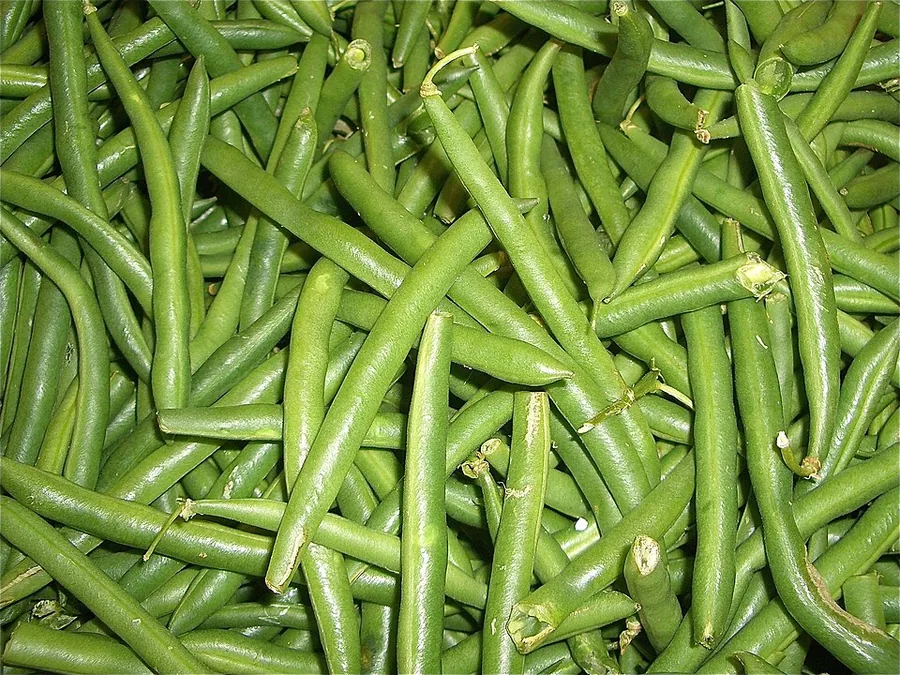
Green Bean
Phaseolus vulgaris
Warm soil and steady moisture drive weeks of tender pods from a self-feeding legume.
Full sun
Every 2–7 days
61–84°F · 16–29°C
50–65 days
Overview
Green beans rank among the most reliable crops for a new grower, largely because their biology forgives so much. The species sits in the legume family, Fabaceae, and originated in the Americas, where cultivation spans thousands of years. Sown into warm soil, the seed produces a fast, productive plant that demands little intervention.
Growth habit determines how you site the crop. Bush beans hold a low, compact form and concentrate their yield into a short window, which suits confined beds and staggered successional sowings. Pole beans climb indeterminately for weeks and continue setting pods through summer, provided a support carries the vine.
The defining trait is nitrogen self-sufficiency. Root nodules host bacteria that convert atmospheric nitrogen into a usable form, so the crop performs on lean soil that would limit heavier feeders. Sustained moisture through flowering and frequent harvest of immature pods together extend productive cropping over several weeks.
Care
The short version: full sun, warm soil, and even moisture from flowering onward. Direct-sow into the final bed, keep fertilizer light, and pick the pods young and often to prolong production.
Light
Beans require full sun, meaning at least six to eight hours of direct light daily to fuel pod production. Site them in the brightest available position, because shade produces etiolated, leggy plants and a sparse, delayed crop.
Water
Supply about 1 inch (2.5 cm) of water a week and hold the soil evenly moist, most critically through flowering and pod set when demand peaks. Direct water to the base and keep foliage dry, since leaf wetness is what allows rust and other fungi to establish.
Soil
Grow them in well-drained loam enriched with organic matter. A pH of 6.0 to 6.8, mildly acidic, suits the crop, and the free drainage of a loose soil prevents the seed from rotting before germination.
Temperature
Beans perform between 61°F and 84°F (16°C to 29°C). Soil must be warm for germination, and because a late frost kills seedlings outright, early sowing gains nothing.
Humidity
Ambient outdoor humidity suffices, so no target figure applies. Airflow governs disease far more than humidity itself, since a crowded, damp canopy is precisely where rust and other fungal problems establish.
Feeding
Because beans fix their own nitrogen, their fertility demand is minimal. A light application of balanced fertilizer at planting meets it, whereas excess nitrogen drives foliage at the expense of pods.
Pruning
No routine pruning applies. Pinch out any diseased foliage as it appears, and harvest pods frequently, since removing mature pods signals the plant to keep setting new ones.
Size & spacing
Mature height ranges from 1 to 10 feet (30 cm to 3 m) according to bush or pole habit. A spread of 8 to 18 inches (20 to 46 cm) sets the spacing each plant needs so air moves through the stand and disease pressure stays low.
When to plant
Green beans are frost-sensitive warm-season annuals, so timing turns on soil temperature rather than the calendar. Once the last frost has passed and the soil has warmed, direct-sow the seed into the garden. Harvesting tender pods every few days through summer sustains the crop.
Northern hemisphere
Southern hemisphere
Typical months for a temperate climate: start earlier in warm zones, later where spring frosts linger.
- Plant: After last spring frost when soil has warmed to at least 60°F
- Harvest: Harvest immature tender pods through summer, picking every few days
Hardiness
USDA hardiness zones: 2–11
Temperature: down to -46°C
Troubleshooting
Bean disorders declare themselves on the foliage or the pods, and close inspection usually resolves the diagnosis. Match the symptom below, then intervene while the affected area is limited. Early action is what confines a setback to a few plants rather than the whole row.
Lace-like feeding damage with larvae on the undersides
The lacy skeletonizing traces to the Mexican bean beetle, whose spiny yellow larvae and copper adults graze the soft mesophyll and leave the leaf veins behind, which is why the tissue reads as lace. The larvae and their yellow egg clusters sit on the leaf undersides, so that is where confirmation lies. Removing every adult, larva, and egg mass by hand cuts the breeding population, and clearing the spent crop after harvest denies the overwintering adults their shelter.
Fix:
- Handpick adults, larvae, and egg masses
- Apply approved insecticide if infestation is heavy
Rust-colored pustules preceding yellowing and defoliation
Raised rusty pustules that shed powdery spores under a fingertip identify bean rust, the fungus Uromyces appendiculatus. Heavy colonization destroys leaf area, which yellows the canopy and forces early leaf drop as photosynthetic tissue fails. Because the spores need leaf wetness to germinate, stripping the worst leaves, opening the spacing so foliage dries, and watering at the base rather than overhead all remove the moisture the pathogen depends on.
Fix:
- Remove and destroy infected foliage
- Apply a labeled fungicide if severe
Blossom drop and failed pod set in heat
When day and night temperatures hold past roughly 85°F to 90°F (29°C to 32°C) during bloom, the flowers abscise and no pods form. The cause is heat stress interfering with pollination and fertilization, not any pest or pathogen. Holding even soil moisture supports the plant through the stress, and pod set resumes on its own once temperatures fall back into the tolerable range.
Fix:
- Maintain even soil moisture
- Wait for cooler temperatures to resume pod set
Sunken dark lesions on the developing pods
Circular sunken lesions rimmed in dark tissue, often bearing pinkish spore masses, are diagnostic of anthracnose, caused by Colletotrichum lindemuthianum. The pathogen is seedborne, which is how it enters a clean garden, and it spreads on contact when foliage is wet. Removing and destroying affected plants and pods eliminates the inoculum, and because the fungus travels in seed, saving seed from infected plants only carries the disease into the next crop.
Fix:
- Remove and destroy infected plants and pods
- Do not save seed from infected plants
Toxicity
Green beans are a safe, edible crop, and the growing plant presents no poisoning risk to people or pets. The tender snap pods are eaten raw or cooked, and cooked beans commonly serve as a dog treat. The single caveat is that mature dry seeds must be cooked before consumption, because raw dried beans retain lectins.
Safe for
People · Cats · Dogs · Horses · Rabbits · Livestock · Birds
Cats None
The plant carries no toxin of concern to cats, so a leaf or tender pod taken by a curious animal causes no poisoning.
Dogs None
Dogs face no toxicity from the plant, and plain cooked pods are widely offered as a low-calorie treat.
Horses Safe
Horses are unaffected by bean plants, since neither the foliage nor the pods contain a toxin harmful to them.
Rabbits Safe
Rabbits can consume the leaves and young pods without poisoning, though any fresh green is best introduced in modest amounts.
Livestock Safe
Cattle, goats, and sheep can browse the plants without toxic effect, leaving the standing crop no cause for concern.
Birds Safe
Poultry and other birds can take the leaves and tender pods with no adverse effect.
People Safe
The tender snap pods are eaten raw or cooked. Only the mature dry seeds require cooking beforehand, since raw dried beans retain lectins.
Mature dry beans of Phaseolus contain lectins (phytohaemagglutinin) and should be cooked before eating, but tender immature snap pods eaten whole are not a pet-toxicity concern.
Varieties
The species includes hundreds of cultivars, yet a small set of proven names recurs across most gardens. These merit attention before you select a packet.
Blue Lake
Available in both bush and pole forms, this heavy-cropping standard produces round, tender pods that snap cleanly and lack strings.
Kentucky Wonder
A vigorous heirloom pole bean retained for its full-flavored, meaty pods.
Provider
An early bush cultivar that germinates and grows despite cool soil, which recommends it for the season's first sowing.
Contender
An early bush snap bean combining stringless pods with reliable resistance to common bean diseases.
Companions
Beans grow well with the crops that share their space without competing, and the three-sisters trio of corn, beans, and squash is the classic example. They sulk next to alliums like onions, which hold their growth back.
Plant near
Corn: Part of the traditional three-sisters planting; corn stalks provide support for climbing beans.
Squash: Three-sisters companion; squash foliage shades soil and suppresses weeds while beans add nitrogen.
Cucumbers: Cited as a compatible companion that grows well alongside beans.
Potatoes: Listed as a beneficial companion in extension companion-planting guidance.
Keep apart
Onions: Alliums such as onions and garlic are reported to inhibit the growth of beans.
How to propagate
Green beans propagate about as simply as any garden plant, entirely from seed. Sow that seed directly into the final position, since the crop tolerates transplanting poorly.
SeedEasy
Direct-sow after the last frost once soil reaches at least 60°F · Seedlings emerge in about 7-14 days under warm conditions
Direct-sow the seed into its final position once the frost date has passed and soil temperature reaches at least 60°F (16°C). Beans resent root disturbance, so transplanting is inadvisable, and sowing into cold, wet soil promotes seed rot rather than germination. Under warm conditions emergence follows in about 7 to 14 days.
Myths
Green beans must be soaked or cooked before eating, just like dry beans.
The soaking-and-cooking requirement applies to mature dry seeds, whose lectins need heat to denature. The tender immature snap pods are safe raw or lightly cooked, so the caution attached to dry beans has no bearing on the green pods harvested off the vine.
Beans need a heavy dose of nitrogen fertilizer to crop well.
Through symbiosis with rhizobia bacteria in root nodules, beans fix atmospheric nitrogen for their own use. Excess applied nitrogen drives vegetative growth at the expense of flowering, so a light feed at planting is all the crop requires.