Vegetable · Cucurbitaceae
Cucumber
Cucumis sativus
Supply full sun, warm soil, and steady water, and a cucumber vine converts that into fruit faster than most gardeners can harvest.
Full sun
Every 2–4 days
59–95°F · 15–35°C
50–70 days
Overview
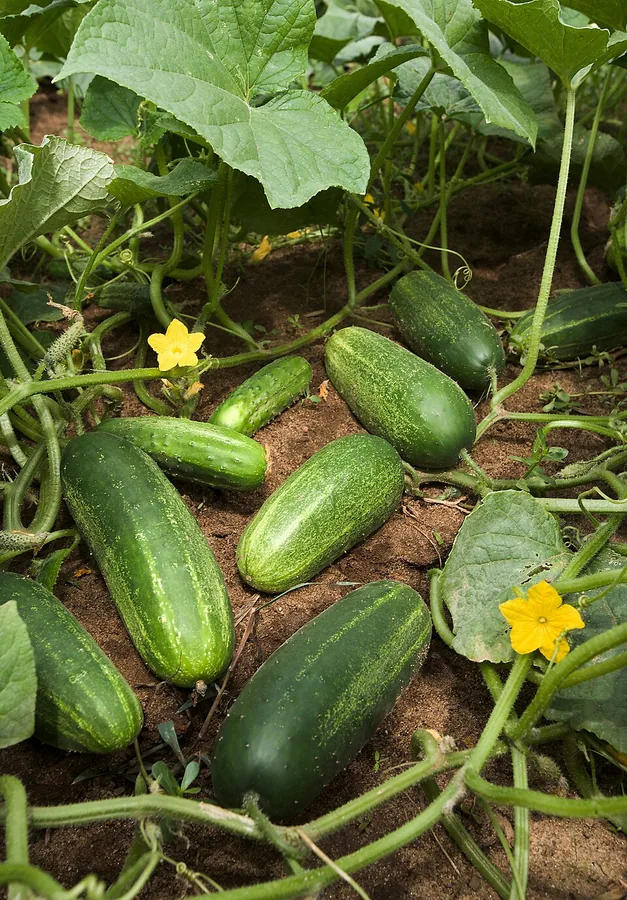
Cucumber is a fast-growing, warm-season annual in the Cucurbitaceae, the gourd family it shares with melons and squash, and growth accelerates once soil and air warm. Because the crop converts heat and light directly into vine extension and fruit, a few well-sited plants supply slicers through the season. The vine trails by default but climbs readily, and training it upward improves airflow and keeps fruit off the soil.
Two functional classes matter. Slicing types are bred long and smooth for fresh use, while pickling types run short and bumpy to suit brining. A subset of parthenocarpic cultivars set fruit without fertilization, which is useful under row covers or in cool, wet seasons when bee activity falls.
The plant's demands reduce to warmth, light, and moisture stability. When soil moisture swings between extremes the fruit accumulates stress compounds and develops unevenly, yielding bitter, misshapen cucumbers, so consistent watering carries the crop. Frequent harvest, every day or two at peak, removes the hormonal brake that maturing fruit places on further fruit set, sustaining production to frost.
Care
The short version: full sun, warm and fertile soil rich in organic matter, and even moisture near an inch a week, paired with frequent harvest so the vine keeps initiating new fruit.
Light
Cucumber requires full sun, on the order of six to eight hours daily, because photosynthate from that light fuels its rapid growth and heavy fruit load. Under partial sun yield falls and disease rises, since shaded, slow-drying foliage stays favorable to fungal infection.
Water
Maintain even soil moisture, roughly an inch of water a week from rain or irrigation, applied deeply at the base. Increase it during flowering and fruiting, when demand peaks. The dry-then-flooded cycle drives bitterness and distortion, because moisture stress disrupts uniform fruit expansion.
Soil
Use fertile, well-drained loam high in organic matter at a pH of 6.0 to 6.5, the range that optimizes nutrient availability for the crop. A raised bed or plastic mulch raises soil temperature early, which matters because this warm-season vine grows little until the root zone warms.
Temperature
Cucumber performs as a warm-season crop between 59°F and 95°F (15°C to 35°C). Germination fails below 50°F (10°C) soil, because the seed's metabolic processes do not proceed at chilling temperatures, so early sowing into cold ground is wasted.
Humidity
Ambient outdoor humidity is adequate, so no target applies. Air circulation outweighs atmospheric moisture here, because still, humid conditions among crowded leaves create the leaf-surface wetness powdery mildew exploits.
Feeding
Incorporate a balanced fertilizer such as 10-10-10 before planting to establish baseline fertility. Apply a nitrogen side-dress once the vines begin to run, since vegetative demand climbs as the canopy expands ahead of a long fruiting period.
Pruning
Cucumber needs minimal pruning. On a trellis, pinching lateral shoots redirects growth and limits congestion, and prompt removal of diseased or damaged foliage lowers inoculum and slows the spread of foliar disease through the canopy.
Size & spacing
Expect a vine only 8 to 18 inches (20 to 46 cm) in height that spreads 3 to 8 feet (91 to 244 cm) along the ground. Allow that lateral room, or trellis the plant, so air moves through the canopy and developing fruit stays clear of the soil surface.
When to plant
As a frost-tender, warm-season annual, cucumber stalls or dies in cold soil and chilling air. Hold planting until frost risk has passed and the soil reaches at least 60°F (16°C), generally mid to late May, then sow seed or set transplants. Fruiting then runs from midsummer to the first killing frost.
Northern hemisphere
Southern hemisphere
Typical months for a temperate climate: start earlier in warm zones, later where spring frosts linger.
- Sow: 2-4 weeks before the last frost (late April in northern regions); use peat or paper pots because seedlings resent root disturbance
- Plant: After all danger of frost when soil has warmed to at least 16-21°C (60-70°F), typically mid to late May; seeds will not germinate in soil below 10°C (50°F)
- Harvest: Flowers in early-to-mid summer; harvest fruit from midsummer until first frost, picking every 1-2 days to keep vines productive
Hardiness
USDA hardiness zones: 2–11
Temperature: down to -46°C
Troubleshooting
Cucumber disorders concentrate on the foliage and the fruit, because those tissues respond first to heat, moisture swings, and the pests that vector disease. Identify the symptom below and intervene early, since several causes spread through the vascular system or across neighboring leaves.
Midday vine wilt without recovery, then stem collapse
Daytime wilting that does not recover, followed by stem collapse, signals bacterial wilt, a vascular infection vectored by striped and spotted cucumber beetles as they feed. Confirm it by cutting a wilted stem, touching the cut faces together, and drawing them apart to reveal sticky, string-like bacterial ooze. The disease cannot be cured, so remove and destroy infected plants, and inspect stem bases for the frass and entry holes that distinguish a squash vine borer.
Fix:
- Remove and destroy infected plants; bacterial wilt cannot be cured
- Control cucumber beetles early in the season
- Use floating row covers on young plants, removing them at flowering for pollination
White powdery growth, then leaf yellowing and desiccation
A white, powdery coating on both leaf surfaces is powdery mildew, a fungus favored by the combination of warm days, cool nights, and crowded plantings. It establishes first on older, shaded leaves and wipes off slightly under a finger. Remove the most affected leaves, improve circulation through spacing or trellising, and site cucumbers in full sun, where conditions suppress the pathogen.
Fix:
- Remove heavily infected leaves
- Improve air circulation by spacing or trellising
- Apply a labeled fungicide at first sign if pressure is high
Skin and stem end turning bitter on the fruit
Bitterness reflects cucurbitacins, defensive compounds the plant synthesizes under heat or drought stress, which concentrate in the skin and stem end. Peeling the fruit and trimming that end removes most of the affected tissue. Prevent the response by holding moisture steady through hot spells, mulching to buffer the soil, and selecting a burpless or bitter-free cultivar.
Fix:
- Peel fruit and trim the stem end before eating
- Water consistently and mulch to even out soil moisture
Fruit forming crooked and constricted at the tip
Curled or pinched fruit indicates incomplete pollination, common after cool, rainy weather suppresses bee flight. Each cucumber requires many bee visits to fertilize enough ovules for even expansion, so a flower receiving too few sets a lopsided fruit. Remove the misshapen fruit to redirect vine resources, avoid insecticides during bloom, and plant nearby flowers to raise pollinator visitation.
Fix:
- Remove misshapen fruit so the vine redirects energy
- Avoid spraying insecticides while plants are flowering
- Maintain even watering
Toxicity
Cucumber poses no toxic risk to any household. The fruit contains nothing harmful to people, pets, livestock, or birds, so a dropped slice is of no concern. The single physical hazard is mechanical: fine prickly hairs on the stems and leaves can abrade sensitive skin during harvest.
Safe for
People · Cats · Dogs · Horses · Rabbits · Livestock · Birds
Cats None
Cucumber is safe for cats, and a slice nibbled now and then causes no harm. Because the flesh is largely water, small pieces serve well as a light treat.
Dogs None
Cucumber presents no risk to dogs, and the crunchy, low-calorie slices suit a snack. Cutting it into bite-sized pieces keeps a fast eater from swallowing a whole chunk.
Horses Safe
Horses digest cucumber well, and a few sliced pieces make a refreshing summer treat. Keep portions small alongside their normal forage, consistent with sound feeding practice.
Rabbits Safe
Rabbits may take cucumber in moderation, since it supplies little fiber and a high water fraction. A thin slice or two occasionally is appropriate next to their hay.
Livestock Safe
Cattle, goats, and sheep eat cucumbers and the trimmed vines without harm. Introduce surplus fruit gradually, because an abrupt large intake can disturb rumen digestion.
Birds Safe
Both pet birds and backyard hens consume cucumber, flesh and seeds alike. It functions as a hydrating snack, with no part of the plant excluded.
People Safe
For people, cucumber is eaten raw, pickled, or in salads, and every part of the fruit is safe. The skin and stem end of a stressed fruit can taste bitter, but that is a flavor compound, not a toxic one.
Stems and leaves bear slightly prickly hairs that can irritate sensitive skin; gloves are optional when harvesting spiny-fruited varieties.
Varieties
Cucumber cultivars divide chiefly into slicing and pickling lines, with selected compact and parthenocarpic types added in. The names below cover the entries a grower meets most.
Marketmore 76
A standard slicing cultivar valued for durability, carrying strong resistance to scab and cucumber mosaic virus.
Straight Eight
An heirloom slicer that yields straight, dark green fruit averaging about 8 inches in length.
Boston Pickling
A productive heirloom pickling type bearing short, blocky fruit with characteristically bumpy skin.
Spacemaster
A compact bush selection suited to the limited footprint of small gardens and containers.
Diva
A parthenocarpic, seedless cultivar that sets fruit without pollination and produces thin, non-bitter skin.
Companions
Cucumbers do well beside beans, corn, and quick radishes, and poorly next to potatoes or strongly aromatic sage that extension guides flag as bad neighbors.
Plant near
beans: Extension companion-planting guides list beans as a traditional cucumber companion; legumes fix nitrogen that benefits neighboring crops.
corn: Listed as a compatible companion in extension guides; tall corn can also serve as a windbreak and partial support.
radish: Traditional extension-listed companion; quick-maturing radishes use space efficiently between young cucumber plants.
How to propagate
Cucumber is propagated almost exclusively by seed, the practical method for an annual cucurbit. Success rests on warm soil for germination and on minimizing root disturbance, because the species establishes poorly when its roots are broken.
SeedEasy
Direct sow after the last frost once soil reaches at least 16°C (60°F), or start indoors 2-4 weeks before transplanting · Seeds germinate in 3-10 days in warm soil; transplants establish within 1-2 weeks
Seed is the standard and reliable means of growing cucumber, and few gardeners propagate it any other way. Direct sow after the last frost once soil reaches at least 60°F (16°C), placing seed 0.5 to 1 inch (1.5 to 2.5 cm) deep in hills or rows, after which emergence follows in 3 to 10 days in warm soil. For an earlier crop, sow indoors 2 to 4 weeks before transplanting in peat or paper pots, because the root system resents disturbance and transplants require a week or two to establish.
Myths
Cucumbers sited near squash or melons hybridize with them and lose their flavor.
Cucumber cannot hybridize with melons or squash, which are separate species, so an adjacent crop cannot influence cucumber flavor. Off-flavors instead arise from cucurbitacins produced under heat and drought stress within the plant itself. Even cross-pollination among cucumber cultivars affects only the genetics of the seed, not the phenotype of the current season's fruit.
Bitterness in a cucumber signals spoilage and makes it hazardous to consume.
Bitterness is cucurbitacin accumulation in the skin and stem end of a stressed fruit, a stress response rather than spoilage or contamination. Peeling the cucumber and trimming the stem end removes most of the compound, leaving the remaining flesh palatable.