Vegetable · Cucurbitaceae
Summer Squash
Cucurbita pepo
Give it full sun, rich soil, and steady water, and summer squash sets fruit heavily from midsummer on.
Full sun
Every 2–4 days
59–95°F · 15–35°C
45–55 days
Overview
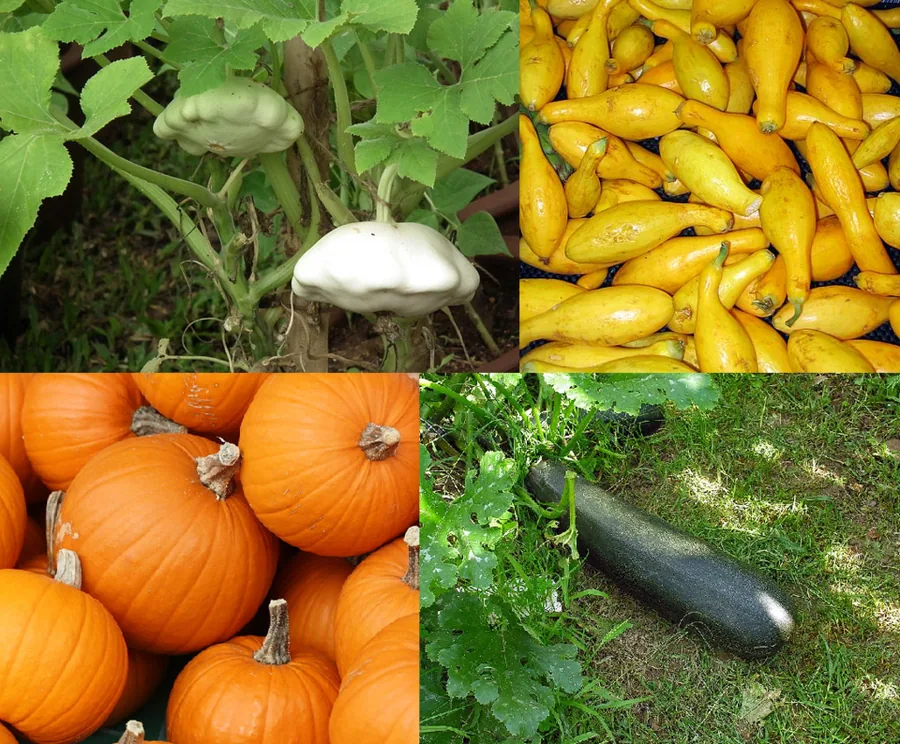
Summer squash is an easy, productive entry crop, and it repays a beginner with more fruit than one household can use. A member of the gourd family, it includes the yellow crookneck, the straightneck, the saucer-shaped pattypan, and zucchini, all cultivars of a single species, Cucurbita pepo. Unlike the winter squashes harvested at full maturity, it is picked immature, while the rind is still tender enough to eat whole.
The plants are fast-growing and bush-form rather than trailing, reaching 18 to 35 inches (45 to 90 cm) in height with a broad spread. Each plant bears separate male and female flowers, so fruit set depends on insect pollinators moving pollen between them, and a planting with strong bee activity yields most heavily. Because development is quick, a fruit left unharvested for only a few days grows oversized and coarse.
The crop demands little technical skill but does require consistent attention. Frequent harvest, even soil moisture, and early scouting for borers and squash bugs are the practices that carry a couple of plants through a full season of production.
Care
The short version: full sun, fertile soil held evenly moist, and frequent harvest. Supply about an inch of water a week, feed once at planting, and cut fruit young, since removing it signals the plant to keep setting more.
Light
Summer squash requires full sun, defined as 6 or more hours of direct light daily. Below that threshold the plant stretches and grows leggy, and flowering and fruit set both fall off.
Water
Hold the soil evenly moist to a depth of about 6 inches, which corresponds to roughly an inch of water per week. Morning watering directed at the root zone keeps the foliage dry and limits the leaf wetness that powdery mildew needs. Demand peaks during fruit set and swelling, the stage at which moisture stress does the most damage.
Soil
Grow it in fertile, well-drained loam amended with compost or aged manure. The preferred range is a pH of 6.0 to 6.5, and the high organic matter supplies the nutrients this heavy feeder draws down through the season.
Temperature
Summer squash performs within a band of roughly 59°F and 95°F (15°C to 35°C) and is injured by frost at either end of the season. Because germination and growth follow soil temperature, holding off until the ground warms avoids a stalled, vulnerable start.
Humidity
Ambient outdoor humidity is adequate, so no target level applies. The more important factor is air circulation, since still, humid conditions around crowded foliage favor powdery mildew.
Feeding
Incorporate a balanced fertilizer such as 5-10-10 before planting, then apply a nitrogen sidedress once the vines are established. Keep the nitrogen moderate, because an excess drives vegetative growth at the expense of fruit.
Pruning
Routine pruning is unnecessary. Remove diseased or mildewed foliage as it appears to slow spread, and harvest often, since regular fruit removal is what sustains continued production.
Size & spacing
Mature plants stand 18 to 35 inches (45 to 90 cm) tall and spread 2 to 4 feet (60 to 120 cm). Thinning seedlings to 12 to 15 inches apart opens the canopy to airflow, which suppresses the humidity that powdery mildew exploits.
When to plant
Summer squash is a frost-tender warm-season annual whose growth tracks soil temperature closely. Sow indoors a few weeks before the last frost to gain a head start, or direct-sow once the ground warms, since cold soil stalls germination. Transplant after frost, and expect fruit from midsummer through the rest of the season.
Northern hemisphere
Southern hemisphere
Typical months for a temperate climate: start earlier in warm zones, later where spring frosts linger.
- Sow: 2 to 4 weeks before the last spring frost
- Plant: After the last frost when soil reaches 60-70°F at planting depth
- Harvest: Harvest fruit when young and tender: crookneck/straightneck at 1.5-2 in diameter, scallop at 3-4 in diameter
Hardiness
USDA hardiness zones: 3–11
Temperature: down to -40°C
Troubleshooting
Summer squash problems concentrate on three tissues, the stems, the leaves, and the fruit, and the stem borers in particular can kill a plant within a day. Reading the early symptoms lets you intervene while the tissue is still viable. Match the sign below to its cause, then treat it before the damage spreads.
Rapid wilting with frass at the stem base
The cause is the squash vine borer, whose larva bores into the stem and severs the vascular tissue that carries water upward, producing sudden collapse. Its entry point sits low on the stem and exudes moist, sawdust-like frass. Slit the stem lengthwise, extract the white larva, and mound soil over the wound so the vine can form roots above the injury and resume uptake.
Fix:
- Slit the stem and remove the larva, then mound soil over the wound to encourage rooting
- Remove and destroy severely infested vines at season end
White powdery growth advancing across the foliage
This is powdery mildew, a fungus that establishes late in the season under warm days and cool nights. The white colony rubs partly off the surface, and the tissue beneath yellows and declines as the infection progresses. Remove the most affected leaves, improve airflow through the canopy, and apply a labeled fungicide only if the spread continues.
Fix:
- Remove and dispose of heavily infected leaves
- Apply a labeled fungicide if needed and improve air circulation
Yellow-speckled, wilting leaves with brown insects and bronze eggs below
The agents are squash bugs, shield-shaped insects that feed on sap and leave the foliage speckled and wilting. On the leaf undersides you will find the adults together with clusters of bronze eggs laid in the angles of the veins. Crush the egg masses, hand-pick the adults, and clear overwintering debris to reduce the population that returns the following year.
Fix:
- Hand-pick adults and crush egg masses
- Remove plant debris where bugs overwinter
Dark, sunken decay at the fruit's blossom end
The disorder is blossom end rot, a physiological problem rather than a pest, caused by inadequate calcium uptake when soil moisture fluctuates. It begins at the blossom end and turns dark and leathery. Water on a consistent schedule, mulch to buffer soil moisture, and hold back on nitrogen and potash.
Fix:
- Maintain even soil moisture and mulch
- Avoid over-application of nitrogen and potash
Toxicity
For a household with pets or children, summer squash carries no toxic principle. Its fruit, flowers, and seeds are edible, and the leaves and vines hold nothing that harms cats, dogs, livestock, or people. The single exception is an occasional fruit high in cucurbitacin, which tastes sharply bitter and should be discarded.
Safe for
People · Cats · Dogs · Horses · Rabbits · Livestock · Birds
Cats None
Cats are unaffected. Neither the foliage nor cooked squash is toxic to them, though a portion of rich food outside the normal diet may cause temporary loose stools.
Dogs None
Dogs face no toxicity. Plain cooked squash is a well-tolerated, common addition to their food, and an incidental mouthful of the raw plant causes no harm.
Horses None
Horses can graze the vines and consume the fruit without adverse effect. Introduce any new feed gradually so the digestive system adjusts.
Rabbits None
Rabbits tolerate the leaves, flowers, and fruit without issue. Provide fresh squash as one component of a varied diet rather than the sole feed.
Livestock None
Goats, sheep, and cattle can consume the foliage and surplus fruit safely, which makes a squash surplus a practical supplemental feed.
Birds None
Wild birds and backyard poultry take the seeds and soft flesh with no toxic risk.
People None
The fruit, flowers, and seeds are edible raw or cooked. An uncommon sharply bitter fruit indicates elevated cucurbitacin, so discard any squash with a harsh taste.
Fruit, flowers, and seeds are edible; no special handling precautions required.
Varieties
The common summer squash types are separated chiefly by fruit form rather than by plant habit. The three below account for most of what a grower will encounter.
Yellow Crookneck (e.g., 'Summer Crookneck', 'Gold Star')
It produces yellow fruit on a curved, tapering neck and eats best when cut young at 1.5 to 2 inches in diameter.
Yellow Straightneck (e.g., 'Early Prolific Straightneck', 'Multipik')
It bears yellow fruit with a straight, uniform neck on compact bush-type plants.
Pattypan / Scallop (e.g., 'Early White Bush', 'Peter Pan', 'Sunburst')
It forms round, flattened fruit with a scalloped margin, taken small at 3 to 4 inches across.
Companions
Summer squash grows best beside the partners of the old three-sisters planting and the flowers that pull its pests away.
Plant near
corn: In the three-sisters planting, corn provides structure and acts as a visual deterrent to squash insects such as squash vine borer.
beans: Beans fix nitrogen for the heavy-feeding squash in the three-sisters system.
nasturtium: Research-supported companion that helps reduce and confuse squash bug populations.
How to propagate
Summer squash is propagated almost exclusively from seed, and its rapid, reliable germination makes direct sowing the standard method. Starting it in place also avoids the root disturbance the crop tolerates poorly.
SeedEasy
Direct-sow after the last frost when soil is 60-70°F; or start indoors 2-4 weeks earlier · Germinates in about 7-10 days; transplants establish within 1-2 weeks
Summer squash establishes readily from seed. Sow it 0.5 to 1.5 inches deep after frost, once the soil holds 60°F to 70°F (16°C to 21°C), or start it indoors 2 to 4 weeks ahead, with germination following in about 7 to 10 days. Thin the stand to 12 to 15 inches apart, and move any transplants carefully, because the crop responds poorly to root disturbance.
Myths
Summer squash grown near cucumbers or melons will cross with them and spoil the flavor of this year's crop.
Botanically, summer squash crosses only within Cucurbita pepo and cannot hybridize with cucumbers or melons, and any cross that does occur is expressed only in the resulting seed. The fruit harvested this season carries its true flavor regardless of neighboring plants.