Vegetable · Cucurbitaceae
Pumpkin
Cucurbita pepo
Give it full sun, fertile soil, and room to run, and a lone pumpkin vine will occupy half the bed.
Full sun
Every 3–7 days
64–95°F · 18–35°C
90–120 days
Overview
Pumpkin is a warm-season, frost-tender annual in the family Cucurbitaceae, cultivated through most of the country. Its trailing runners root and photosynthesize across a wide footprint, and that leaf area is what powers the large, hard-rinded fruit it ripens late in the season. Supplied full sun and a fertile, free-draining soil, the plant is undemanding except in one respect: it needs space to spread.
Type selection is mostly a matter of end use. Carving cultivars are medium and round with a strong handle, the pie and sugar types are smaller and denser for cooking, and the competition giants may claim hundreds of square feet for one fruit. Because all share the same heat requirement and heavy water demand, cultural practice changes little across them. Master the routine on one and it transfers to the rest.
The limiting factor is heat, not effort. Pumpkins require a long warm run of 90 to 120 days to carry a seed through to a fully colored, hard-shelled fruit, which pins the crop between the last spring frost and the first of autumn. Consistent soil moisture sustains fruit fill, and active pollinators set the fruit in the first place. Get those two right and most of the harvest follows.
Care
The short version: site pumpkins in full sun on deep, fertile soil, allowing wide room for the vines to run. Hold the soil evenly moist through fruit fill, feed at planting, and rely on bees or hand transfer to set the fruit.
Light
Pumpkins demand full sun and tolerate no shade. Maximum light drives the vigorous canopy and continuous flowering that the plant converts into fruit, so exposure directly limits yield.
Water
Hold the soil evenly moist, most critically through flower set and fruit expansion, when water demand peaks. Irrigate to wet roughly the top 6 inches (15 cm) and keep the foliage and fruit dry, since free moisture on the surface favors disease. Once established, the vine withstands a brief hot, dry interval without lasting harm.
Soil
Grow pumpkins in deep, fertile loam enriched with organic matter and freely draining. The optimum pH falls between 6.0 and 6.5, and because the crop feeds heavily, soil fertility correlates directly with performance.
Temperature
Pumpkins perform in the warm band of 64°F to 95°F (18°C to 35°C) and have no frost tolerance at either end of the season. Cold soil suppresses germination, so delaying sowing until the ground warms yields faster, more uniform emergence.
Humidity
Ambient outdoor humidity is adequate and no target value applies. Air movement matters more, because a crowded, moist canopy raises leaf wetness and creates the conditions powdery mildew needs to establish.
Feeding
Incorporate a balanced fertilizer such as 5-10-10 before planting, then side-dress with calcium nitrate as flowering begins. The pre-plant charge and the timed nitrogen support the sustained vegetative and fruit growth that follows.
Pruning
Standard culture requires no pruning, though vines may be trained or repositioned. Growers pursuing a giant thin each plant to one or two fruit and pinch the vine tips, redirecting assimilate into the retained fruit rather than further vine extension.
Size & spacing
The canopy stays low at about 12 to 18 inches (30 to 45 cm), while the vines extend 6 to 20 feet (1.8 to 6 m) across the ground. Generous spacing is functional, not cosmetic, since a crowded stand restricts airflow and predisposes the planting to disease.
When to plant
Pumpkin culture is governed by a warm, frost-free window. Where the growing season is short, sow indoors in late April to gain a head start. Transplant from late May into early July, once soil at depth has warmed past 60°F (16°C) and frost has cleared, then harvest from late summer into fall as the rind hardens and the stem begins to dry, both signs of maturity.
Northern hemisphere
Southern hemisphere
Typical months for a temperate climate: start earlier in warm zones, later where spring frosts linger.
- Sow: Late April (about 2-3 weeks before transplanting), where the season is short
- Plant: Late May to early July, after all danger of frost has passed and soil at 4-inch depth is above 60°F
- Harvest: Harvest in late summer to fall when rind is hard, fully colored, and the stem begins to dry
Hardiness
USDA hardiness zones: 3–9
Temperature: down to -40°C
Troubleshooting
Nearly every pumpkin complaint traces to the vines, the foliage, or the flowers, and the agent is usually a pest, a fungus, or a lapse in pollination. Early diagnosis keeps the remedy straightforward. Match the symptom below and intervene before vascular damage or infection outpaces the plant.
A vine wilts abruptly with sawdust-like frass at the stem base
Abrupt collapse of a single vine points to the squash vine borer, a stout white larva feeding inside the stem just above the crown and severing its vascular flow. Split the stem lengthwise beside the entry hole, extract the larva, then bury that node in moist soil, where it can throw fresh adventitious roots. A cut stem that yields sticky strands under pressure instead indicates bacterial wilt, vectored by cucumber beetles, and warrants removing the vine.
Fix:
- Slit the stem and remove the borer, then bury that node in moist soil to encourage new roots
- Remove and destroy severely infested vines
White powdery patches advancing over the leaves
The coating is powdery mildew, a fungus favored by warm days, cool nights, and dense foliage, and its pressure is heaviest on late-planted crops. The talc-like growth rubs away, which distinguishes it from an inert mineral deposit. Remove the most affected leaves, open the canopy to improve airflow, and apply a labeled fungicide only if the infection continues to advance.
Fix:
- Improve air circulation and apply a labeled fungicide if needed
- Remove heavily infected leaves
Flowers abort or young fruit shrivels before setting
Some abscission is expected rather than pathological. The staminate male flowers open first on a plain stalk and drop once they have shed pollen, while only the pistillate female flowers, identifiable by the miniature fruit at the base, develop further. When those young fruit shrivel, inadequate pollination is the usual cause, so transfer pollen from a male to a female bloom by hand in the early morning and withhold insecticides during bloom to protect foraging bees.
Fix:
- Wait for female flowers to open and ensure pollinators are active
- Hand-pollinate by transferring pollen from male to female flowers in early morning
Wilting, scorched foliage with insects massed on the stems
Two insects account for most of this decline. Squash bugs are flat and shield-shaped and deposit bronze egg clusters on the leaf undersides, and cucumber beetles, marked by yellow-and-black stripes or spots, both feed and transmit disease as they move. Handpick the adults and destroy the egg masses, reserving a labeled insecticide for heavy infestations and keeping it off the crop during bloom to spare pollinators.
Fix:
- Handpick adults and crush egg masses
- Apply a labeled insecticide for heavy infestations, avoiding bloom periods
Toxicity
Pumpkin carries no toxic principle. Flesh, seeds, flowers, and young leaves are all edible, so no part needs to be withheld from pets, livestock, or children. Plain cooked pumpkin is benign enough to serve as a routine ingredient in commercial pet food.
Safe for
People · Cats · Dogs · Horses · Rabbits · Livestock · Birds
Cats None
Pumpkin poses no risk to cats. Plain cooked flesh serves as a mild dietary addition and is a recognized ingredient in commercial cat food.
Dogs None
Dogs tolerate pumpkin without issue. A measured spoonful of plain cooked pumpkin is a long-standing aid for digestive upset.
Horses Safe
Horses accept pumpkin in moderation with no adverse effect, since the flesh, seeds, and vines contain no toxic constituents.
Rabbits Safe
Rabbits may take small amounts of pumpkin and its foliage safely, though the sugar content argues for limiting the flesh to an occasional treat.
Livestock Safe
Cattle, goats, and sheep consume pumpkins freely, and surplus fruit is commonly fed out whole as forage.
Birds Safe
Backyard poultry readily consume pumpkin flesh and seeds, none of which presents any toxic hazard.
People Safe
Pumpkin is fully edible for people, with the flesh, seeds, flowers, and young leaves all fit for the table.
No special handling toxicity concerns; the flesh, seeds, flowers, and young leaves are edible to people.
Varieties
The species spans a broad range of cultivars, but they cluster into a few practical groups. These are the distinctions worth understanding before selecting seed.
Jack-o'-Lantern types (Cucurbita pepo)
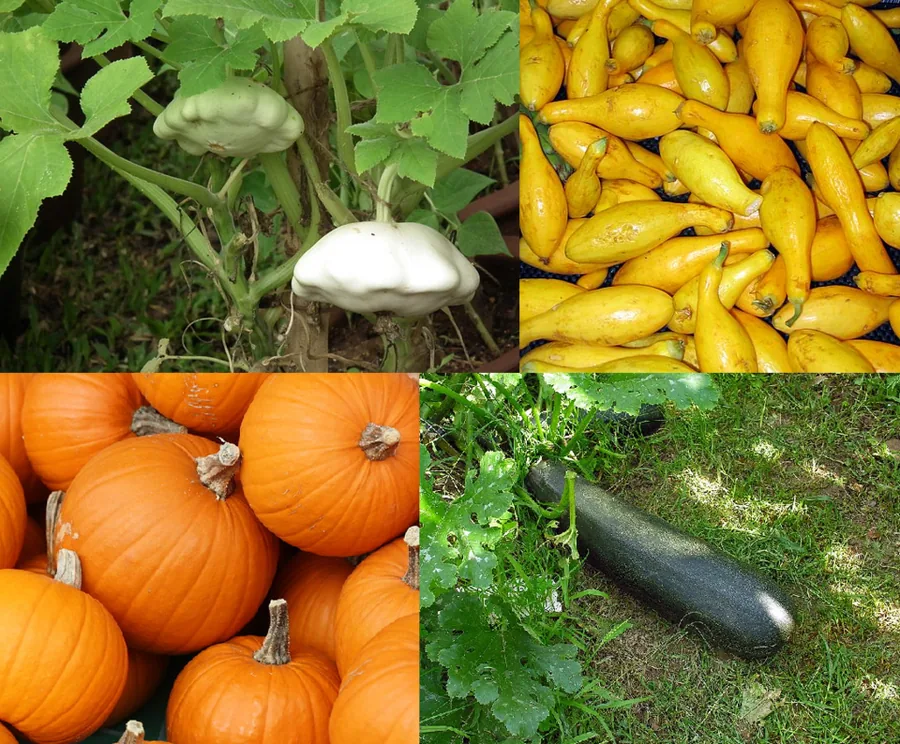
Bred primarily for carving, these are the medium, round, bright orange fruit distinguished by a sturdy handle.
Pie/Sugar pumpkins (Cucurbita pepo)
Smaller and sweeter with denser flesh, the pie and sugar types are selected for baking and culinary use.
Miniature/ornamental pumpkins (Cucurbita pepo)
Borne on compact plants spaced about 2 feet apart, these miniature fruit are grown chiefly as ornamentals.
Giant pumpkins (Cucurbita maxima)
A distinct species, Cucurbita maxima, the giants require 400 or more square feet per plant and reach maximum size only when thinned to a single fruit.
Companions
Pumpkins do well beside the tall crops and pest-pulling flowers of the old Three Sisters tradition, and poorly beside plants that fight them for the same food and water.
Plant near
Corn: Classic Three Sisters partner; cornstalks provide vertical structure while sprawling pumpkin vines shade the soil and suppress weeds.
Beans: Three Sisters partner; beans fix nitrogen that benefits the heavy-feeding pumpkin.
Nasturtium: Used as a companion to help draw and divert squash pests away from the vines.
Keep apart
Potato: Competes heavily for nutrients and water and shares pest/disease pressure, making it a poor neighbor for sprawling pumpkins.
How to propagate
Pumpkin is propagated almost exclusively by seed, which simplifies the process to a single caveat: the root system resents disturbance, so transplanting demands a careful hand.
SeedEasy
Direct sow after the last frost when soil is above 60°F, or start indoors 2-3 weeks before transplanting · Seeds germinate in about 7-10 days; vines establish over several weeks
Pumpkin establishes readily from seed sown about an inch deep into warm soil. Direct-sow once the soil has risen past 60°F (16°C), or, in short-season areas, start indoors 2 to 3 weeks ahead of transplanting. Emergence takes roughly 7 to 10 days, and the vines then require several weeks to develop. Because the roots resist disturbance, set transplants out gently and keep the rootball intact to avoid a check in growth.
Myths
Pumpkin is poisonous to dogs and cats.
Pumpkin contains no compound toxic to companion animals and is absent from the ASPCA toxic-plant listing. Plain cooked pumpkin is safe to offer to dogs and cats in modest amounts, which is why it already features in many commercial diets. The persistent belief has no basis in the plant's chemistry.
Because every flower should set fruit, dropped flowers signal a failing plant.
The species is protandrous, so the male flowers open first and abscise once their pollen is spent, contributing nothing further. Only the female flowers, each bearing a small fruit at the base from an inferior ovary, mature into pumpkins, which means early flower drop reflects the normal reproductive sequence rather than decline.