Vegetable · Cucurbitaceae
Winter Squash
Cucurbita maxima, Cucurbita moschata, Cucurbita pepo
Full sun, generous spacing, and warm soil drive the vigor that lets winter squash mature a hard-rinded, storable crop.
Full sun
Every 3–7 days
50–95°F · 10–35°C
80–110 days
Overview
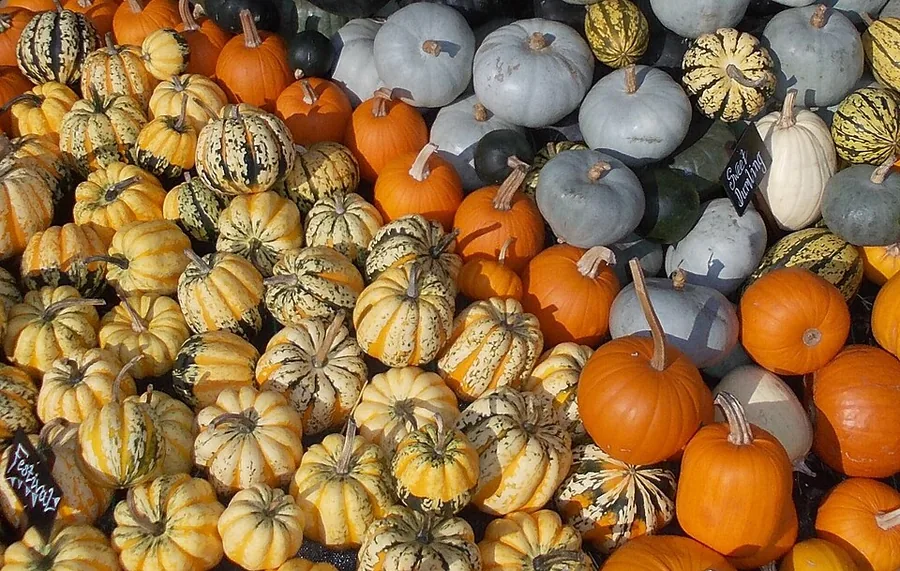
Winter squash is named for its keeping quality, not its growing season. Sown in late spring, the vines develop through the warm months and the fruit is gathered in fall once the rind lignifies and hardens. The group spans three species of Cucurbita, encompassing butternut, acorn, kabocha, and the large blue-gray Hubbard.
These are heavy feeders with high water demand and a sprawling habit; a single vining hill can occupy 50 to 100 square feet. Grown with adequate room, they set fruit that stores for months in cool conditions. The sweet flesh and edible seeds explain why the crop is grown primarily to store rather than for fresh use.
After establishment, culture is straightforward, but two factors govern success. Insect pressure from the vine borer and squash bug can kill plants outright, and storage life depends on full physiological maturity followed by proper curing before the fruit enters the cellar.
Care
The short version: site winter squash in full sun with ample space and consistent moisture in rich, well-drained soil, incorporating a balanced fertilizer before planting. Allow fruit to reach full rind hardness, then cure it ahead of storage.
Light
Winter squash demands full sun, on the order of 8 hours daily, with no meaningful shade tolerance. Under lower light the plant favors vegetative growth over fruiting, yielding weak vines and a sparse crop.
Water
Supply at least 1 inch of water a week, wetting the profile to roughly 6 inches rather than the surface, because deep moisture supports the demand of expanding fruit. Water is most critical during fruit set and development. Base irrigation through drip or soaker lines keeps foliage dry and limits fungal infection.
Soil
Grow in fertile, well-drained loam high in organic matter; where drainage is marginal, hills or raised beds prevent waterlogging of the roots. A pH of 6.0 to 6.5, slightly acidic, is optimal.
Temperature
As a warm-season crop, winter squash grows within roughly 50°F and 95°F (10°C to 35°C) and tolerates no frost. Delay sowing until soil reaches 60°F to 65°F (16°C to 18°C), since seed sown into cold ground rots rather than germinating.
Humidity
Ambient outdoor humidity is adequate, so no target applies. Air circulation is the more relevant factor, because still, humid air within a crowded canopy favors powdery mildew infection.
Feeding
Incorporate a balanced fertilizer such as 5-10-10 before planting, adjusted to a soil test. Side-dress with modest nitrogen as the vines begin to run or the first flowers open; excess nitrogen shifts the balance toward foliage at the expense of fruit set.
Pruning
Routine pruning is unnecessary. Pinching the vine tips in late summer redirects assimilate into the fruit already set, and diseased leaves should be removed to slow spread. Fruit set too late to mature before frost can also be cut away.
Size & spacing
The vines remain low, about 12 to 24 inches (30 to 60 cm) in height, but extend 6 to 15 feet (1.8 to 4.6 m) across. Allowing each plant its full spread improves air movement through the canopy and gives the fruit room to develop.
When to plant
Winter squash requires accumulated heat and a long frost-free interval to finish its fruit. Sow in late spring after the soil warms, carry the vines through summer, and harvest in fall before hard frost while the rinds remain hard.
Northern hemisphere
Southern hemisphere
Typical months for a temperate climate: start earlier in warm zones, later where spring frosts linger.
- Sow: Start indoors 2-4 weeks before the last frost in individual pots; harden off before transplanting (seedlings resent root disturbance)
- Plant: Direct seed or transplant after all danger of frost when soil reaches at least 60-65°F at seeding depth, typically late May to early June in northern regions
- Harvest: Harvest in late summer to fall before hard frost, when rinds are hard and cannot be dented with a thumbnail; cure most types about 10 days in warmth, then store at 50-55°F
Hardiness
USDA hardiness zones: 2–11
Temperature: down to -46°C
Troubleshooting
Most disorders present on the vines, at the flowers, or in storage after harvest. Recognizing the earliest symptoms allows intervention before losses compound. Identify the sign below, then treat while control is still effective.
Rapid vine collapse with sawdust-like frass at the stem base
The cause is the squash vine borer, whose larva tunnels the stem and can sever a vine's vascular flow, collapsing it quickly. Split the stem lengthwise, extract the white larva, and mound moist soil over the wound so the vine can form adventitious roots. Sticky sap strands from a cut stem instead indicate bacterial wilt, vectored by cucumber beetles, and such plants do not recover.
Fix:
- Slit infested stems, remove borers, and mound moist soil over the wound to encourage rooting
- Remove and destroy plants with bacterial wilt; they will not recover
- C. moschata (butternut) types resist vine borer, so replant with those if pressure is high
White powdery growth on the foliage in late summer
This is powdery mildew, an obligate fungus that colonizes the oldest leaves first and wipes off like talc. Remove the most affected leaves, open the canopy to improve air movement, and irrigate at the base to keep the foliage dry. Where pressure is high, a labeled fungicide applied at first symptom is warranted.
Fix:
- Remove badly affected leaves
- Apply a labeled fungicide at first sign if needed
- Improve air movement by giving vines full spacing
Flower drop or shriveling of young fruit before set
Early flower drop is normal, because the first flowers a squash produces are staminate (male) and the pistillate (female) flowers open later. Once females appear, inadequate pollination under wet, cold, or hot conditions leaves them unfertilized, and the young fruit aborts from the tip. Transfer pollen from a male to a female flower by hand in the morning, and withhold insecticide during bloom to protect pollinators.
Fix:
- Wait, fruit set usually improves as female flowers appear
- Hand-pollinate by transferring pollen from a male flower to a female flower in the morning
- Avoid spraying insecticides while plants are blooming
Ragged chlorotic patches with shield-shaped insects beneath the leaves
Squash bugs are feeding, and their sap removal drives the progression from yellowing to browning and tearing of the leaf. Inspect the undersides along the veins for gray adults, gray nymphs, and the characteristic clusters of bronze eggs. Crush the egg masses, hand-pick adults, and set a board as a nocturnal trap to collect and destroy them each morning.
Fix:
- Hand-pick adults and crush egg masses
- Trap bugs under boards laid near plants and destroy them each morning
- Treat young nymphs with a labeled insecticide if populations are heavy
Stored fruit softening or rotting within weeks of harvest
Storage failure usually traces to fruit harvested immature, chilled by frost, or not cured. Physiological maturity is confirmed when the rind resists a thumbnail, so any soft or damaged fruit should be used promptly rather than stored. Cure sound fruit about 10 days at 80°F to 85°F (27°C to 29°C) to heal the skin, then hold it at 50°F to 55°F (10°C to 13°C) with ventilation.
Fix:
- Use damaged or immature fruit promptly instead of storing
- Cure sound fruit about 10 days at 80-85°F, then move to 50-55°F with 50-75 percent humidity and ventilation
Toxicity
Winter squash is an edible crop, benign to people and animals alike. Both flesh and seeds are consumed, and no part of the plant is listed as toxic. Two minor cautions apply: the prickly trichomes on leaves and stems can irritate skin at harvest, warranting gloves, and any fruit with a strongly bitter taste should be discarded.
Safe for
People · Cats · Dogs · Horses · Rabbits · Livestock · Birds
Cats Safe
Cooked squash poses no hazard to cats, and a small portion of the plain flesh is well tolerated. The salt, butter, and seasonings often added are the greater concern, not the squash.
Dogs Safe
Plain cooked squash is a common, mild treat for dogs and is often given to firm a loose stool. Offer it in modest amounts, since a large serving mainly produces gas.
Horses Safe
Squash is safe for horses, and some accept it as a variation on their usual ration. Cut it into pieces so a large piece cannot obstruct the throat.
Rabbits Safe
Rabbits tolerate squash flesh as an occasional item. Keep portions small, because their digestion is adapted to hay and leafy forage rather than starchy fruit.
Livestock Safe
Cattle, goats, sheep, and pigs consume squash readily, and surplus or cull fruit serves as useful supplemental feed. Break large fruit open so an animal cannot choke on a whole one.
Birds Safe
Poultry and parrots take both the cooked flesh and the raw seeds, extracting the latter with ease. No component of the plant is harmful to them.
People Safe
Winter squash is a dietary staple, providing sweet flesh and seeds suitable for roasting. The single caution is a strongly bitter taste, an uncommon indicator of elevated cucurbitacins, which warrants discarding the fruit.
Leaves and stems have prickly hairs that can irritate skin during harvest, so gloves are helpful. Very rarely, squash from stray or saved seed can taste strongly bitter due to cucurbitacins; do not eat bitter-tasting squash.
Varieties
Winter squash comprises several species and a wide range of fruit forms, but a limited set predominates in gardens. The following are the cultivars worth identifying.
Waltham Butternut (C. moschata)
A tan, bottle-shaped fruit with deep orange flesh borne on solid stems that resist vine borer entry, and it holds in storage for months.
Table Queen acorn (C. pepo)
A small, ribbed, dark green fruit maturing in roughly 80 to 85 days that is among the few types stored without curing.
Blue Hubbard (C. maxima)
A large heirloom storage type with a bumpy blue-gray rind and teardrop form, frequently exceeding 15 pounds.
Kabocha/buttercup types (C. maxima)
A squat, dark green fruit whose dense, sweet, dry orange flesh performs well roasted.
Spaghetti squash (C. pepo)
An oblong yellow fruit whose cooked flesh separates into pasta-like strands.
Delicata (C. pepo)
A small, cream-and-green striped fruit with thin, edible skin and a shorter storage life than the hard-rinded types.
Companions
Plant near
corn: Traditional three sisters planting: sprawling squash vines shade soil between corn, conserving moisture and suppressing weeds
beans: Three sisters companion: beans fix nitrogen that benefits the heavy-feeding squash
nasturtium: Extension-recommended companion flower that attracts pollinators and can help deter squash pests
Keep apart
potato: Traditional extension lists pair them poorly; both are heavy feeders and compete, and digging potatoes disturbs squash roots and vines
How to propagate
Winter squash is propagated by seed, which germinates readily once soil temperature is adequate.
SeedEasy
Direct sow after the last frost when soil is at least 60-65°F, or start indoors in individual pots 2-4 weeks before transplanting · Seeds germinate in 5-10 days in warm soil; plants reach harvestable maturity in 80-110 days
Winter squash is grown almost exclusively from seed. Sow 1 inch deep in hills or rows once soil reaches 60°F to 65°F (16°C to 18°C) after the last frost, or start it indoors in pots 2 to 4 weeks earlier. Warm soil produces emergence in 5 to 10 days, and plants advance to a mature, storable crop in 80 to 110 days. Vining types require considerable space, up to 50 to 100 square feet per hill, and because the roots resent disturbance, transplants should be raised in peat or other plantable pots.
Myths
Winter squash is a winter-grown crop.
It is sown in spring after frost, grown through summer, and harvested at maturity in fall. The designation reflects the hard rind, which confers the long storage life that carries the fruit through winter, not the season of cultivation.
Cross-pollination with cucumbers, melons, or other squash spoils the current season's fruit.
Squash is not cross-compatible with cucumbers or melons, so no such crossing occurs. Crossing among squash cultivars alters only the embryo within the seed, meaning off-type fruit appears only when that seed is saved and replanted the following year.