Vegetable · Cucurbitaceae
Zucchini
Cucurbita pepo
Match its three essentials, full sun, warm soil, and even moisture, and a single vigorous Cucurbita pepo plant will crop heavily all summer.
Full sun
Every 3–7 days
50–95°F · 10–35°C
45–60 days
Overview
Zucchini is a summer squash of the species Cucurbita pepo, harvested immature so the fruit stays tender rather than storing like a winter type. The genus sits in the gourd family, Cucurbitaceae, and originated in Mexico, though the familiar slender green cultivars were developed in Italy. As a warm season annual, it completes its cycle in one season, growing fast and sprawling once soil temperatures rise.
Its defining trait is productivity. A single healthy plant can yield a picking every day or two at midsummer, so two plants usually supply a household. The species is monoecious, bearing separate male and female flowers on one plant, and because pollen must be moved between them, fruit set depends on bee activity. Without pollinators present, flowers open and abort.
It rates as an easy crop precisely because its requirements are few: full sun, warm soil, and steady moisture cover nearly all of them, leaving frequent harvest and pest scouting as the main tasks. Frequent picking matters mechanically, because maturing seeds signal the plant to slow new flowering. Left to mature, the fruit turns woody and seedy while overall cropping falls off.
Care
The short version: site it in full sun after the soil warms, supply about 1 inch (2.5 cm) a week deeply at the base to keep moisture even, space plants for open airflow, and harvest the fruit young and frequently.
Light
Zucchini is a full sun crop requiring 8 or more hours daily. Insufficient light shifts growth toward soft, leggy shoots at the expense of fruit, and the resulting dense, shaded canopy also favors powdery mildew.
Water
Supply roughly 1 inch (2.5 cm) of water per week, increasing in heat, applied deeply at the base rather than over the canopy. Even moisture through flowering and fruiting maintains calcium transport into the fruit and prevents blossom-end rot, while dry foliage limits mildew infection.
Soil
Grow it in fertile, moisture-retentive but well-drained loam amended with compost. A pH of 6.0 to 6.8 suits nutrient uptake, and raised beds correct drainage where heavy soils remain waterlogged.
Temperature
Zucchini performs across roughly 50°F to 95°F (10°C to 35°C). Germination and early growth stall in cold ground, so the soil should reach at least 70°F (21°C) before sowing, and any frost is lethal to the tissue.
Humidity
No specific humidity target applies to this outdoor crop. The controlling factor is air movement, because a crowded, humid canopy provides the conditions powdery mildew needs to establish.
Feeding
Incorporate a balanced fertilizer or compost at planting, then side-dress with nitrogen once the first fruits set. Restraint matters, because excess nitrogen drives vegetative growth at the expense of fruiting.
Pruning
Routine pruning is unnecessary. Removing dead or mildew-infected leaves improves airflow, and harvesting every 1 to 2 days at 6 to 8 inches (15 to 20 cm) sustains flowering and yield.
Size & spacing
Plants reach 18 to 35 inches (45 to 90 cm) tall with a broad spread, so allow 2 to 4 feet (60 to 120 cm) between them. That spacing maintains the airflow that suppresses powdery mildew.
When to plant
Zucchini is frost-tender and heat-driven, so timing follows soil temperature rather than the calendar alone. Once frost has passed and the ground has warmed, direct sowing in late spring establishes the crop quickly, and fruiting continues from early summer until the first autumn frost.
Northern hemisphere
Southern hemisphere
Typical months for a temperate climate: start earlier in warm zones, later where spring frosts linger.
- Sow: 2-4 weeks before last frost in individual pots (optional; direct sowing is usually preferred because cucurbit roots resent disturbance)
- Plant: After last frost once soil reaches at least 21°C (70°F) at 5 cm depth, typically late spring
- Harvest: Flowers and fruits early summer until frost; begin harvest about 45-60 days after sowing, picking fruit at 15-20 cm (6-8 in) while glossy
Hardiness
USDA hardiness zones: 3–10
Temperature: down to -40°C
Troubleshooting
Zucchini problems concentrate on three tissues: the leaves, the stems, and the developing fruit, each pointing to a distinct cause. Reading those early symptoms lets you intervene before a disorder or pest overwhelms the plant. Match the sign below to its mechanism, then treat accordingly.
Wilting despite moist soil
Wilt over wet soil points to a vascular blockage, most often the squash vine borer larva tunneling the main stem, though bacterial wilt vectored by cucumber beetles produces the same collapse. A basal hole packed with damp, sawdust-like frass confirms the borer. Slit the stem, extract the larva, and mound moist soil over the wound to promote rooting above the injury.
Fix:
- Slit the stem, remove the borer, and mound moist soil over the wound to encourage rooting
- Destroy collapsed plants to kill larvae before they pupate in soil
Powdery white film on the foliage
The coating is powdery mildew, a fungal disease that establishes where crowding and shade raise canopy humidity. It appears first on the older leaves and advances until the tissue yellows and desiccates. Remove the worst leaves, increase spacing for airflow, and water at the base so the foliage stays dry.
Fix:
- Remove heavily infected leaves
- Improve airflow by spacing or thinning plants
- Apply a fungicide labeled for powdery mildew on cucurbits if infection is severe
Sunken lesion at the blossom end
This is blossom-end rot, a calcium-transport failure driven by fluctuating soil moisture rather than a true soil deficiency. When the plant cycles between drought and saturation, it cannot deliver calcium to the expanding fruit tip. Remove affected fruit, water deeply on a consistent schedule, and mulch to buffer soil moisture.
Fix:
- Remove affected fruit
- Water deeply and evenly
- Mulch to stabilize soil moisture
Speckled foliage with insects at the base
Yellow stippling that browns and crisps indicates squash bugs feeding on sap, while nearby cucumber beetles compound the damage by transmitting disease. Shiny bronze egg clusters and gray nymphs on the leaf undersides confirm the infestation. Hand-pick adults, destroy the egg clusters, and trap bugs under a board left out overnight.
Fix:
- Hand-pick adults and crush egg clusters
- Trap squash bugs under boards overnight and destroy them in the morning
- Use insecticides labeled for cucurbits only as a last resort and never on open flowers
Young fruit aborting after flowering
Fruit that yellows and shrivels from the tip days after flowering, on an otherwise healthy plant, signals poor pollination. Low bee activity, rain, or a run of only male flowers early in the season all reduce pollen transfer. Hand-pollinate in the morning by transferring pollen from a male to a female flower, and avoid insecticides while the flowers are open.
Fix:
- Hand-pollinate by transferring pollen from male to female flowers in the morning
- Avoid spraying insecticides when flowers are open
Toxicity
Zucchini presents no toxic hazard. The ASPCA classifies Cucurbita pepo as non-toxic to cats, dogs, and horses, and the fruit is a routine human food. The only qualifications are the occasional high-cucurbitacin fruit, recognizable by a sharply bitter taste and best discarded, and the stiff prickly hairs on leaves and stems that can irritate skin.
Safe for
People · Cats · Dogs · Horses · Rabbits · Livestock · Birds
Cats None
The ASPCA classifies zucchini as non-toxic to cats, so ingestion of plant or fruit carries no poisoning risk. Overconsumption of any unfamiliar food may cause a mild, self-limiting digestive upset, but no toxic principle is involved.
Dogs None
Zucchini is non-toxic to dogs and serves as a low-calorie treat raw or cooked. Added butter, salt, or seasoning is the more likely cause of digestive upset, not the squash itself.
Horses None
Horses tolerate zucchini without harm, consistent with the ASPCA listing. Cutting it into small pieces removes any choking risk from a horse bolting a whole fruit.
Rabbits Safe
Rabbits can take zucchini, foliage included, as an occasional fresh supplement to a hay-based diet. Because it is high in water, introduce it in small amounts to avoid loosening the stool.
Livestock Safe
Goats, sheep, pigs, and cattle digest zucchini and its vines readily, which makes surplus fruit a practical feed. Introduce it gradually so the gut flora can adjust.
Birds Safe
Chickens and pet birds consume zucchini flesh and seeds with no toxic risk. It is best offered as one component of a varied diet.
People Safe
Zucchini is a common edible vegetable, eaten raw or cooked and safe for people. The exceptions are rare high-cucurbitacin fruit, identified by a sharply bitter taste and discarded, and the prickly foliage, which can abrade skin at harvest.
Leaves and stems bear stiff prickly hairs that can irritate bare skin; wear long sleeves and gloves when harvesting. Discard any fruit that tastes strongly bitter (rare high-cucurbitacin fruit can cause stomach upset in people).
Varieties
A manageable set of cultivars covers most garden needs, ranging from an open-pollinated standard to round-fruited and near-spineless selections. The following are the cultivars worth knowing by name and habit.
Black Beauty
An open-pollinated standard valued for uniformly glossy dark green fruit and a long record of reliable garden performance.
Eight Ball
An award-winning hybrid producing round, baseball-sized dark green fruit on compact plants well suited to stuffing.
Spineless Beauty
Selected for nearly spineless stems and leaf stalks, which markedly reduces skin irritation during harvest.
Senator
A high-yielding hybrid bearing straight, medium-green fruit that sustains a heavy, continuous harvest.
Elite
An early hybrid whose open plant architecture exposes the glossy medium-green fruit for easier location and picking.
Companions
Zucchini's best-known companions come from the traditional Three Sisters planting, where corn and beans each pull their weight beside the sprawling squash.
Plant near
Corn: In the traditional Three Sisters planting described by Illinois Extension, sprawling squash acts as a living mulch beneath corn, suppressing weeds and conserving soil moisture
Beans: Beans fix nitrogen in the Three Sisters system, contributing fertility that heavy-feeding squash uses
How to propagate
Zucchini is propagated almost exclusively by seed, and because cucurbit roots resent disturbance, establishment hinges on sowing site and timing rather than technique.
SeedEasy
Direct sow a half-inch (1.3 cm) deep after last frost once soil is at least 21°C (70°F); indoor starts only 2-4 weeks before transplanting · Germinates in about 5-10 days in warm soil; first harvest roughly 45-60 days from sowing
Direct sow at half an inch (1.3 cm) deep once frost has passed and the soil holds at least 70°F (21°C). Direct seeding is preferred because cucurbit roots resent disturbance; where an early start is required, use individual pots only 2 to 4 weeks ahead and transplant with minimal root handling. Germination follows in 5 to 10 days in warm soil, with first harvest roughly 45 to 60 days from sowing. The plant is monoecious, so bees are needed to carry pollen between its male and female flowers for fruit to set.
Myths
Zucchini is toxic to cats and dogs.
ASPCA classification places zucchini squash among the non-toxic plants for cats, dogs, and horses, so ingestion of the fruit or foliage poses no poisoning risk to pets. The only genuine hazard is human and infrequent: fruit with elevated cucurbitacins tastes sharply bitter and can cause transient gastrointestinal upset, so bitter fruit should be discarded.
Larger zucchini fruit are superior.
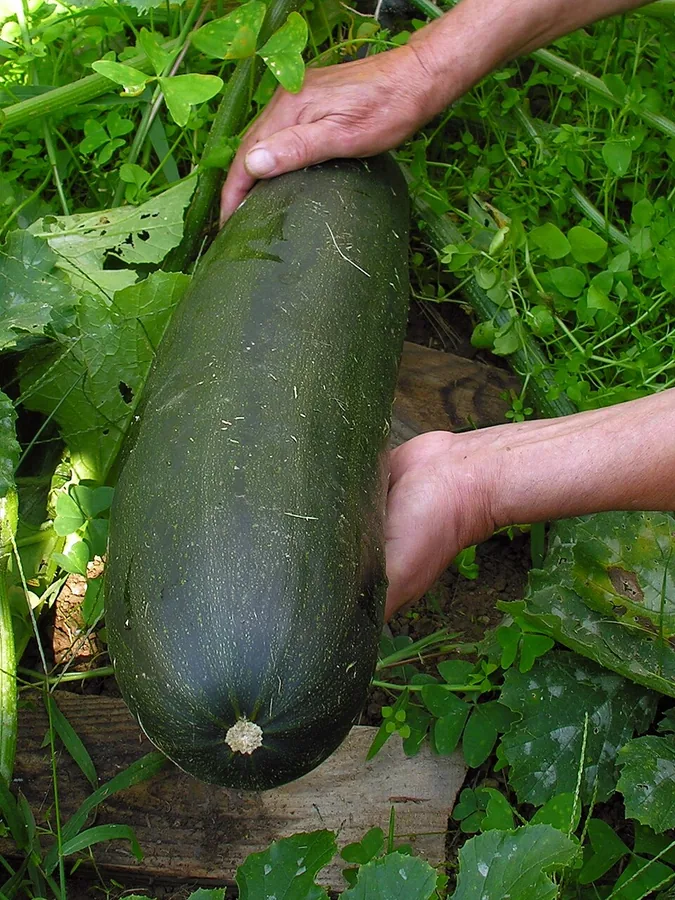
Quality peaks in immature fruit. Extension guidance is to harvest at about 6 to 8 inches (15 to 20 cm) while the skin remains glossy, and regular removal sustains fruit set by preventing seed maturation from suppressing flowering. Fruit left to enlarge into a bat-sized marrow slows the plant markedly.
The Three Sisters planting is proven to increase squash yields.
The corn, bean, and squash association holds substantial historical and cultural significance, which is distinct from measured productivity. Illinois Extension notes there is little published evidence that it surpasses conventional spacing for yield or soil health.