Vegetable · Cucurbitaceae
Cantaloupe
Cucumis melo
Given full sun, warm soil, and steady water, cantaloupe builds sweet, fragrant fruit that ripens by late summer.
Full sun
Every 2–4 days
59–95°F · 15–35°C
75–90 days
Overview
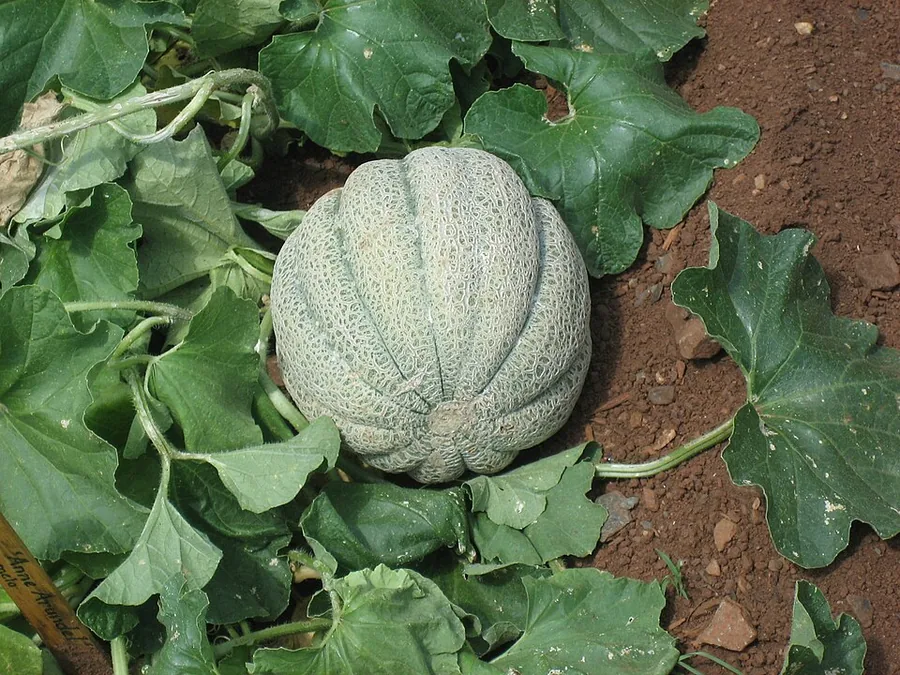
Cantaloupe is a sprawling warm season melon in the Cucurbitaceae, the cucumber and squash family, cultivated for the sweet, fragrant orange flesh held within its netted rind. Its origins lie in the warm zones of Africa and Asia, which explains its sustained demand for heat and its place in the summer vegetable garden. The names muskmelon and rockmelon refer to the same species, Cucumis melo.
The plant develops long, trailing vines that either run across the ground or ascend a trellis where support is provided. It requires warmth, full sun, and bees to set fruit, because its monoecious flowers cannot self-pollinate. With correct timing a single hill can supply a household through late summer.
Cultivation rewards patience more than intervention. The decisive skill is judging harvest, since sugar accumulation ceases the instant the fruit leaves the vine. Allowing the melon to slip free on its own yields the deep, sugary flavor the plant has spent the whole season translating from sunlight.
Care
The short version: full sun and warm, well-drained soil, with steady moisture of about 1 to 2 inches a week that is reduced in the final week before harvest to concentrate the sugars.
Light
Cantaloupe requires full sun with as little shade as the site allows. Direct light powers the photosynthesis that produces the sugars responsible for sweetness, so the brightest available position gives the best fruit.
Water
Maintain the soil evenly moist rather than alternating between dry and saturated, supplying roughly 1 to 2 inches (2.5 to 5 cm) of water a week during fruiting. Reduce irrigation in the final week before harvest, since mild late-season water stress concentrates sugar in the fruit instead of diluting it.
Soil
Grow it in fertile, well-drained loam amended with ample compost. A pH of 6.0 to 6.8 is optimal, and free drainage is critical because saturated soil favors the vascular wilts that kill melon vines.
Temperature
This is a heat-adapted crop that performs between 59°F and 95°F (15°C to 35°C). It has no frost tolerance and germinates and grows poorly in cold soil, so planting should wait until the ground is genuinely warm.
Humidity
Average humidity near 40% to 70% is sufficient, so no specific target need be met. Air movement matters more than the reading, because persistent leaf wetness in a crowded canopy is the principal driver of powdery and downy mildew.
Feeding
Apply a balanced fertilizer through the growing season and side-dress as the vines begin to run. Restrict nitrogen, since excess promotes foliage over fruit and leaves the plant softer toward disease.
Pruning
Cantaloupe requires no real pruning. Vines may be trained up a trellis to conserve space or selectively thinned to improve airflow, but the plant otherwise performs well left to sprawl.
Repotting
Not typically container-grown; direct sow or transplant outdoors
Size & spacing
Trained vines extend 6 to 9 feet (183 to 274 cm), and each plant spreads 1 to 3 feet (30 to 91 cm) across. Allow the sprawling habit generous spacing so air circulates through the canopy and disease pressure stays lower.
When to plant
Cantaloupe is governed by heat and intolerant of frost. Sow indoors a few weeks ahead or direct sow once the soil warms, anticipate the yellow flowers in midsummer, and harvest from mid to late summer once the fruit separates at full slip.
Northern hemisphere
Southern hemisphere
Typical months for a temperate climate: start earlier in warm zones, later where spring frosts linger.
- Sow: 2 to 4 weeks before the last frost
- Plant: After danger of frost has passed and soil warms to about 65°F (18°C)
- Harvest: Yellow flowers bloom July to August; harvest mid to late summer at full slip
Hardiness
USDA hardiness zones: 2–11
Temperature: down to -46°C
Troubleshooting
Most cantaloupe disorders appear first on the foliage or vines, and several connect directly to cucumber beetles as vector or cause. Recognizing the early signs lets you intervene before a localized problem moves through the planting. Match the symptom below to the description, then act while management still changes the outcome.
Daytime wilt with nighttime recovery before final collapse
This pattern points to bacterial wilt, whose pathogen the striped and spotted cucumber beetles introduce as they feed and wound the tissue. The bacteria multiply inside the water-conducting vessels and plug them, which is why the vine flags in the heat, rebounds when transpiration eases at night, and finally dies. No treatment clears an infected plant, so remove and destroy it and direct your control at the beetle vector, the only point where the cycle can be broken.
Fix:
- Remove and destroy infected plants, as there is no cure once infected
- Control cucumber beetles to limit further spread
Vein-bounded yellow lesions with sporulation beneath
Angular yellow lesions confined by the leaf veins, paired with gray-purple sporulation on the underside in the morning, identify downy mildew. The pathogen requires free moisture on the leaf to infect and sporulate, which is why humid weather and extended leaf wetness accelerate it. Strip the infected foliage, water early in the day or at the roots to dry the canopy, and apply a protectant fungicide while wet conditions persist.
Fix:
- Remove infected foliage and improve airflow
- Apply a protectant fungicide during humid conditions
Progressive one-sided yellowing and wilt of individual runners
Runner-by-runner yellowing and one-sided wilt indicate fusarium wilt, a soilborne fungus that invades the vascular system and blocks water movement to one section at a time until the plant collapses. A split stem shows brown vascular streaking but releases no stringy sap, the diagnostic contrast that separates it from bacterial wilt. The fungus persists in soil and cannot be cured, so remove the plant and rotate cucurbits off that ground for at least 3 years.
Fix:
- Remove infected plants, as this soilborne fungus cannot be cured
Feeding holes across foliage and rinds with stunted seedlings
The chewing comes from cucumber beetles, the small yellow-and-black insects whose direct feeding both injures tissue and opens the door to bacterial wilt. Handpicking or trapping reduces the population, while row covers physically exclude them from vulnerable young plants. Remove those covers at flowering, since the monoecious blooms depend on bees and cannot set fruit while sealed off.
Fix:
- Handpick or trap beetles
- Apply row covers over young plants, removing them at flowering for pollination
White fungal coating that resists wiping off
The talc-like layer that resists rubbing off is powdery mildew, a leaf-surface fungus that colonizes the older, shaded foliage first where airflow is poorest. As it spreads it degrades the photosynthetic surface, so the leaves yellow and die and the fruit ends up smaller and less sweet for lack of sugar supply. Open the canopy to move air, remove the most heavily colonized leaves, and apply a labeled fungicide only if it continues to advance.
Fix:
- Improve air circulation and remove severely infected leaves
- Apply a labeled fungicide if needed
Heavy bloom with little or no fruit set
Heavy bloom with poor fruit set usually reflects poor bee pollination, since the monoecious flowers need insects to carry pollen and cannot self-pollinate. The first flush of flowers is staminate, or male, so an early shortage of fruit is normal and worth waiting out while you confirm bee activity. Support pollinators, withhold insecticides during open bloom to protect them, and transfer pollen from male to female flowers by hand if visitation stays low.
Fix:
- Encourage pollinators and avoid spraying insecticides during bloom
- Hand-pollinate by transferring pollen from male to female flowers
Toxicity
For pet owners the verdict is reassuring: cantaloupe is not toxic. The sweet flesh is a safe treat across most animals, and the only genuine risk is mild gastrointestinal upset when a pet consumes excess rind or seeds. Keep portions small and there is nothing here that warrants concern.
Safe for
People · Cats · Dogs · Horses · Rabbits · Livestock · Birds
Cats None
The flesh carries no compound toxic to cats. The only concern is digestive, since a large helping can produce a soft stomach or loose stool, so portions should stay small.
Dogs None
A few pieces of ripe flesh serve well as a treat for dogs. Excess rind or seeds is harder to digest and can cause mild gas or stomach upset, but presents no greater danger.
Horses Safe
Horses tolerate small amounts of the sweet flesh without harm. As with any high-sugar treat, the quantity should remain modest to avoid disturbing the gut.
Rabbits Safe
Rabbits can take a little ripe flesh on occasion. The sugar content is high relative to their needs, so a thin sliver as an infrequent treat is appropriate rather than a routine food.
Livestock Safe
Goats, sheep, and cattle digest both flesh and rind without difficulty, and surplus fruit is a common feed. Introduce it gradually, since a sudden large quantity can loosen the gut.
Birds Safe
Both pet birds and backyard hens accept ripe cantaloupe, flesh and seeds together. It contains nothing harmful to them and can be shared freely in reasonable amounts.
People Safe
Cantaloupe is eaten fresh from the rind as a sweet, refreshing fruit. The netted surface can harbor bacteria, so rinse the exterior before slicing to avoid drawing it into the flesh with the knife.
Offer only small amounts of ripe flesh and remove rind and seeds.
Varieties
Cantaloupe spans dozens of cultivars, from long-standing heirlooms to modern disease-resistant hybrids. The selections below are the ones worth knowing by name.
Hale's Best
This oval, heavily netted heirloom muskmelon is valued for its deep orange flesh and small seed cavity, which yields more edible fruit per melon.
Ambrosia
A widely planted hybrid noted for very sweet salmon-orange flesh paired with solid resistance to common melon diseases.
Athena
An eastern-type F1 hybrid bred for firm flesh and good storage life, with built-in tolerance to several diseases.
Hearts of Gold
An old heirloom distinguished by dense netting over deep orange, aromatic flesh.
How to propagate
Cantaloupe is propagated almost entirely from seed, which germinates quickly once soil temperature is adequate.
SeedEasy
Start indoors 2 to 4 weeks before the last frost, or direct sow after the soil warms · Germinates in 5 to 10 days; seedlings establish in 1 to 2 weeks
Cantaloupe propagates readily from seed. Direct sow once the soil reaches about 65°F (18°C), or sow indoors 2 to 4 weeks before the last frost, after which germination follows in 5 to 10 days and the seedlings establish within one to two weeks. Because the species resents root disturbance, any early indoor sowing should go into biodegradable pots that can be set out intact, preserving the root system at transplant.
Myths
Cantaloupe and muskmelon are two completely different fruits.
In US usage the two names denote the same plant. What is sold as cantaloupe here is botanically a netted muskmelon, whereas the true European cantaloupe bears a warty, scaly rind and is rarely grown in this region. The names are used interchangeably in the US.
A cantaloupe is ripe whenever you cut it from the vine.
Sugar accumulation halts the moment the fruit is detached, because the developing melon depends on the vine to supply it. Harvest at full slip, the stage at which the fruit separates from the stem under light pressure and releases a sweet aroma. Picked before that point, it will not gain any further sweetness.
More fertilizer makes bigger, sweeter melons.
Surplus nitrogen drives vegetative growth, producing dense vines at the expense of fruit. Balanced feeding plus easing off the water near harvest is what builds sweetness, since controlled late-season moisture concentrates the sugars rather than diluting them.