Vegetable · Cucurbitaceae
Watermelon
Citrullus lanatus
Give it full sun, warm soil, and room to sprawl, and watermelon converts a long, hot season into sweet, heavy fruit.
Full sun
Every 7–14 days
68–95°F · 20–35°C
70–90 days
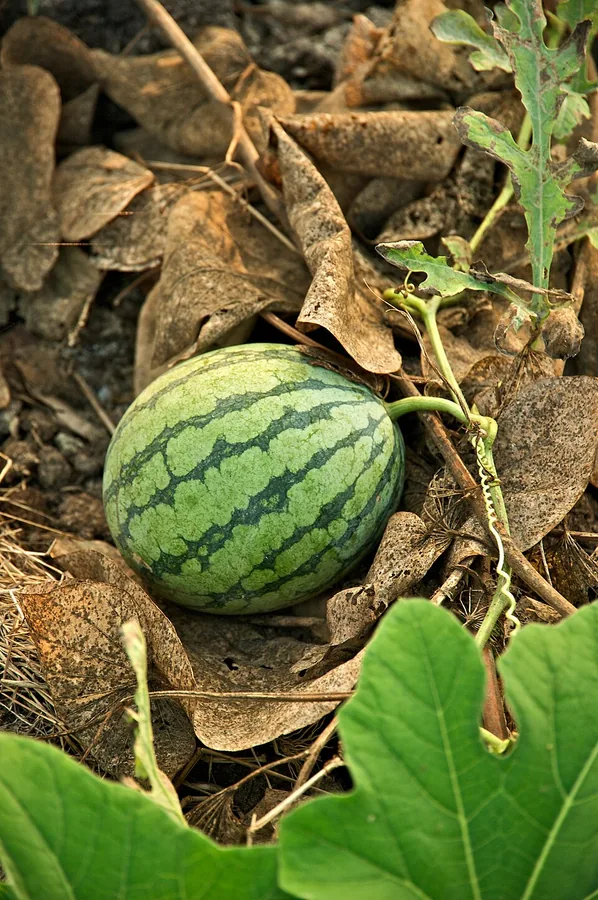
Overview
Watermelon is a prostrate annual in the Cucurbitaceae, the same family as cucumbers and squash. It trails flat rather than climbing, so a single plant covers 5 to 10 feet (1.5 to 3 m) of ground while its canopy stays only ankle high. That habit reflects its origin as a heat crop, which needs a long, warm season to move enough sugar into the fruit to mature it well.
The species is monoecious, carrying separate male and female flowers on the same plant, so fruit set depends on insects moving pollen between the two. That dependence is sharpest in seedless triploids, which are sterile and will not set unless a seeded diploid grows near enough to supply viable pollen. Where pollination succeeds, fruit follows.
As a warm-season crop it has no frost tolerance and stalls in cold soil. It performs best in full sun with deep, well-drained sandy loam and steady moisture through vine growth and fruit set. Tapering the water as the melons approach ripeness limits dilution and concentrates the sugars, which is why a well-timed home melon outsweetens most supermarket fruit.
Care
The short version: watermelon needs full sun, warm well-drained soil, and 1 to 2 inches of water a week through vine growth and fruit set, tapering as the melons ripen to concentrate sugars. Feed lightly with a low-nitrogen mix and give each plant ample room to run.
Light
Watermelon is an obligate full-sun crop and wants eight or more hours of direct light with no meaningful shade. The foliage is the plant's sugar factory, so higher light translates directly into sweeter, heavier fruit.
Water
Supply about 1 to 2 inches (2.5 to 5 cm) per week as deep soaks every 7 to 14 days, holding the soil evenly moist through vine growth and fruit set. Taper the water as the fruit ripens so the sugars concentrate rather than dilute, and irrigate at the base, since dry foliage carries far less disease.
Soil
The crop roots deeply and wants well-drained sandy loam rich in organic matter. A pH of 6.0 to 6.8 keeps nutrients available, and loose, warm soil both lets the long taproot extend and sheds excess water quickly after rain.
Temperature
Growth tracks warmth, with the optimum band around 68°F to 95°F (20°C to 35°C) and no frost tolerance at all. Cold soil suppresses germination and cool spells check fruit development, so planting into genuinely warm ground is not optional.
Humidity
Ambient humidity of 40% to 70% is unremarkable for this crop and needs no management. Canopy airflow matters more, because still, humid air within a crowded canopy is what allows mildew and blight to establish.
Feeding
Use a low-nitrogen balanced fertilizer such as 5-10-10, incorporated before planting and side-dressed before the vines run and again after bloom. Excess nitrogen drives vegetative growth at the expense of fruit, so the low first number is deliberate.
Pruning
The crop is not normally pruned, and the trailing vines are left to run. Remove only dead or diseased foliage, and note that restricting each vine to a few fruit concentrates the plant's resources and sizes up the remaining melons.
Repotting
Watermelon is a field crop rather than a container subject, so repotting seldom applies. In a container, pot up only under real crowding, indicated by roots matting at the base, wilting between waterings, and stunted, poorly setting vines.
Size & spacing
Mature vines stand only 4 to 8 inches (10 to 20 cm) tall yet spread 5 to 10 feet (1.5 to 3 m) across, so spacing is set by the spread, not the height. Allowing that footprint gives the runners room and keeps the canopy open enough to suppress disease.
When to plant
Every stage of the crop is governed by soil and air temperature. Sow indoors a few weeks before the last frost or direct sow once the soil has warmed through, and the fruit matures from summer into early fall.
Northern hemisphere
Southern hemisphere
Typical months for a temperate climate: start earlier in warm zones, later where spring frosts linger.
- Sow: 2 to 4 weeks before the last spring frost in biodegradable pots
- Plant: After all danger of frost has passed and soil is at least 65°F (18°C)
- Harvest: Summer to early fall
Hardiness
USDA hardiness zones: 3–11
Temperature: down to -40°C
Troubleshooting
Watermelon problems concentrate on the foliage and the developing fruit, and most trace to soil moisture, weather, or pollination. Identify the disorder below by its diagnostic signs and intervene early, before it costs the crop.
Progressive one-sided wilt of the vines
One runner wilting at a time indicates Fusarium wilt, a soilborne fungus that colonizes the vascular system and blocks water movement, for which no cure exists once a plant is infected. Splitting a lower stem reveals internal brown streaking, and symptoms intensify in warm soil. Remove and destroy infected plants without composting them, and rely on resistant or grafted varieties and multi-year rotation away from cucurbits going forward.
Fix:
- Remove and destroy infected plants
- Do not compost diseased vines
Sunken leathery rot at the blossom end of the fruit
The sunken, leathery lesion is blossom end rot, a physiological disorder driven by fluctuating soil moisture rather than a soil calcium deficiency. Because calcium moves with water, a dry-then-saturated cycle interrupts its delivery to the expanding fruit. Correct it by watering deeply on a consistent schedule, mulching to stabilize soil moisture, and removing affected fruit so the plant reallocates resources.
Fix:
- Keep soil evenly moist with deep, regular watering
- Mulch to buffer soil moisture
- Avoid heavy nitrogen fertilizer that outpaces calcium uptake
- Remove affected fruit so the plant redirects energy
Striped or spotted beetles feeding on foliage and flowers
These are cucumber beetles, which feed directly on leaves and blossoms and can also vector bacterial wilt, to which watermelon is less susceptible than cucumber or muskmelon. Manage them by handpicking or by excluding them with floating row covers until flowering forces the covers off for pollination. Confirm bacterial wilt by cutting a wilted stem and pressing it: a stringy strand of ooze indicates infection, and that vine should be removed.
Fix:
- Handpick beetles or use floating row covers until flowering
- Apply an approved insecticide if populations are high
- Remove and destroy any plant confirmed to have bacterial wilt
White powdery colonies developing across the foliage
The talc-like coating is powdery mildew, a fungus favored by warm days over a crowded, humid canopy. Unlike surface dust it does not rub away, and it colonizes the oldest leaves first. Manage it by opening the canopy for airflow, keeping irrigation off the foliage, and removing the most heavily infected leaves before inoculum spreads along the vine.
Fix:
- Improve air flow and avoid overhead watering
- Remove badly infected leaves
- Apply a labeled fungicide if needed
Poor fruit set and misshapen, undersized melons
Abundant flowers with little sound fruit indicates poor pollination. Because the flowers are monoecious, bees must transfer pollen from male to female blooms, and too few visits leaves fruit unset or distorted. Seedless triploids compound the issue, since they require a seeded diploid within about 10 feet (3 m) to supply viable pollen. Protect the pollinators by withholding insecticide during bloom and adding nearby flowers to draw them in.
Fix:
- Plant a seeded pollenizer within about 10 feet of seedless types
- Avoid spraying insecticides during bloom and while bees are active
- Add nearby flowers to attract pollinators
Dark sunken lesions on foliage, stems, and fruit
Sunken, water-soaked lesions across leaves, stems, and fruit point to anthracnose or gummy stem blight, fungi dispersed by splashing water in warm, wet conditions. Diagnostic signs include tan to dark leaf spots with yellow halos, sunken fruit lesions, and a characteristic gummy stem exudate where gummy stem blight is present. Convert to drip irrigation, avoid working the canopy while wet, sanitize infected debris, and apply a labeled fungicide preventively during prolonged wet weather.
Fix:
- Remove infected debris
- Use drip irrigation and avoid handling plants when wet
- Apply a labeled fungicide on a preventive schedule
Toxicity
For a household with pets, watermelon poses essentially no risk: the fruit is non-toxic to people and animals. The only consideration is that tough rind or a quantity of seeds can produce mild, self-limiting digestive upset if a pet overeats them. Served as ripe, deseeded flesh in moderation, it is entirely benign.
Safe for
People · Cats · Dogs · Horses · Rabbits · Livestock · Birds
Cats Safe
The flesh is non-toxic, and most cats show little interest beyond a sniff. Only a large intake of rind or seeds is likely to produce transient loose stool, which resolves without intervention.
Dogs Safe
Deseeded flesh is a suitable treat in moderation. Ingestion of the fibrous rind or a quantity of seeds, however, can bring on a day of mild gastrointestinal upset.
Horses Safe
Small pieces of flesh are well tolerated by horses. Portions should stay modest, since a sudden sugar load can disturb the hindgut.
Rabbits Safe
An occasional thin sliver of flesh suits a rabbit. The rind is best omitted and quantities kept small, as the watery, sugary fruit can loosen the droppings when overfed.
Livestock Safe
Cattle, goats, and sheep consume surplus melons without harm, and culls are commonly fed to them. Any new feed should be introduced gradually to avoid digestive upset.
Birds Safe
Backyard poultry and pet birds readily take the flesh and even the seeds, and it serves as a cooling summer feed. Nothing in the fruit is harmful to them.
People Safe
Watermelon is eaten worldwide, seeds included, and the flesh is safe for everyone, children among them.
Offer only ripe, rind-free flesh in moderation and remove seeds and rind before sharing with pets.
Varieties
Hundreds of cultivars span the range from small icebox melons to giants. The following are the reference points worth knowing by name.
Crimson Sweet
Crimson Sweet is a widely grown open-pollinated cultivar with a striped rind and sweet, crisp red flesh that keeps it in steady rotation among gardeners.
Sugar Baby
Sugar Baby is a compact icebox cultivar bearing small, round, dark green fruit that mature early enough to suit a short growing season.
Charleston Gray
Charleston Gray is a long-established standard producing large, oblong fruit beneath a pale gray green rind.
Jubilee
Jubilee is a large, oblong striped cultivar selected for high yield, with open-pollinated forms such as Jubilee II favored in Texas.
Seedless (triploid)
Seedless triploids are sterile hybrids that set fruit only when a seeded diploid grows nearby to provide the pollen they cannot supply themselves.
How to propagate
Seed is the only practical means of propagation for watermelon. Growers either raise transplants under cover or direct sow once soil temperature permits.
SeedEasy
Start indoors about 2 to 4 weeks before the last spring frost in peat or paper pots to limit root disturbance · Seeds sprout in about 7 to 10 days at 70 to 90°F (21 to 32°C); transplant after frost once soil is at least 65°F (18°C)
Watermelon resents root disturbance, so raise transplants in biodegradable peat or paper pots about 2 to 4 weeks before the last frost and set out the intact pot to avoid checking the roots. Held at 70°F to 90°F (21°C to 32°C), germination takes about 7 to 10 days. Harden the seedlings off and transplant only after frost has passed and the soil has reached at least 65°F (18°C).
SeedEasy
Direct sow outdoors after all danger of frost has passed and the soil seed zone is at least 65 to 70°F (18 to 21°C) · Emerges in about 7 to 10 days in warm soil, then thin to the strongest plants
Direct sowing is equally viable once frost has passed and the seed zone holds 65°F to 70°F (18°C to 21°C). In that warm soil emergence takes about 7 to 10 days, after which the stand is thinned to the strongest plants. Sowing in place avoids transplant shock, but the trade-off is a crop that can mature up to two weeks later than transplants.
Myths
A watermelon continues to ripen on the counter after harvest.
Watermelon is non-climacteric, so once it is cut from the vine its sugar content is fixed and does not rise. What you harvest is what you get, which makes picking at true ripeness the decisive step rather than any post-harvest holding.
A hollow thump is the only reliable indicator of ripeness.
The thump is at best a coarse cue. A dried, brown tendril at the node nearest the fruit and a ground spot that has shifted from white to creamy yellow are the more reliable indicators, corroborated by a rind that has dulled from its earlier gloss.
Watermelon fruit is toxic to dogs and cats.
The flesh is non-toxic to pets, with only a large intake of rind or seeds capable of causing brief digestive upset. The ASPCA classes the closely related honeydew melon as non-toxic to dogs, cats, and horses, consistent with that assessment.