Ornamental · Tropaeolaceae
Nasturtium
Tropaeolum majus
Lean ground plus full sun is the entire cultural formula: withhold fertility and Tropaeolum majus responds with peppery foliage and edible blooms across the whole season.
Full sun
50–86°F · 10–30°C
35–50 days
USDA 2–11
Overview
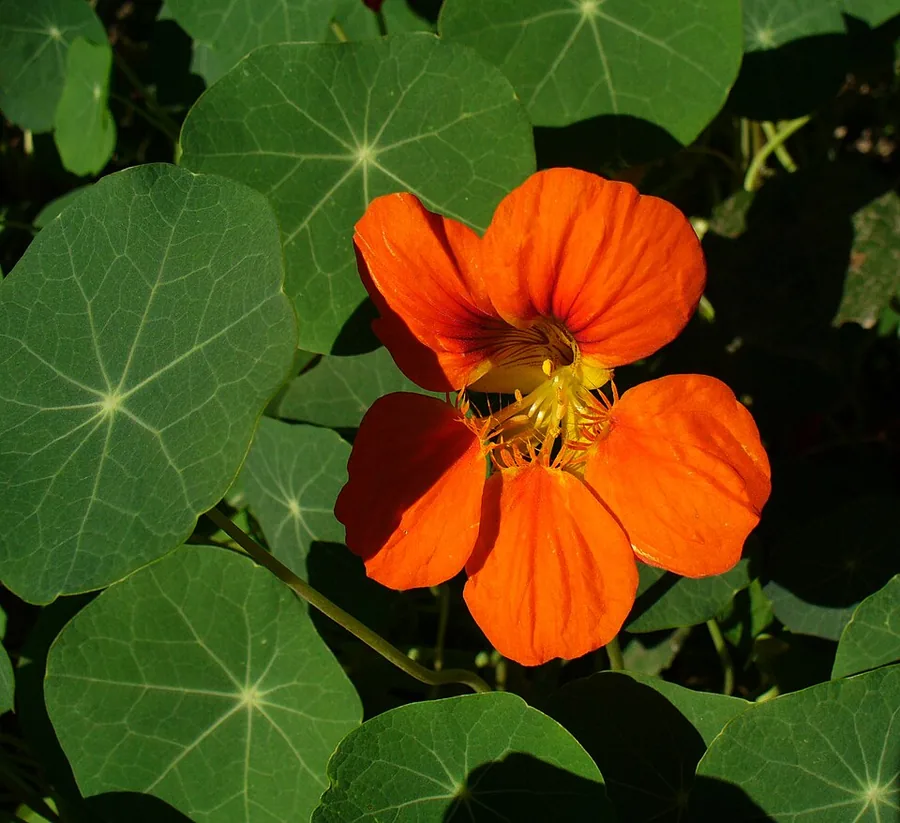
Nasturtium is a fast-growing annual valued for its edible flowers and peppery leaves. Habit varies with the selection, from climbing and trailing forms to compact mounds, and the round peltate leaves paired with warm-toned blooms account for its long standing as a cottage-garden plant. The characteristic watercress-like pungency runs through the whole plant, which is why the leaves and flowers appear in salads and as a garnish.
Its defining trait horticulturally is a low nutrient requirement. Most ornamentals reward feeding, but nasturtium performs best in lean, poor soil with no added fertility, because excess nitrogen shifts the plant toward foliage and suppresses flowering. The practical rule is to plant it and leave it unamended.
The plant also has a documented role in pest management. Aphids and cabbage caterpillars are strongly drawn to it, a behavior gardeners exploit by growing it as a trap crop that concentrates those pests away from adjacent vegetables.
Care
The short version: full sun and lean, well-drained soil with no fertilizer, since added nitrogen costs you flowers. Water enough to carry young plants through establishment, then let settled plants dry slightly between waterings, and direct sow the seeds in place rather than transplanting.
Light
Site nasturtiums in full sun, which is where they flower most freely. They persist in part shade, but reduced light shifts the plant toward leaf production at the cost of blooms, so the sunniest available position is best.
Water
Hold the soil lightly and evenly moist through the establishment phase, when the root system is still shallow. Once established in lean, well-drained ground, the plant tolerates short dry spells, so let the top inch dry before rewatering. The one condition to avoid is waterlogging, which suffocates the roots.
Soil
Grow it in lean, well-drained loam or sandy soil of poor to average fertility, and omit rich compost. This is a plant adapted to low fertility, and enriched ground drives it toward foliage rather than flowers.
Temperature
The comfortable range runs from 50°F to 86°F (10°C to 30°C). As a frost-tender annual with no cold tolerance, it must be sown only after the danger of frost has passed, and it finishes at the first hard frost.
Humidity
Ambient outdoor humidity is sufficient, with no target figure to meet. Good airflow is the more important factor, because congested plantings favor the aphids the species already attracts.
Feeding
Withhold fertilizer entirely. Nasturtium flowers best in hungry soil, and nitrogen-rich feeds produce a leafy plant with almost no bloom, the same nutrient effect described under flowering problems.
Pruning
Maintenance amounts to deadheading. Removing spent flowers redirects the plant's energy into further bloom, and damaged or diseased growth should be cleared as it appears.
Size & spacing
Mature size ranges from 12 inches (30 cm) on the bushy dwarfs to 10 feet (3 m) on the climbers, so confirm the form before placing plants. Allow trailing types room to spread and provide the tall forms a support to ascend.
When to plant
Nasturtium is frost-tender and fast to develop, so timing follows the frost. Sow directly into warmed soil once the spring frost has passed, and the plants flower from early summer until the first fall frost ends the season.
Northern hemisphere
Southern hemisphere
Typical months for a temperate climate: start earlier in warm zones, later where spring frosts linger.
- Sow: Optional, 2 to 4 weeks before the last spring frost in biodegradable pots; resents root disturbance.
- Plant: Direct sow after the last spring frost once soil has warmed; dislikes transplanting.
- Harvest: Blooms early summer until the first fall frost.
Hardiness
USDA hardiness zones: 2–11
Temperature: down to -46°C
Troubleshooting
Problems on nasturtium fall into two groups: pests colonizing the leaves, and a plant that grows lush yet refuses to flower. Both are straightforward to diagnose and correct. Match the symptom below, then intervene before it advances.
Shoot tips coated in honeydew and swarming with small insects
Few garden plants draw aphids as reliably as nasturtium, which is the mechanism behind its long use as a trap crop. Because the plant concentrates the colonies onto itself, a strong jet of water dislodges most of them and a tolerable population can be left in place while it protects nearby vegetables. Where a plant is overwhelmed, remove it and treat the worst foliage with insecticidal soap, since heavy honeydew and curling signal that the colony has outrun predators.
Fix:
- Hose off colonies with a strong jet of water
- Tolerate moderate numbers when used intentionally as an aphid trap crop and remove the worst-infested plants
- Apply insecticidal soap to heavily infested foliage if needed
Ragged holes chewed through the leaves
The feeding damage traces to cabbageworms and cabbage loopers, the larvae of the cabbage white butterfly. Because their green bodies match the foliage, they escape notice, so inspect the leaves closely and remove them by hand along with the dark droppings that give them away. Interplanted with brassicas, the nasturtium concentrates these larvae onto itself, and Bacillus thuringiensis controls any population heavy enough to justify treatment.
Fix:
- Handpick caterpillars
- Use as a companion trap to draw cabbage pests away from nearby brassicas
- Apply Bacillus thuringiensis (Bt) to heavily fed foliage if needed
Plenty of leaves but hardly any flowers
Vigorous foliage with few blooms is the diagnostic sign of soil that is too rich. Excess nitrogen drives vegetative growth at the expense of flowering, so fertile ground and any feeding leave you with a dense mound of leaves and sparse flowers. Withhold fertilizer and grow the plant in lean, well-drained soil in full sun, and the balance shifts back toward bloom.
Fix:
- Stop fertilizing
- Grow in lean, well-drained soil in full sun
Toxicity
For households with pets, the verdict is straightforward: nasturtium is safe all round. The ASPCA lists it as non-toxic to cats, dogs, and horses, and the leaves and flowers are edible for people, with a bright peppery flavor. No part of the plant needs to be kept away from curious animals or children.
Safe for
People · Cats · Dogs · Horses · Rabbits · Livestock · Birds
Cats None
The ASPCA classifies garden nasturtium as non-toxic to cats, so an exploratory nibble carries no risk.
Dogs None
Dogs face no hazard from this plant. A chewed leaf or flower causes no harm, though ingesting a large quantity of any plant material can produce loose stools.
Horses None
The ASPCA rates nasturtium safe for horses, so grazing on the foliage presents no toxicity concern.
Rabbits Safe
The peppery leaves and flowers are non-toxic to rabbits, and many will browse them readily as fresh forage.
Livestock Safe
Grazing livestock can consume the foliage without harm, so a planting within reach of a paddock poses no danger.
Birds Safe
Backyard birds and poultry can take the leaves and seeds safely, as the plant contains no parts toxic to them.
People Safe
Both leaves and flowers are edible, carrying a bright, peppery flavor prized in salads. The immature seed pods can be pickled as a caper substitute.
Varieties
The cultivars divide broadly into trailing climbers and compact bushy dwarfs, with flower color spanning soft cream to deep scarlet. The selections below are the ones worth knowing by name.
Alaska
A compact, bushy selection grown as much for its cream-marbled variegated foliage as for its flowers.
Empress of India
A compact cultivar that sets deep crimson-scarlet flowers over notably dark blue-green leaves.
Jewel
A mounding dwarf that produces semi-double to double flowers on compact, bushy plants.
Climbing/Tall single
A vigorous trailing or climbing form reaching roughly 10 feet (3 m), suited to fences and trellises.
Companions
Nasturtiums earn their place beside vegetables by drawing pests onto themselves and away from the crop, which makes them a useful neighbor for brassicas and squash alike.
Plant near
Cabbage and other brassicas: Used as a companion and trap crop; nasturtium helped reduce imported cabbageworm and cabbage looper damage in broccoli and cabbage.
Squash and other cucurbits: Interplanting nasturtium helped reduce squash bug and cucumber beetle damage in squash and pumpkin.
How to propagate
Nasturtium is among the simplest plants to raise from seed, and the large seeds with quick germination make it well suited to a first-time grower.
SeedEasy
Direct sow after the last spring frost once soil is warm. · Germinates in about 7 to 14 days; blooms within roughly 5 to 7 weeks.
Propagation is from the large, pea-sized seeds, and the plant grows readily from them. Soaking the seeds overnight softens the coat and speeds imbibition, after which they should be sown in their final position once the spring frost has passed and the soil has warmed, because the taproot resents disturbance and the plant rarely transplants well. Germination follows in 7 to 14 days, and flowering begins within roughly 5 to 7 weeks. For an earlier start, sow into biodegradable pots that can be planted intact to avoid handling the roots.
Myths
Nasturtium ingestion poisons cats and dogs.
The ASPCA classifies garden nasturtium as non-toxic to cats, dogs, and horses, and its leaves and flowers are edible for people. The confusion arises from watercress, an unrelated species that carries the botanical name Nasturtium officinale and shares only the common name. Tropaeolum majus is safe to grow around pets.
Aphids avoid gardens where nasturtiums are planted.
The observed effect is the reverse. A nasturtium attracts aphids rather than repelling them, and that attraction is the basis of its function as a trap crop. Sited near a vegetable planting, it concentrates aphids and some caterpillars onto its own tissue and away from the crop you intend to protect.