Ornamental · Amaranthaceae
Amaranth
Amaranthus caudatus
Provide full sun and warm soil, and amaranth produces its trailing tassels from summer into fall.
Full sun
USDA 2–11
3–5 ft · 0.9–1.5 m
Overview
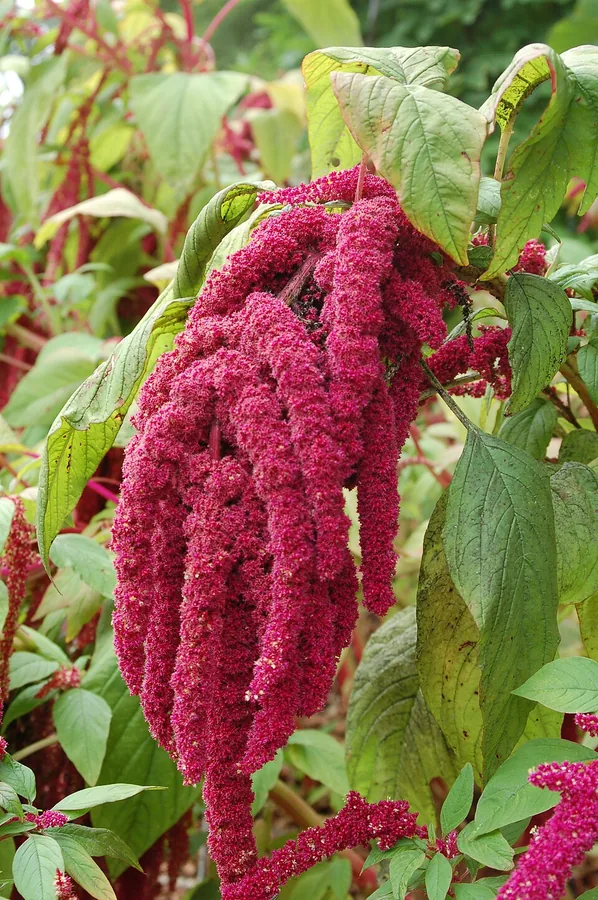
Amaranth is a crop of considerable antiquity, cultivated for grain in the Andes and Mexico over several thousand years and retained today chiefly for its striking inflorescences. The ornamental standard, Love-Lies-Bleeding, bears weighty ropes of crimson or gold tassels that descend nearly to soil level. As an annual it demands little beyond warmth and sun to perform well.
The genus divides along functional lines. The ornamental selections carry pendent or erect plumes in saturated reds, greens, and golds, bred for display. The grain types are grown for the small edible seeds borne within their heads, while the weedy pigweeds occupy the same genus and account for its more troublesome reputation.
Under garden conditions amaranth is exceptionally undemanding. It withstands heat, performs in low-fertility soil, and reseeds without intervention once established. The single agronomic caveat is that the foliage can hold high nitrates, a consideration only where grazing animals have access to the planting.
Care
The short version: position amaranth in full sun and well-drained, moist soil, irrigate it through establishment, restrict fertility, and stake the taller selections once flower spikes develop.
Light
Site amaranth in full sun to obtain the deepest pigmentation and the most robust habit. It accepts a degree of afternoon shade, but reduced light yields weak, etiolated stems and sparse flower spikes.
Water
Maintain evenly moist soil while the plants are young and establishing their root systems. Once established they withstand a dry interval, though consistent moisture supports the fullest growth.
Soil
Amaranth requires well-drained, moist soil and tolerates little beyond that. Drainage is the governing factor, since waterlogged ground is precisely what predisposes the plant to root rot.
Humidity
Ambient outdoor humidity is adequate for amaranth, so no target value applies. Air movement is the greater priority, keeping the foliage dry and suppressing leaf spot.
Feeding
Amaranth seldom requires feeding and performs best in low-fertility ground. Limit nitrogen in particular, because excess drives soft tissue and induces the foliage to accumulate nitrates.
Pruning
Pruning requirements are minimal. Deadhead or cut the spikes for fresh or dried arrangements, and stake the taller selections once the heavy heads form to prevent lodging.
Size & spacing
Mature plants attain 3 to 5 feet (91 to 152 cm) in height with a spread of 12 to 24 inches (30 to 61 cm). Allocate the taller selections adequate room and ensure free air movement around them.
When to plant
Amaranth is a warm-season annual with no frost tolerance. Sow under cover in early spring or direct sow once the danger of cold has passed, and the plants flower from midsummer into autumn, roughly three months from sowing.
Northern hemisphere
Southern hemisphere
Typical months for a temperate climate: start earlier in warm zones, later where spring frosts linger.
- Sow: 6 to 8 weeks before last frost, or direct sow after last frost
- Plant: After danger of last frost has passed
- Harvest: Blooms summer through fall; flowering begins about 3 months after sowing
Hardiness
USDA hardiness zones: 2–11
Temperature: down to -46°C
Troubleshooting
Amaranth remains largely trouble-free across the season, and the few disorders it does encounter present on the foliage, the inflorescences, or the root system. Identify the symptom below, then intervene before it progresses.
Collapse from dark, softened tissue at the crown
Saturated soil deprives the roots of oxygen and favors Phytophthora blight and root rot, the water mold that darkens and softens the root system and lower stems until the plant collapses. An infected specimen cannot recover, so removal and disposal is the only sound response. Correcting drainage in that location is essential before replanting.
Fix:
- Remove and destroy affected plants
- Improve soil drainage
Vein-limited angular lesions on the foliage
Lesions that stay angular and water-soaked, frequently edged with a yellow halo, are characteristic of bacterial leaf spot, where the veins constrain the spread and produce that geometric outline. Removing marked leaves limits inoculum on the plant. Because the bacteria move in surface moisture, watering at the base rather than overhead denies them the film of water they need to disperse.
Fix:
- Remove affected foliage
- Avoid overhead watering to reduce leaf wetness
Honeydew film with curled, malformed new growth
Distorted shoots paired with a sticky residue indicate an aphid colony feeding on phloem sap, which is what deforms the soft tissue and excretes the honeydew you see. Inspect the leaf undersides and flower spikes for the soft-bodied insects clustered there. A forceful jet of water dislodges most of the population, and insecticidal soap is warranted only once numbers climb beyond that.
Fix:
- Spray off with a strong jet of water
- Apply insecticidal soap if populations are heavy
Toxicity
Amaranth presents no toxicity to cats or dogs, both of which the ASPCA classifies it non-toxic for. The substantive concern lies with grazing animals: the foliage can accumulate nitrates and oxalates, and a livestock animal consuming a large quantity of stressed tissue can be poisoned. Exclude cattle, horses, and other grazers from extensive plantings.
Toxic to
Horses · Rabbits · Livestock · Birds · People
Safe for
Cats · Dogs
Horses Caution
The ASPCA rates amaranth non-toxic to horses, yet as obligate grazers they consume foliage in bulk, and high-nitrate tissue poses a risk to any animal taking in that volume. Exclude horses from a sizable planting, particularly following drought.
Rabbits Caution
A small quantity is unlikely to affect a rabbit, but the nitrates and soluble oxalates that compromise grazing stock concentrate in the same foliage. Restrict it to an infrequent portion rather than a dietary staple.
Livestock Severe
Nitrate poisoning in cattle and other grazing animals: increased salivation, labored breathing, incoordination, weak pulse, muscle tremors, weakness, chocolate-brown blood, and death; signs appear about two to six hours after eating. Soluble oxalates and nephrotoxin can also cause kidney damage.
Birds Caution
Birds readily consume the ripe seed, which poses no issue, but sustained feeding on nitrate-rich foliage is a separate hazard. Permit access to the seed heads and disregard concern over the rest.
People Caution
Amaranth is cultivated as both a grain and a leaf crop, each consumed after cooking. The qualification is the nitrate and oxalate content in foliage from stressed plants, so cook the greens and exclude leaves harvested from drought-affected stands.
Cats None
The ASPCA classifies amaranth as non-toxic to cats, so an exploratory bite presents no clinical concern.
Dogs None
Amaranth carries the same non-toxic classification from the ASPCA for dogs, meaning an ingested leaf produces no toxic effect.
Safe to grow around dogs and cats; the main risk is to grazing animals eating large amounts of foliage, especially under drought stress or high soil nitrogen.
Helpline numbers

United States
ASPCA Animal Poison Control: (888) 426-4435 (fee applies)
Poison Control: (800) 222-1222



Canada
Poison Centres: 1-844-764-7669
Varieties
Amaranth spans ground-trailing ornamentals through to erect grain crops. The selections below are the ones most commonly encountered.
Amaranthus caudatus (Love-Lies-Bleeding)
The defining ornamental species, distinguished by pendent tassels of red or gold that cascade toward ground level.
'Viridis'
A green-flowered selection of Love-Lies-Bleeding cultivated for its uncommon chartreuse inflorescences.
Amaranthus cruentus
An erect dual-purpose species, grown for ornament and for the edible seed produced in its upright plume-like heads.
Amaranthus hypochondriacus (Prince's Feather)
A tall, upright grain species, and the one the ASPCA documents as non-toxic to cats and dogs.
How to propagate
Amaranth ranks among the most straightforward plants to raise from seed, and it self-seeds throughout the garden once introduced.
SeedEasy
Sow indoors 6 to 8 weeks before last frost, or direct sow outdoors after last frost. · Flowering begins roughly 3 months after sowing
Amaranth germinates readily and naturalizes through self-seeding once established in a bed. Sow under protection 6 to 8 weeks ahead of the last frost, or direct sow into prepared ground once frost risk has lifted. Thin the seedlings or transplant them, after which the inflorescences open approximately three months from sowing.
Myths
Amaranth flowers are toxic to cats and dogs.
The ASPCA enters amaranth on its non-toxic list for cats, dogs, and horses, which means the flowers carry no genuine hazard for companion animals. The documented toxicity applies to grazing livestock, in which nitrate and oxalate accumulation within the foliage is the operative mechanism.
Amaranth is edible, so unrestricted grazing must be safe for any animal.
Pigweeds in this genus sequester nitrates and soluble oxalates in their leaves and number among the principal causes of nitrate poisoning in cattle. Drought stress and high nitrogen elevate those concentrations to their maximum, which is precisely the window in which a grazing animal incurs the greatest risk.