Ornamental · Amaranthaceae
Globe Amaranth
Gomphrena globosa
Site globe amaranth in full sun and warm, well drained ground, and it carries papery clover-like flowers from summer until frost.
Full sun
Every 5–10 days
70–75°F · 21–24°C
84–112 days
Overview
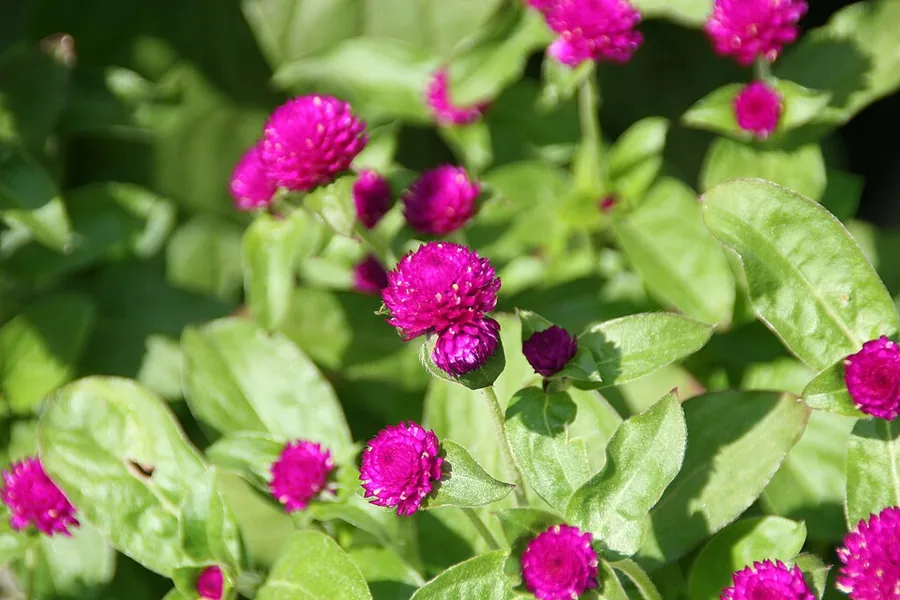
Globe amaranth is valued for its round, papery flowerheads, which read like small clover blooms and retain pigment for months because the color sits in persistent, chaffy bracts rather than short-lived petals. As a tender annual it performs across a broad climatic range in a sunny bed or container, and its heat and drought tolerance exceed that of most summer flowers.
Flower color spans pink, purple, white, and red, borne on wiry stems above a compact mound of foliage. The bracts that give the heads their durability also let cut stems dry while holding form and shade for a year or longer, the reason the species dominates everlasting bouquets. In the border it draws butterflies and is generally passed over by deer.
It is an undemanding plant well suited to beginners. It needs little once established, tolerates poor soil, and continues flowering as long as spent heads are removed and apical growth is checked. Supply full sun and enough spacing for air to move, and the most common problems seldom develop.
Care
The short version: grow it in full sun and average, well drained soil, keep it evenly moist while young, then reduce watering because it manages heat and drought once established. Feed every couple of weeks through the season and deadhead to sustain flowering.
Light
Globe amaranth requires full sun, meaning at least 6 hours of direct light daily. It persists in partial shade, but under reduced light the stems elongate, lodge, and initiate far fewer flowers. Flower yield rises in direct proportion to the sun the plant receives.
Water
Hold the soil evenly moist while the plants are young and rooting in. Once established, reduce watering sharply, because the species tolerates heat and drought yet is intolerant of saturated roots. Allow the top half of the profile to dry before rewatering, since sustained wetness predisposes it to disease.
Soil
Average, well drained soil meets its full requirement. A pH of 6.0 to 7.0 is ideal, and it endures poorer ground than most annuals. The one condition it will not accept is a heavy, waterlogged medium that remains wet.
Temperature
This is a warmth-dependent species that grows best near 70°F to 75°F (21°C to 24°C). It performs through hot summers but has no frost hardiness, so transplant it out only after the risk of cold has passed.
Humidity
Ambient outdoor humidity is adequate, so no target value applies. Air movement is the operative factor, because still, humid air within a crowded stand is what precipitates mildew and mold.
Feeding
Apply a water-soluble fertilizer at planting, then continue at intervals of a couple of weeks through the growing season. Regular light feeding underwrites the extended flowering period.
Pruning
Deadhead or harvest the spent flowerheads to maintain successive bloom across the season. Pinching young plants early is equally useful, as it releases lateral branches for a denser, bushier form.
Size & spacing
Mature plants stand 12 to 24 inches (30 to 61 cm) tall with a spread of 6 to 12 inches (15 to 30 cm). Space them about 8 inches apart so air circulates between plants and the foliage dries.
When to plant
Globe amaranth is a warm season annual with no frost tolerance, so its schedule tracks soil and air warmth. Sow indoors in late winter or direct sow after the soil has warmed, and the plants flower from early summer until the first killing frost.
Northern hemisphere
Southern hemisphere
Typical months for a temperate climate: start earlier in warm zones, later where spring frosts linger.
- Sow: 6 to 8 weeks before last frost; soak seed overnight and keep at 70 to 75°F for germination in 2 to 3 weeks
- Plant: After all danger of frost has passed and soil has warmed, spaced about 8 inches apart
- Harvest: Blooms from early summer through fall until frost
Hardiness
USDA hardiness zones: 2–11
Temperature: down to -46°C
Troubleshooting
Most disorders in globe amaranth arise from damp, crowded conditions or inadequate light, both of which are correctable. Reading the leaf symptoms early usually lets you reverse the problem through better spacing and a steadier watering regime. Match the observed sign below, then intervene before it advances.
Gray fuzzy growth or dark lesions on the foliage
Prolonged cool, wet weather favors gray mold (Botrytis) along with several fungal leaf spots, all of which need a film of surface moisture to infect. Excising the affected tissue as it appears removes the inoculum, and watering at soil level rather than over the canopy denies the spores the wet leaf they require. Wider spacing raises airflow through the stand, which speeds drying and suppresses reinfection.
Fix:
- Remove affected plant parts
- Avoid overhead watering and wetting foliage
- Increase spacing and air movement
Sparse or absent emergence following sowing
Gomphrena carries a naturally low germination rate and slow emergence, a trait that cold soil compounds by holding the seed dormant. An overnight soak softens the seed coat and speeds imbibition, and a soil temperature of 70°F to 75°F (21°C to 24°C) supplies the warmth the embryo needs to break dormancy. Oversowing offsets the expected losses, and delaying any direct sowing until the ground is warm avoids chilling the seed.
Fix:
- Soak seed in water overnight before planting
- Maintain 70 to 75°F soil for germination
- Sow extra seed to compensate for low germination
White powdery film across the leaf and stem surfaces
That coating is powdery mildew, a foliar fungus that gains a foothold when the plant is weakened by drought stress or held in cool, damp air. Because the pathogen thrives in stagnant humidity, opening the planting with wider spacing and thinning crowded stems lets the canopy dry, while a consistent watering rhythm keeps the plant unstressed. Remove and discard the most heavily colonized foliage to cut the source of new spores.
Fix:
- Improve air circulation by spacing and thinning
- Water consistently to avoid drought stress
- Remove and discard severely affected foliage
Elongated, lax stems bearing sparse bloom
Etiolated, floppy growth with few flowers is the plant's response to insufficient light, since low irradiance drives stem elongation at the expense of flower initiation. Relocating or replanting it where it receives at least 6 hours of direct sun restores the compact, floriferous habit. Pinching young plants removes apical dominance, which releases the lateral buds into more branches and a denser display.
Fix:
- Relocate or plant in full sun
- Pinch young plants to encourage branching
Toxicity
For households with animals, globe amaranth is safe throughout. The ASPCA lists it as non-toxic to cats, dogs, and horses, and it presents no meaningful hazard to other animals or to people. The only foreseeable effect is a brief digestive upset in an animal that consumes a large volume of any plant material.
Safe for
People · Cats · Dogs · Horses · Rabbits · Livestock · Birds
Cats None
The ASPCA classifies globe amaranth as non-toxic to cats, so ingestion carries no systemic toxin. A cat that samples the papery flowers is unharmed, though the mechanical bulk of any large plant meal can trigger transient drooling or mild gastrointestinal upset.
Dogs None
The species is safe for dogs, with no toxic principle in the stems or flowerheads. The only likely effect from overconsumption is a mild, self-limiting digestive upset driven by plant fiber rather than poison.
Horses None
Globe amaranth registers as non-toxic to horses, and incidental grazing presents no measurable toxicological risk.
Rabbits Safe
Rabbits may browse the foliage freely, as the tissue contains no toxin that would affect them, leaving the plant safe for any that reach the bed.
Livestock Safe
Cattle, goats, and sheep can graze in proximity without hazard, since the plant holds nothing toxic to ruminant livestock.
Birds Safe
Birds face no risk from it, and many forage on the dried seed heads, which keeps the plant safe for both wild and pet species.
People Safe
For people the plant is safe, and the dried flowers are prepared as a herbal infusion in several traditions. No precaution is needed to keep children clear of it.
Varieties
Globe amaranth is offered in tall cutting selections and compact dwarfs for edging. The selections below are the ones most frequently encountered.
Strawberry Fields
A taller selection at 18 to 28 inches, distinguished by vivid red bracts set with minute yellow true flowers.
Las Vegas series
A compact 16 to 20 inch series available in pink, purple, and white, useful for assembling a multicolor planting from one habit.
Buddy series
A dwarf reaching only 6 to 8 inches, suited to edging and confined sites that larger selections would overwhelm.
Fireworks
Marked by luminous pink bracts finished with yellow tips, it sustains a longer flowering period than most other globe amaranths.
How to propagate
Globe amaranth is propagated from seed, and the single constraint is the patience the slow, low-germinating seed demands.
SeedEasy
Start indoors 6 to 8 weeks before last frost, or direct sow after frost and once soil is warm · Germinates in 2 to 3 weeks; blooms about 12 to 16 weeks after sowing
Propagate globe amaranth by seed, sown indoors 6 to 8 weeks before your last frost or direct sown into warmed soil once frost has passed. An overnight soak plus a steady 70°F to 75°F (21°C to 24°C) hastens germination, which follows in 2 to 3 weeks. Harden the seedlings before transplanting into full sun, and anticipate first bloom roughly 12 to 16 weeks from sowing.
Myths
Globe amaranth needs frequent watering to thrive.
After establishment this species tolerates heat and drought through deep, efficient rooting, so constant irrigation is unnecessary. Watering on a fixed heavy schedule is counterproductive, because saturated soil and persistently wet foliage create the conditions mildew and root rot exploit. Irrigate the plant well while young, then reduce watering and allow the surface to dry between applications.
Globe amaranth is toxic to pets.
The ASPCA records it as non-toxic to dogs, cats, and horses. Consumption of a large quantity may provoke a mild, self-limiting gastrointestinal upset from plant bulk, but the species contains no toxic compound of concern.