Vegetable · Amaranthaceae
Swiss Chard
Beta vulgaris subsp. vulgaris
One sowing, harvested from the outer stalks, yields leaves across a long season as the crown keeps regenerating.
Full sun
Every 3–7 days
41–86°F · 5–30°C
50–60 days
Overview
Swiss chard is a leaf vegetable in the family Amaranthaceae, the same species as the garden beet but selected for its foliage rather than a swollen root. The broad, glossy blades and thick petioles are the harvested crop. As a biennial grown as an annual, it invests the first season entirely in vegetative growth, flowering only if carried into a second year.
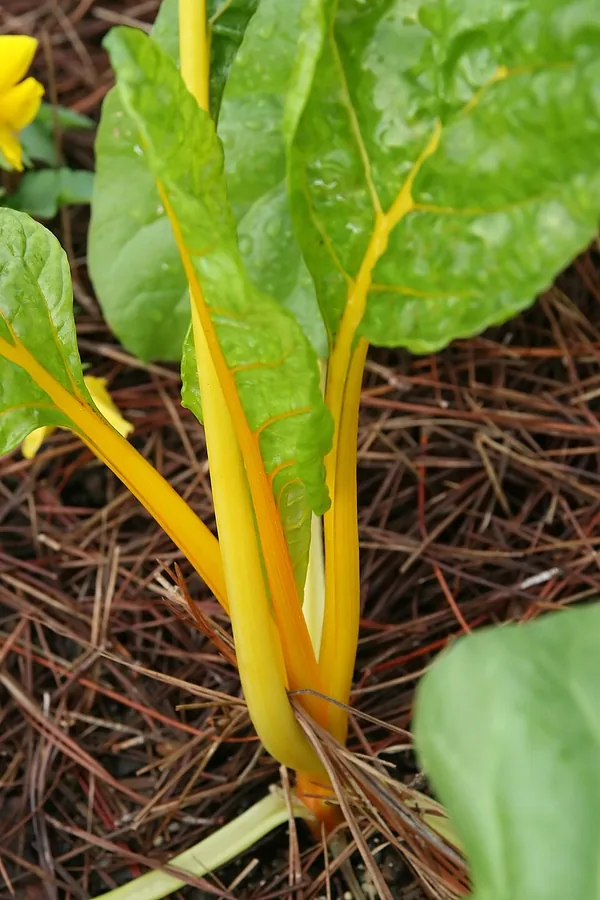
Its value in the garden rests on unusual tolerance at both ends of the temperature range. Chard withstands summer heat and light frost more readily than most leafy greens, which is why a single spring sowing can remain productive into fall. The pigmented cultivars add ornamental interest, with stalks in red, pink, yellow, and white contrasting against dark blades.
Few crops suit a beginner better. Sowing, consistent soil moisture, and repeated removal of the outer leaves are enough to keep the central crown producing. Provided with steady water and a fertile medium, chard demands little further intervention across the season.
Care
The short version: full sun with tolerance for afternoon shade, a fertile and evenly moist medium, and regular removal of the outer leaves to sustain tender new growth from the crown.
Light
Chard yields best under full sun but tolerates partial shade, and that shade is useful in hot weather because a reduced heat load delays bolting. Under deep shade, photosynthesis falls off, producing thin blades and slow growth.
Water
Maintain evenly moist soil, roughly 1 to 1.5 inches of water per week. Consistent moisture keeps the blades tender and buffers the plant against the moisture stress that, together with heat, drives bolting.
Soil
Grow chard in rich, well-drained loam with ample organic matter. It performs at a pH of 6.0 to 7.0, and incorporating compost before sowing improves both fertility and moisture retention through the season.
Temperature
Chard grows across a broad thermal range, from about 41°F to 86°F (5°C to 30°C). It endures light frost without injury and continues through summer heat that halts less tolerant greens.
Humidity
Ambient outdoor humidity suits chard, with 40% to 70% well within tolerance. Air movement matters more than any set figure, since still, humid conditions around crowded foliage favor Cercospora leaf spot.
Feeding
Side-dress a balanced, nitrogen-containing vegetable fertilizer during active leaf growth, beginning in spring. Because harvest continuously removes foliage, a sustained nitrogen supply is what drives replacement growth.
Pruning
Harvest is the operative pruning. Cutting the outer leaves at 4 to 12 inches near the base while leaving the central crown intact preserves the growing point, so the plant regenerates cut-and-come-again.
Repotting
Grown as an annual, chard is not repotted. Reseed containers each season rather than carrying a plant over, and use a planter with enough volume to avoid root restriction.
Size & spacing
Mature plants reach 12 to 24 inches (30 to 60 cm) in height with an 8 to 18 inch (20 to 45 cm) spread. Thinning seedlings to 4 to 6 inches apart provides room for each plant and airflow between them.
When to plant
Chard is a cool-season crop tolerant of both spring cold and summer heat, which widens its sowing window. Start seed indoors in late winter, or direct-sow a couple of weeks ahead of the last frost. A second sowing in late summer extends production through fall.
Northern hemisphere
Southern hemisphere
Typical months for a temperate climate: start earlier in warm zones, later where spring frosts linger.
- Sow: 4 to 6 weeks before the last spring frost
- Plant: 2 to 3 weeks before the last spring frost, and again in late summer for a fall crop
- Harvest: Harvest leaves from early summer through fall (and over winter in mild climates)
Hardiness
USDA hardiness zones: 3–10
Temperature: down to -40°C
Troubleshooting
Chard is largely trouble-free, and the disorders that do occur concentrate on the foliage. Because the outer leaves are expendable, early recognition lets you remove affected tissue before a problem establishes. Identify the symptom below, then intervene while removal still resolves it.
Tan lesions with purple margins on the blades
Round spots edged in purple that coalesce as they enlarge indicate Cercospora leaf spot, a fungal disease of the foliage. Excise and destroy affected leaves while continuing to harvest the clean outer ones. The most effective control is thinning to increase air movement, since drier foliage limits infection.
Fix:
- Remove and destroy infected leaves
- Harvest healthy outer leaves
- Improve air circulation by thinning
An elongating seed stalk with declining leaf quality
A rising central stalk marks bolting, the shift from vegetative growth to reproduction triggered by sustained heat or by cold exposure early in development. As the stalk elongates, leaf production slows and flavor turns bitter. Harvest the usable foliage before quality declines, then remove the bolted plant and resow.
Fix:
- Harvest remaining leaves before they turn bitter
- Pull bolted plants and resow for a fresh crop
Serpentine pale mines within the leaf tissue
The winding tunnels are the work of leafminer larvae, which feed within the leaf between the upper and lower surfaces. Backlighting a blade reveals the larva or its dark frass inside the mine, confirming the cause. Removing and destroying mined leaves as they appear ends the infestation, and a vigorous plant readily compensates for the sacrificed foliage.
Fix:
- Pick off and destroy mined leaves promptly
- Remove larvae by hand
- Keep plants vigorous so outer leaves can be sacrificed
Toxicity
For people, Swiss chard is a nutritious green eaten cooked or raw, with nothing toxic present. Its concern is a high content of soluble oxalates, a mild caution for cats, dogs, horses, and grazing animals consuming large amounts over time. An incidental taste is harmless, but sustained feeding is inadvisable for any animal.
Toxic to
Cats · Dogs · Horses · Rabbits · Livestock · Birds
Safe for
People
Cats Caution
Chard is not toxic to cats, but the foliage is high in soluble oxalates. An occasional nibble is inconsequential, whereas frequent large servings can irritate the digestive tract and, with time, burden the kidneys.
Dogs Caution
A small quantity poses no risk to dogs. Portions should stay limited, however, since a high oxalate intake can upset the stomach and, in quantity, act against the kidneys.
Horses Caution
Small amounts are safe for horses, though chard carries more oxalate than is ideal. Prolonged heavy grazing can disrupt calcium metabolism and place added load on the kidneys.
Rabbits Caution
Chard is acceptable within a rabbit's mixed leafy diet but unsuited to daily feeding. Because oxalates accumulate, it is best rotated with lower-oxalate greens rather than offered on its own.
Livestock Caution
Goats, sheep, and cattle tolerate modest amounts without incident. Large intakes of the oxalate-rich foliage over time can interfere with calcium availability and strain the kidneys.
Birds Caution
Backyard hens and pet birds may take chard intermittently. Its oxalate content makes it suitable as an occasional item rather than a staple ration.
People Edible
For people, Swiss chard is a nutritious culinary green, safe cooked or raw. The single caveat is its high oxalate content, chiefly relevant to individuals predisposed to kidney stones.
No special handling precautions are required; rinse leaves before eating.
Helpline numbers

United States
ASPCA Animal Poison Control: (888) 426-4435 (fee applies)

United Kingdom
Animal PoisonLine: 01202 509000 (fee applies)

Australia
Animal Poisons Helpline: 1300 869 738
Varieties
Chard cultivars are distinguished mainly by petiole and midrib color and by leaf texture rather than by growth habit. The following are the most widely grown.
Bright Lights
An All-America Selections winner whose petioles and midribs express a range of red, pink, yellow, orange, and white.
Northern Lights
It shows comparable pigmentation in its petioles and midribs, spanning red, pink, yellow, and white.
Ruby (Rhubarb) Chard
Distinguished by deep red petioles and veins set against dark green, heavily savoyed blades.
Fordhook Giant
A vigorous heirloom producing broad white petioles and large, dark green, crumpled blades.
Companions
Chard does well alongside other cool-season leafy crops and a few common garden neighbors, and poorly next to beans, which don't share well with it or its beet relatives.
Plant near
Cabbage family (brassicas): Listed as compatible neighbors that share cool-season conditions in extension companion guidance.
Lettuce: Compatible low-competition leafy crop grown in the same cool-season beds.
Tomatoes: Listed as a beneficial companion for chard in extension companion planting guidance.
Keep apart
Beans: Beans are listed as an incompatible companion for chard and beets in extension companion planting guidance.
How to propagate
Chard is propagated from seed alone. One feature of that seed warrants explanation before sowing.
SeedEasy
Spring and again in late summer for a fall crop · 50 to 60 days from sowing to first full harvest
Chard establishes readily from seed sown in spring and again in late summer for a fall crop. Each 'seed' is in fact a multigerm ball, a dried fruit cluster that produces several seedlings together, so thinning to 4 to 6 inches apart is necessary after emergence. Allow about 50 to 60 days from sowing to the first full harvest.
Myths
Swiss chard requires resowing every few weeks, as spinach does, to prevent bolting.
In practice, chard tolerates heat and cold far better than spinach and is markedly slower to bolt. A single planting remains productive cut-and-come-again over a long season, so the successional sowings spinach requires are unnecessary here.