Vegetable · Brassicaceae
Arugula
Eruca vesicaria subsp. sativa
Start it during cool weather and peppery foliage is ready to cut in roughly a month.
Full sun
Every 2–3 days
41–77°F · 5–25°C
40–50 days
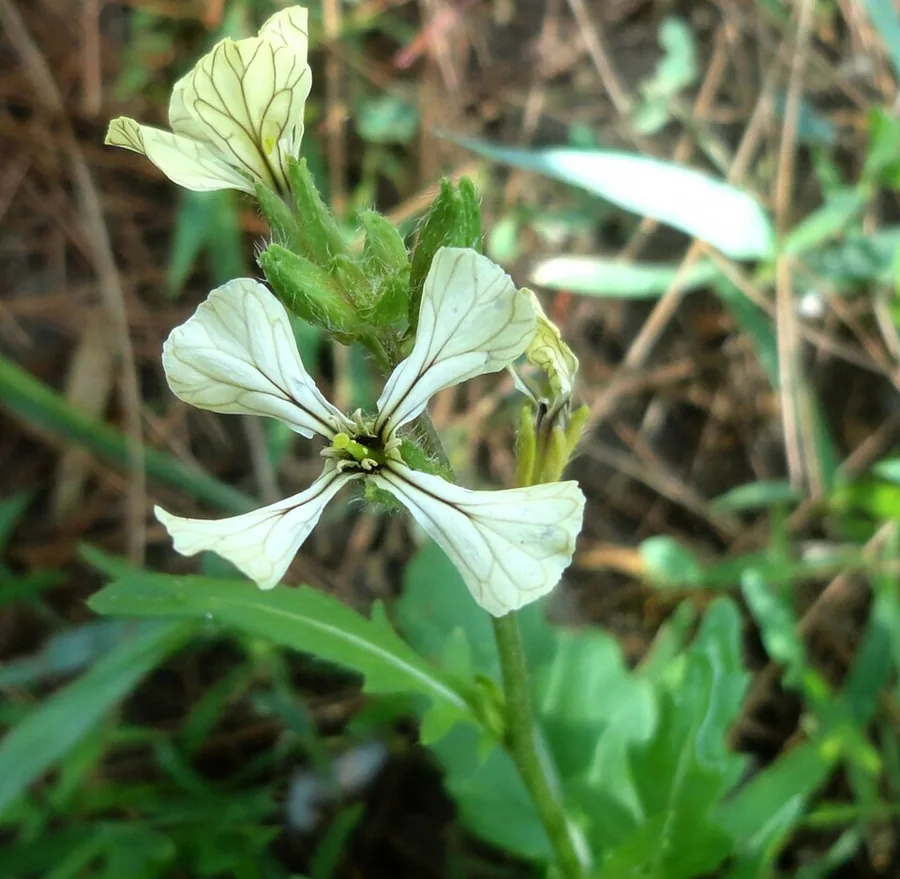
Overview
Arugula is the quick, peppery salad green suited to a gardener short on patience. It sits within the cabbage family, alongside broccoli and mustard, and that kinship explains the sharp mustardy character of the leaves, which carry the same glucosinolate-driven pungency as its relatives. Drop a short row and foliage is ready to pick about 4 to 6 weeks later.
By nature this is a cool-season crop. Its strongest performance comes during the temperate intervals of spring and fall, the conditions that keep foliage tender and nutty. Force it through midsummer heat and the plant bolts, throwing a flower stalk and shifting leaf chemistry toward bitter and tough.
Almost no green demands less. Arugula performs equally in a garden bed or a shallow windowsill pot, germinates within days, and keeps producing provided you take the outer leaves and sow a fresh row every week or two.
Care
The short version: full sun with a touch of afternoon shade, soil held evenly moist, and cool temperatures to preserve mild flavor. Sow shallowly, take the outer leaves frequently, and begin a new row every week or two.
Light
Arugula favors full sun through spring and fall, while temperatures remain low enough to suit it. As heat builds, a position offering afternoon shade tempers the plant's drive to bolt and holds the leaves milder longer.
Water
Hold the soil evenly moist and irrigate every 2 to 3 days through dry periods. Allowing it to dry imposes water stress, which advances bolting and shifts the leaves toward bitter and tough.
Soil
Set it in rich, well-drained loam with ample organic matter incorporated. A pH between 6.0 and 7.0 is appropriate, and ground that retains moisture without becoming waterlogged sustains fast, tender leaf growth.
Temperature
Arugula performs best in the cool, between roughly 41°F and 77°F (5°C to 25°C). It tolerates light frost without harm, yet heat is the limiting factor, driving flowering and degrading flavor.
Humidity
Standard outdoor air is adequate, in the region of 40% to 70% humidity, so no precise figure warrants attention. Consistent soil moisture carries far more weight for arugula than atmospheric moisture.
Feeding
Incorporate a nitrogen-rich balanced fertilizer or compost into the bed at planting, and a quick crop of this kind generally needs nothing more. Sound soil at the outset sustains the leaves through to harvest a few weeks on.
Pruning
Take the outer leaves often to prompt fresh growth from the crown. Once the plant initiates bolting and raises a flower stalk, gather what remains before the flavor turns sharp.
Repotting
Arugula is treated as an annual and resown each season rather than potted on. For container culture, choose one at least 4 to 6 inches deep and begin with new seed each cycle instead of carrying over an aging plant.
Size & spacing
The plants remain compact, reaching from 8 to 36 inches (20 to 91 cm) in height, with the flower stalk responsible for the tallest figures. Thin or set seedlings about 6 inches apart so each has space to develop a full rosette.
When to plant
Arugula responds to temperature rather than the summer calendar. Direct sow during early spring as soon as the soil is workable, repeat the sowing in late summer for an autumn crop, and foliage will be cuttable roughly a month after each round. Avoid the peak heat weeks, when bolting can begin almost as quickly as the plant emerges.
Northern hemisphere
Southern hemisphere
Typical months for a temperate climate: start earlier in warm zones, later where spring frosts linger.
- Sow: 4-6 weeks before the last spring frost (optional; direct sowing preferred)
- Plant: Direct sow in early spring as soon as soil can be worked, then again in late summer for a fall crop
- Harvest: Leaves harvestable about 4-6 weeks after sowing, mainly in cool spring and fall
Hardiness
USDA hardiness zones: 2–11
Temperature: down to -46°C
Troubleshooting
Arugula presents few problems, and they read clearly. Heat-driven bolting dominates, with a pair of common insects filling out the rest. Compare what is in front of you against the entries below and intervene early, while foliage remains worth cutting.
Central stalk rises and the foliage sharpens
What you are seeing is bolting, the plant redirecting its energy from vegetative leaves into reproduction, and warmth paired with long summer days is the trigger. After the switch flips, fresh foliage emerges thin and aggressively pungent. Cut whatever is still palatable, remove the spent plant, and start a new batch in a cooler position.
Fix:
- Harvest all usable leaves promptly before they turn bitter
- Pull bolted plants and start a fresh succession sowing
- Move new sowings to a cooler or partly shaded spot
Foliage stippled with small circular punctures
Those pinpoint perforations come from flea beetles, tiny dark insects that spring away the instant a leaf is disturbed. The damage concentrates on tender seedlings, which have the least tissue to spare. Lay floating row cover over the bed from sowing day, and cut the quick-growing foliage before the feeding accumulates.
Fix:
- Cover plantings with floating row cover at sowing
- Harvest quickly-maturing leaves before damage accumulates
Soft-bodied colonies coating the tender growth
Green or gray groupings clinging to leaf undersides and young shoots point to aphids, which often leave a tacky film as they feed. A forceful jet of water dislodges the bulk of them, and any leaf that is heavily encrusted can simply be removed. Resident predators tend to suppress populations without further intervention.
Fix:
- Rinse colonies off with a strong spray of water
- Remove and discard heavily infested leaves
Toxicity
Arugula is a salad green in every respect, safe for people and pets alike. No part of the plant carries a toxic principle, so it grows freely among cats, dogs, rabbits, and inquisitive children. Its single request is to be eaten.
Safe for
People · Cats · Dogs · Horses · Rabbits · Livestock · Birds
Cats None
Harmless to cats, since the foliage holds no compound that would injure them. A small taste could produce brief digestive upset, as any unfamiliar green might, but no genuine hazard exists.
Dogs None
Free of toxins, so an inquisitive dog can investigate or chew the plant safely. A large quantity of any leafy green may temporarily soften the stool, and that marks the limit of the concern.
Horses Safe
No component of arugula threatens horses. Like any nutrient-dense green, it serves best as an occasional portion rather than a fixture of the ration.
Rabbits Safe
The leaves are suitable for rabbits, and many take readily to the peppery flavor. Provide it sparingly alongside their established greens.
Livestock Safe
Goats, sheep, and cattle may graze arugula without ill effect. It is a sound leafy green that integrates well into mixed forage.
Birds Safe
Backyard hens and similar birds can safely peck at the foliage, and the greens lend some variety to their feeding.
People Safe
Arugula exists to be eaten. The leaves drop raw into salads or wilt into cooked preparations, with no portion of the plant requiring caution.
Safe to grow around pets and children; the leaves are edible raw.
Varieties
Most arugula on the market is ordinary salad rocket, yet a handful of named selections merit attention for their flavor and their tolerance of warm conditions.
Astro
Matures quickly, carries a gentle flavor, and resists bolting beyond the typical window, making it dependable when temperatures climb.
Roquette
The classic heirloom salad rocket, marked by deeply cut foliage and the assertive peppery edge most associate with arugula.
Wasabi
Selected for an exceptionally pungent, horseradish-like heat that distinguishes it even within the rocket group.
Companions
Plant near
Bush beans: Beans fix nitrogen and their canopy shades the bed, helping cool-loving arugula stay productive and delay bolting.
Lettuce: Shares arugula's preference for cool, moist conditions and interplants well in the same cool-season bed.
Root crops (beets and carrots): Listed as compatible interplanting partners that use different soil layers, allowing efficient use of cool-season bed space.
How to propagate
Arugula is propagated from seed and essentially nothing else, which is one reason the crop is so straightforward to maintain.
SeedEasy
Direct sow in early spring and again in late summer/fall · Germinates in about 5-7 days; seedlings established within 2-3 weeks
Seed is effectively the only way arugula is raised. Sow it shallowly directly into the bed during early spring, repeat the sowing in late summer for an autumn crop, and expect emergence in about 5 to 7 days. As the seedlings take hold across 2 to 3 weeks, thin them to roughly 6 inches apart, then keep dropping a brief row every week or two so foliage continues all season.
Myths
Arugula is naturally bitter and unpleasant to grow.
Bitterness traces to heat and bolting rather than to any inherent quality of the plant. Foliage cut young during cool spring or fall weather is mild and nutty, nothing like the harsh greens left standing through a summer that ran too long.
Arugula is hard to grow from seed.
It ranks among the simplest and quickest greens available. Germination occurs within days and foliage is cuttable in roughly 40 to 50 days, which makes it an excellent starting crop for someone new to gardening.