Vegetable · Brassicaceae
Cauliflower
Brassica oleracea Botrytis Group
Give it cool air, ample feeding, and unbroken moisture, and the payoff is one firm, weighty head.
Full sun
Every 3–7 days
45–75°F · 7–24°C
55–100 days
Overview
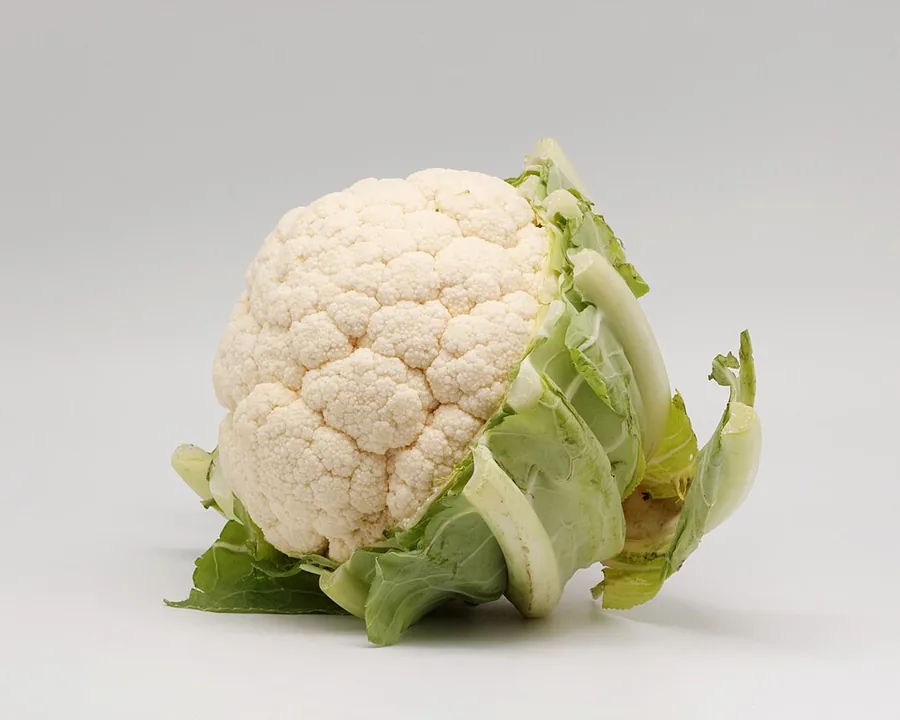
Belonging to the cabbage family and built for cool seasons, cauliflower is grown for its curd: the dense white dome of arrested flower buds packed at the center of a leafy rosette. Selection took it down a different road from its wild relatives that also gave rise to cabbage, broccoli, and kale, concentrating the plant's energy into that one compact cluster. Timing is everything at harvest, because a head cut on schedule stays firm and mild while one left too long breaks open quickly.
Few brassicas test a grower the way this one does, and it ranks fairly among the more demanding brassicas. What it asks for is constancy: cool, settled weather running unbroken from the seedling stage all the way to the cut. Throw a cold snap, a run of warm days, or a brief dry patch into that stretch and growth falters, often yielding a marble in place of a head.
These days the color range is reason enough to plant it. Set beside the ordinary white you have orange, purple, and lime-green Romanesco options, and each of those pigmented forms builds its color out in the open sun instead of under tied wrapper leaves. Choose according to your season and how much fuss you will tolerate, and a worthwhile crop comes of it.
Care
The short version: site it in full sun, in fertile soil kept evenly damp at roughly pH 6.0 to 7.0, feed it heavily, and protect the one thing that matters most, cool and unbroken growth running from seedling to harvest.
Light
Plan on full sun for this crop, six hours daily or better, with a tolerance for light afternoon shade in regions where spring warms ahead of schedule. Sunlight does double duty for the pigmented selections, which use it to lay down their orange, purple, and green coloring.
Water
Everything turns on keeping the root zone evenly damp. Target about 1 inch (2.5 cm) of water a week, and treat any drying out as a real threat, since a lone bout of drought stress is enough to spoil the curd or kick off buttoning. Because sandy ground sheds water faster than clay, irrigate it on a tighter schedule.
Soil
Set plants into rich, fertile, well-drained loam that has been built up with compost or aged manure so it stays damp yet never sodden. Keeping pH at 6.0 to 7.0 maintains nutrient availability and works against the hollow stem that acidic ground tends to bring on.
Temperature
Cool seasons are its element, with growth strongest between 45°F and 75°F (7°C to 24°C). Push past 86°F (30°C) for days on end, or string together warm nights, and the curd aborts or comes in misshapen, so schedule around any spell of true heat.
Humidity
Ambient outdoor moisture in the 40% to 70% band serves it fine, with nothing to monitor on that front. Far more useful is steady air movement across the bed, because foliage that stays crowded and wet is an invitation to disease.
Feeding
Count cauliflower among the heavy feeders. Blend a balanced 5-10-10 product through the soil ahead of planting, return with a nitrogen side-dressing roughly 3 to 4 weeks after the transplants go in, and keep boron at sufficient levels to head off curd browning.
Pruning
Shaping plays no part, yet blanching is the job for white types: as soon as the curd grows to 2 to 3 inches, gather the wrapper leaves over it and secure them to hold the pale color, except where the variety blanches on its own. Romanesco along with the orange and purple kinds stay open to the light, and any spent outer leaf gets cleared away.
Repotting
Treat cauliflower as a garden crop, not a potted one, so a repotting schedule never applies. Raise it in cells or flats and give it a single move out to the bed around 4 to 6 weeks past sowing, catching the seedling before it hardens off and stiffens into woodiness.
Size & spacing
Expect a plant 12 to 24 inches (30 to 60 cm) in height with a roughly matching footprint. Allow 18 to 24 inches (45 to 60 cm) between plants, which gives every rosette the elbow room to fill out a full head while letting air travel freely down the row.
When to plant
This is a crop tuned to cool weather, unhappy in frost and equally so in heat. The pattern is to raise seedlings under cover, transplant them out a couple of weeks ahead of the final spring frost, or aim for mid- to late July when growing for fall, and then gather the heads before warmth returns.
Northern hemisphere
Southern hemisphere
Typical months for a temperate climate: start earlier in warm zones, later where spring frosts linger.
- Sow: Spring crop: start seed indoors about 4-6 weeks before the last frost (around April in cold climates). Fall crop: start seed in July, indoors or direct-seeded.
- Plant: Transplant 2-3 weeks before the average last spring frost, or mid- to late July for a fall crop; space plants 18-24 inches apart.
- Harvest: Harvest the curd when full-sized, firm, and still tight/white, before the florets begin to separate; cut with a few wrapper leaves attached.
Hardiness
USDA hardiness zones: 3–10
Temperature: down to -40°C
Troubleshooting
Track most cauliflower failures back far enough and the same culprit appears: growth that lost its rhythm, with the evidence written across the head or the leaves. The payoff for recognizing these signals early is the chance to correct course before a small stumble claims the whole planting. Pair your observation with one of the entries below, then move while there is still something to save.
Yellow leaf wedges or knotted, swollen roots
Two soil pathogens share this look. Black rot, a bacterial disease, scorches yellow V-shaped wedges along the margins and blackens the veins; clubroot twists the root system into water-blocking galls, which is why the plant wilts. No rescue exists once either takes hold. Dig out and destroy anything infected, begin only with clean stock, keep cabbage-family ground out of rotation for at least four years, and favor resistant varieties.
Fix:
- Remove and destroy infected plants
- Use clean, disease-free transplants
Tiny premature heads on stunted plants
The condition is buttoning. When a young plant stalls, whether from cold, heat, drought, or sitting overlong in its cell as a transplant, it initiates the curd far too early and settles for a marble instead of a head. Prevention rests on momentum: deploy vigorous, on-time transplants, refuse anything root-bound or over-hardened, and give the crop nothing that breaks its growth.
Fix:
- Keep plants growing vigorously with steady water and nutrients
- Replace stressed plants; avoid root-bound or over-hardened transplants
Coarse, loose curd with florets pulling apart
Gardeners label this a ricey curd, and heat is the engine behind it. Once warmth arrives, the dormant flower buds resume their development, elongating and parting before harvest. The remedies follow from the cause: schedule the head to mature under cool conditions, lift it the moment it bulks up, and hold nitrogen down so growth stays measured.
Fix:
- Harvest promptly before florets separate
- Time the crop so the curd matures during cool weather
Holed leaves with green worms and droppings
Three pests usually account for it: cabbageworms, cabbage loopers, and diamondback moth larvae, all velvety green caterpillars that shred foliage and leave dark frass in their wake. Add flea beetles, whose pinprick shot-holes punish seedlings most. Respond by picking off what you find, switching to Bt once feeding outruns hand control, and tenting young plants beneath a floating row cover.
Fix:
- Handpick caterpillars
- Apply Bt (Bacillus thuringiensis)
- Cover young plants with floating row cover
Browned curd or a hollow, discolored stem
Suspect boron deficiency first, because that micronutrient drives the cell development that keeps the curd and stem sound, and without enough of it the florets discolor and the core browns or hollows. Acidic soil paired with on-off irrigation makes the shortfall bite harder. The fix is methodical: test the soil before reaching for any boron, hold pH within range, and water on a fixed rhythm.
Fix:
- Correct boron based on a soil test
- Maintain proper pH and even moisture
Toxicity
Being a routine kitchen vegetable, cauliflower holds nothing poisonous in it, which makes it a free choice to raise around children and pets. The brassica trait worth knowing is its goitrogens and gas-forming fiber: a heavy raw helping may leave a pet briefly queasy, yet toxic it never is.
Safe for
People · Cats · Dogs · Horses · Rabbits · Livestock · Birds
Cats None
There is no toxin in the plant that affects cats, so a stray nibble of leaf or curd does nothing.
Dogs None
Dogs tolerate it without issue. A generous portion of the raw curd may bring a touch of gas, but nothing harmful.
Horses None
Horses face no poisoning from it, though brassicas digest heavily, so limit any feeding to small amounts.
Rabbits None
Rabbits handle the leaves and curd in moderation. Overdoing it can produce gas, so keep helpings small.
Livestock None
Grazing poses no poisoning risk to cattle, goats, or sheep, since the plant carries no harmful compounds.
Birds None
Chickens and other backyard birds may pick at leaf and curd with no trouble whatsoever.
People Safe
A staple at the table, raw or cooked, with zero hazard. Handling and harvesting the whole plant is perfectly safe.
As a brassica it contains goitrogens and can cause gas/bloating; large quantities may cause mild, temporary digestive upset in pets, but the plant is not poisonous.
Varieties
Plain white barely begins to describe the range. A short roster handles most backyard plantings, spanning dependable early hybrids through the strongly colored selections.
Snow Crown
A reliable early white hybrid with modest heat tolerance, maturing in about 50 to 60 days and ranking among the top choices for spring.
Amazing
A white, self-wrapping selection asking for minimal hand-blanching if any, and forgiving across a wider span of growing conditions.
Cheddar
An orange-curded selection loaded with beta-carotene that pigments under full sun rather than beneath tied wrapper leaves.
Graffiti
A bold purple head tinted by natural anthocyanins, and one that should be grown without any blanching.
Romanesco
A lime-green curd that coils into a dramatic fractal pattern and takes its color from sunlight, not from blanching.
Companions
Cauliflower's worst neighbors are its own relatives, the other cabbage-family crops that pass the same pests and soil diseases back and forth.
Keep apart
Other brassicas (cabbage, broccoli, Brussels sprouts, kale, turnip): Share the same pests and soilborne diseases (cabbageworms, clubroot, black rot); extension guidance is to rotate and avoid planting them together for several years.
How to propagate
Seed is where every plant begins, yet the real skill lies in the move outdoors: bring on stout little seedlings and plant them out before anything interrupts their pace.
SeedModerate
Start indoors about 4-6 weeks before transplanting; sow in early spring (around April) for a spring crop and in July for a fall crop. · Transplant-ready in about 4-6 weeks; curd harvest roughly 55-100 days after transplanting.
Direct sowing is rare here; the standard practice is to set out transplants, which holds seedling vigor and avoids the growth interruptions responsible for buttoning. Begin seed under cover about 4 to 6 weeks before planting out, and plan on something like 55 to 100 days between transplant and a head worth cutting.
Myths
A cauliflower head turns white only if you tie it shut.
Self-blanching cultivars are common now, folding their own foliage across the head, which leaves hand-tying as a job for only a portion of white types. Orange, purple, and Romanesco kinds need full sun to color up and must never be blanched.
Cauliflower is just broccoli under another name.
A shared species, Brassica oleracea, links the two, but they are not interchangeable crops. Cauliflower belongs to the Botrytis Group and broccoli to the Italica Group, two separate cultivar lines.
Any cold-hardy crop is simple, cauliflower included.
Of all the brassicas, it is among the hardest to grow really well. It demands steady, cool conditions and reacts badly to both heat and any check in its growth, and those stresses are what produce buttoning and ricey curds.