Vegetable · Brassicaceae
Cabbage
Brassica oleracea (Capitata Group)
Supply steady moisture, fertile soil, and cool temperatures, and cabbage sets a heavy, tightly wrapped head.
Full sun
Every 3–7 days
41–77°F · 5–25°C
60–100 days
Overview
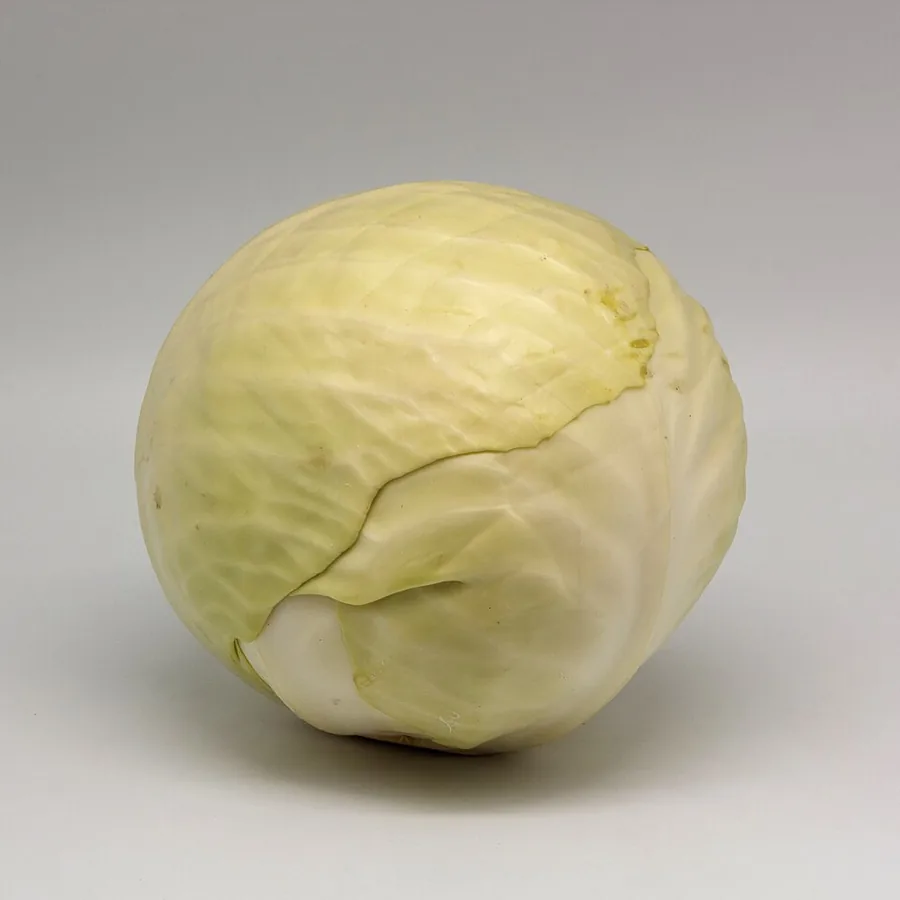
Cabbage is a cool-season vegetable cultivated for the dense head it develops from concentric, tightly wrapped leaves. It belongs to the brassica family with broccoli, kale, and Brussels sprouts, and selections fall into smooth green, deep red, and crinkled savoy forms. As a biennial grown as an annual, it directs all of its first-season energy into that head, which is why harvest precedes any attempt to flower.
The species favors cool conditions and tolerates light frost, the basis for its success as both a spring and a fall crop. It remains compact at 12 to 18 inches (30 to 45 cm) tall, so it suits a confined bed. Its two governing requirements are fertile soil and uniform moisture, and most cabbage problems can be traced to a lapse in one of them.
Cabbage rewards patience, since a head requires 60 to 100 days to firm. It also attracts a persistent succession of caterpillars and a few intractable diseases. Manage those, hold the moisture steady, and the season ends with solid heads that store for weeks and gain sweetness after a fall chill.
Care
The short version: full sun and cool temperatures, fertile soil held evenly moist at roughly an inch to an inch and a half of water a week, a balanced feed at planting followed by nitrogen a few weeks on, and harvest once the heads reach full firmness.
Light
Cabbage requires full sun, about six hours or more daily, because the head depends on sustained photosynthesis to pack tightly. It will grow in partial shade, but reduced light yields a looser, slower head, so reserve shadier sites for warm spells when moderated heat is an asset.
Water
Hold the soil evenly moist at about 1 to 1.5 inches of water a week, wetting to a depth of at least 6 inches and watering in the morning. Uniformity is the point: once a head is firm, the leaf tissue can no longer expand quickly, so a sudden uptake after drought splits it.
Soil
Grow cabbage in fertile, well-drained sandy loam rich in organic matter, which retains moisture without waterlogging the roots. Target a pH of 6.0 to 7.0, since a slightly acidic to neutral range suppresses the clubroot pathogen, which favors acidic ground.
Temperature
Cabbage is a cool-season crop, most productive between 41°F and 77°F (5°C to 25°C). Light frost causes no harm and a fall chill raises sugar content, but sustained summer heat triggers bolting in place of tight leaf formation.
Humidity
Ambient outdoor humidity meets the plant's needs, so no target value applies. Air circulation matters far more than any reading, because crowded, persistently wet foliage favors the diseases that ruin a head.
Feeding
Incorporate a balanced fertilizer at planting based on a soil test, then side-dress with nitrogen about 3 to 4 weeks after transplanting to sustain the plant through head formation. Cabbage is a heavy feeder, and that mid-season nitrogen drives the bulking of the head.
Pruning
Cabbage requires no structural pruning. Remove yellowed, damaged, or pest-infested outer leaves as they develop, and sever the head with a sharp knife at harvest. Leaving the outer leaves on the stalk can prompt a secondary flush of small mini-heads from the remaining buds.
Size & spacing
Plants stay compact at 12 to 18 inches (30 to 45 cm) tall and 12 to 24 inches (30 to 61 cm) across. Allowing that full spacing lets each head reach size and admits the airflow that limits foliar disease.
When to plant
Cabbage performs on cool temperatures rather than heat, so timing follows the seasons rather than the calendar alone. Start seed indoors in late winter and set transplants out a few weeks before the last frost for an early summer harvest, or plant again in mid to late summer for heads that mature in fall, where cold improves their flavor.
Northern hemisphere
Southern hemisphere
Typical months for a temperate climate: start earlier in warm zones, later where spring frosts linger.
- Sow: 6-8 weeks before last spring frost
- Plant: Set hardened transplants out 2-4 weeks before the last spring frost; for a fall crop, transplant in mid-to-late summer about 6-8 weeks before the first fall frost
- Harvest: Harvest when heads are firm and dense, typically early summer for spring plantings and mid-to-late fall for fall plantings; flavor improves after light fall frost
Hardiness
USDA hardiness zones: 2–11
Temperature: down to -46°C
Troubleshooting
Most cabbage disorders express themselves on the foliage or within the head, and a careful inspection usually separates insect feeding from disease or a moisture fault. Identify the pattern below, then intervene early, while the head remains marketable.
Daytime wilt with leaf yellowing and swollen roots
The cause is clubroot, caused by a soilborne organism that proliferates in acidic ground and converts the roots to swollen, non-functional clubs, which is why infected plants wilt and yellow under heat stress. No treatment recovers an infected plant, so lift and destroy them rather than composting, since the resting spores persist. Liming toward a pH of 6.8 to 7.2, sourcing clean transplants, and excluding brassicas from that ground for several years break the cycle.
Fix:
- Remove and destroy infected plants; do not compost them
- Lime soil toward pH 6.8-7.2 in affected beds
Chlorotic V-shaped lesions moving inward from the margins
Those chlorotic wedges with blackened veins indicate black rot, a bacterial disease introduced on infected seed and transplants that moves through the vascular tissue from the leaf margin inward. Remove and destroy affected plants, and avoid working among wet foliage, since the bacteria spread readily in water films. Certified disease-free stock, base-level irrigation, and a 2 to 3 year brassica rotation address the seedborne and residual sources.
Fix:
- Remove and destroy infected plants
- Avoid working among wet plants to limit spread
Ragged feeding holes, green larvae, and dark frass on foliage
The agents are cabbage caterpillars: the imported cabbageworm, the looper that arches as it crawls, and the small diamondback moth larva. Handpicking removes them on sight, and Bacillus thuringiensis (Bt) is most effective on early instars, with spinosad reserved for heavy pressure because resistance management favors restraint. A floating row cover applied at transplanting excludes the egg-laying butterflies and moths, which is why prevention outperforms treatment here.
Fix:
- Handpick caterpillars when first spotted
- Apply Bacillus thuringiensis (Bt) consistently while larvae are small
- Use spinosad per label if pressure is heavy
A mature, dense head split across its surface
Splitting is a physiological response: a dry interval followed by heavy rain or irrigation drives rapid water uptake that a firm head cannot accommodate, so the tissue ruptures. Because no pathogen is involved, it follows downpours on already-dense heads. Harvest a split head promptly and use it, and reduce uptake in the remaining mature heads by giving each plant a quarter twist or severing one side of the root zone with a spade to prune feeder roots.
Fix:
- Harvest split heads immediately and use promptly
- Twist plants a quarter turn or spade one side of the root zone to slow water uptake on remaining mature heads
Leaf curling and puckering under waxy gray-green colonies
These are cabbage aphids, gray-green and coated in a whitish wax, colonizing leaf undersides and the folds of the head where their feeding curls and puckers the tissue. A strong jet of water dislodges the colonies, and insecticidal soap or horticultural oil works on contact, so direct it into the clusters. Inspecting transplants before setting them out, conserving natural enemies such as lady beetles, and destroying crop residue after harvest reduce the carryover population.
Fix:
- Dislodge with a strong spray of water
- Apply insecticidal soap or horticultural oil, ensuring contact with colonies
Toxicity
Cabbage ranks among the safest crops to grow in a household setting. It contains no toxic principles, so pets, livestock, and people may all consume it. The single caveat is quantity, because a large serving of raw brassica can produce gas in any animal.
Safe for
People · Cats · Dogs · Horses · Rabbits · Livestock · Birds
Cats None
Cabbage contains nothing harmful to a cat. An occasional bite of cooked leaf poses no risk, though most cats show little interest in it.
Dogs None
It is safe in small amounts for dogs. A dog that consumes a large quantity of raw cabbage may become gassy or pass a soft stool, which reflects digestion rather than poisoning.
Horses Safe
There is no toxic risk to horses. Large servings of any brassica cause gas, so it is best offered as an occasional treat rather than a dietary staple.
Rabbits Safe
Rabbits can eat cabbage, and the leaves serve as a suitable green. Introduce it gradually and in small pieces, since an abrupt large amount can disturb a sensitive digestive tract.
Livestock Safe
Cattle, goats, and sheep graze brassicas without harm. Cabbage and its trimmings are a common feed, best balanced against other forage so it does not constitute the entire ration.
Birds Safe
Chickens and other birds readily peck a suspended cabbage head, and keepers often use one for occupation. Nothing in the plant harms them.
People Safe
Cabbage is a dietary staple eaten raw, cooked, or fermented and is safe for everyone. Only chronic, very high intake of raw brassicas raises any goitrogen concern.
No special handling needed. Large quantities of raw brassicas can cause mild gas in pets and people, and brassicas contain goitrogenic compounds that matter only with chronic, very high intake; this is a dietary note, not poisoning.
Varieties
Cabbage encompasses far more than the smooth green type most people picture, spanning green, red, and savoy forms. The selections below stand out for flavor, maturity, or holding ability in the field.
Early Jersey Wakefield
Early Jersey Wakefield is an heirloom early type recognized for its pointed, conical head and sweet flavor.
Stonehead
Stonehead is an early hybrid that sets very dense, solid round heads with notable resistance to splitting.
Ruby Ball
Ruby Ball is a red cabbage producing firm round heads with a slightly peppery flavor and good holding ability in the field.
Savoy King
Savoy King is a savoy type bearing deeply crinkled blue-green leaves that mellow once cooked.
Companions
Plant near
dill: Aromatic herb that attracts ladybugs and parasitic wasps that prey on cabbage pests
sage: Aromatic herb traditionally interplanted with cabbage to help deter cabbage moths
mint: Aromatic herb reported to deter cabbage pests; best kept contained due to spreading roots
onion: Onion-family crops grow well alongside cabbage-family crops and may help confuse pests
beet: Compatible root crop that shares cool-season conditions without competing with cabbage heads
Keep apart
strawberry: Companion planting guides list strawberries as incompatible neighbors for cabbage-family crops
tomato: Traditional companion charts advise keeping tomatoes away from cabbage plantings
pole bean: Companion planting guides list pole beans as poor companions for the cabbage family
How to propagate
Cabbage is propagated by seed, started indoors for an early crop or sown later for a fall one. No vegetative method applies; a seed packet and a protected head start are all the plant requires.
SeedEasy
Sow indoors 6-8 weeks before the last spring frost, or direct sow/transplant in mid-to-late summer for a fall crop · Germinates in about 4-10 days; transplants are garden-ready in 4-6 weeks
Cabbage propagates readily from seed. Sow indoors 6 to 8 weeks before the last spring frost, or sow in mid to late summer for a fall crop, and expect germination in about 4 to 10 days. Transplants reach garden size in 4 to 6 weeks and should be hardened off before setting out. Direct-seeded plants avoid transplant shock but can require up to three weeks longer to reach maturity.
Myths
Frost ruins a cabbage crop, so every head must be harvested before any cold weather.
Cabbage is a hardy cool-season crop that tolerates light frost, and a fall chill raises sugar content rather than harming the head. Only a hard freeze damages a mature head, so there is no need to clear the bed at the first cold night.
Split cabbage heads indicate disease in the soil.
Splitting is a physiological event, not an infection. A firm, mature head takes up water rapidly after uneven watering or heavy rain and ruptures its own surface tissue. No pathogen is involved, only the abrupt transition from dry to wet.