Vegetable · Amaryllidaceae
Onion
Allium cepa
Match the variety to your day length, keep the water steady, and onions all but grow themselves.
Full sun
Every 3–7 days
55–75°F · 13–24°C
90–120 days
Overview
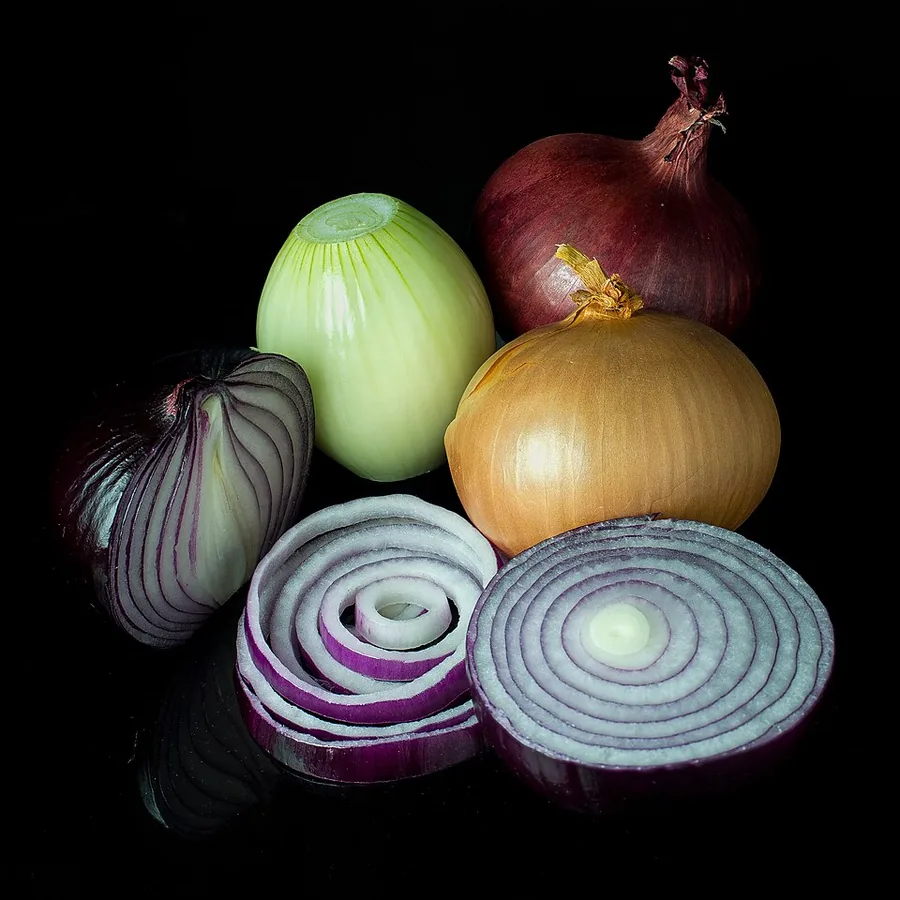
Cultivated in the kitchen garden for millennia, the onion delivers a return on modest inputs. Though botanically a biennial, it is harvested within a single season, since the plant invests its first year of vegetative growth in the bulb that swells for lifting and storage. It sits within the same family as garlic, leeks, and chives and carries their characteristic pungent scent.
Bulb formation in the onion is governed by photoperiod, the day length the plant experiences. Long-day cultivars will not initiate bulbs until the extended days of a northern summer arrive, short-day cultivars respond to the shorter days of a southern winter, and day-neutral cultivars occupy the range between. Select a cultivar mismatched to your latitude and the plant yields foliage with negligible bulb development.
None of this places onions beyond a beginner. Provide full sun to drive photosynthesis, loose and fertile soil for unimpeded bulb expansion, and reliable moisture during bulb fill, and the crop demands little further attention. Most failures trace to cold-stressed sets that vernalize and bolt or to bulbs cured poorly that rot in storage.
Care
The short version: full sun, loose and fertile soil, and about an inch of water a week through bulb fill. Apply nitrogen during leaf growth and withdraw it once bulbing begins, then reduce watering as the tops fall over.
Light
Onions require full sun, and the more they receive the better, because the foliage is the engine that fills the bulb. Reduce the light and photosynthesis falls short, so the bulb finishes thin rather than plump.
Water
Hold the soil evenly moist at roughly an inch of water a week, since the shallow root system cannot forage deeply for moisture. Consistency matters most during bulb fill, when a check in growth costs size. Taper watering once the tops fall over so the bulbs can dry down for storage.
Soil
Grow onions in loose, fertile, well-drained loam enriched with organic matter, a structure that lets the bulb expand without mechanical resistance. A pH of 6.0 to 6.8, marginally acidic, keeps nutrients available.
Temperature
As a cool-season crop, the onion performs across roughly 55°F to 75°F (13°C to 24°C). Young foliage tolerates a light frost, which is precisely why the crop can go in so early in the season.
Humidity
Ambient outdoor humidity suffices, so no target figure applies. The variable that matters is airflow, because the damp, congested canopy that favors downy mildew is the genuine threat.
Feeding
Apply a nitrogen-based fertilizer through the leafy phase in spring and early summer, side-dressing every few weeks to build the foliage that fills the bulb. Withdraw it the moment bulbing begins, since late nitrogen produces the soft necks that rot in storage.
Pruning
Onions need no routine pruning. Remove any flower stalk the instant it appears so the plant redirects its resources to the bulb, and strip away yellowed or diseased leaves as you find them to limit disease.
Size & spacing
Mature plants reach 12 to 18 inches (30 to 46 cm) in height with a narrow upright spread of only 4 to 6 inches (10 to 15 cm). That compact footprint permits high planting density within a small bed.
When to plant
Onions go in early and come out in late summer, a schedule dictated by their cool-season origins. Sow seed indoors in late winter or set out sets as soon as the soil is workable in early spring, then lift the bulbs from midsummer onward, once the tops yellow and fall over to signal maturity.
Northern hemisphere
Southern hemisphere
Typical months for a temperate climate: start earlier in warm zones, later where spring frosts linger.
- Sow: 6 to 8 weeks before the last spring frost
- Plant: As soon as soil can be worked in early spring, 2 to 4 weeks before the last frost
- Harvest: Mid to late summer when tops yellow and fall over
Hardiness
USDA hardiness zones: 3–9
Temperature: down to -40°C
Troubleshooting
Onion problems present in the foliage during the growing season and in the bulbs after storage. Reading the early signs lets you protect the standing crop, or at minimum the portion already lifted. Match the symptom below to identify the cause, then intervene while the response still changes the outcome.
Foliar lesions bearing violet-gray sporulation
This is downy mildew (Peronospora destructor), a pathogen that establishes under cool, wet, humid conditions and sporulates as a velvety violet-gray growth on the lesions during humid mornings. As the lesions age they turn pale and papery, and heavily colonized leaves yellow and collapse. Remove and destroy infected foliage to cut the spore load, widen spacing so the canopy dries faster, and hold a multi-year rotation to keep inoculum from accumulating in the soil.
Fix:
- Apply a labeled fungicide preventively where disease is common
- Improve air circulation
- Remove and destroy infected foliage
Post-harvest neck breakdown from Botrytis
This is neck rot, a Botrytis infection that emerges weeks into storage as gray mold at the neck and brown, softened inner scales. Immature or poorly cured bulbs enter storage more vulnerable, and a late nitrogen application compounds the risk by producing thick, soft necks that resist proper drying. Discard the affected bulbs, cure the remainder in a warm, dry, airy setting to seal the neck, and withhold nitrogen once the bulbs begin to swell.
Fix:
- Discard affected bulbs
- Cure remaining bulbs thoroughly in a warm, dry, airy place
Premature flowering diverts growth away from the bulb
This is bolting, the plant's response to vernalization after a cold spell following planting, which oversized sets and early transplants make far more likely. Because a flowering plant channels its resources into the seed stalk, the bulb left behind stays small and stores poorly. Remove the stalk as soon as it emerges and use those bulbs fresh, since their keeping quality is already compromised.
Fix:
- Remove flower stalks as soon as seen
- Use the affected bulbs fresh rather than for storage
Silvery stippling from rasping foliar feeders
The culprit is onion thrips, which rasp the leaf surface and concentrate their damage in the axils where the leaves meet the neck, leaving the telltale silver flecks. Because the plant loses photosynthetic tissue, heavy feeding reduces the final bulb size. Dislodge them with a strong jet of water or a labeled spray, hold soil moisture steady to limit stress, and clear surrounding weeds and volunteer alliums that harbor the population.
Fix:
- Use a strong spray of water or labeled insecticide for heavy infestations
- Encourage natural predators
- Remove heavily infested debris
Toxicity
Onions are safe on the plate yet genuinely hazardous to animals. Every part contains organosulfur compounds that oxidatively damage the red blood cells of cats, dogs, horses, and livestock, and cats show the greatest sensitivity. Keep raw and cooked onion, scraps, and anything seasoned with onion or garlic powder well away from pets.
Toxic to
Cats · Dogs · Horses · Rabbits · Livestock · Birds
Safe for
People
Cats Severe
Cats show the greatest sensitivity of any species, so even a small taste warrants concern. As the red blood cells break down, expect vomiting, pale gums, rapid breathing, and red or brown urine, progressing to weakness and collapse.
Dogs Severe
A dog that ingests onion typically vomits and develops diarrhea first, then grows weak and lethargic with pale gums and an elevated heart rate. Dark or reddish urine confirms that hemolysis is under way as the red blood cells are destroyed.
Horses Toxic
Horses grazing onion or wild alliums become weak and dull, their gums pale, and their urine darkens as anemia develops. The injury accumulates through repeated grazing rather than resulting from a single bite.
Rabbits Toxic
Onion has no place in a rabbit's diet. The same organosulfur compounds that harm cats and dogs damage a rabbit's blood, producing weakness, pale gums, and a loss of appetite.
Livestock Toxic
Cattle, sheep, and goats that reach onions or onion-rich cull piles develop anemia, weakness, and stained urine. Sheep tolerate small quantities more readily than cattle, though sustained intake harms all three.
Birds Toxic
Birds are equally at risk, since the organosulfur compounds rupture their red blood cells exactly as they do in mammals. Keep onion, cooked scraps, and seasoned food well beyond their access.
People Edible
For people, onions are a dietary staple and safe to eat raw or cooked. The oxidative toxicity is confined to animals and poses no hazard to the cook.
Keep all parts of the plant, scraps, and any foods seasoned with onion or garlic powder away from pets and livestock. Cats are especially sensitive.
Helpline numbers

United States
ASPCA Animal Poison Control: (888) 426-4435 (fee applies)

United Kingdom
Animal PoisonLine: 01202 509000 (fee applies)

Australia
Animal Poisons Helpline: 1300 869 738
Varieties
Onions are classified less by color than by the photoperiod required to trigger bulbing. Selecting the group matched to your latitude carries more weight than any other decision in the crop.
Long-day onions (e.g., 'Walla Walla', 'Yellow Sweet Spanish')
Bulb initiation in these waits until the photoperiod reaches roughly 14 to 16 hours, which is why they suit the long summer days of northern gardens.
Short-day onions (e.g., 'Texas Early Grano', 'Granex')
Because bulbing triggers at just 10 to 12 hours of daylight, southern growers sow them in fall or winter to obtain an early crop.
Intermediate/day-neutral onions (e.g., 'Candy')
With bulb initiation near 12 to 14 hours of daylight, these perform across a broad range of latitudes and are the dependable choice when the local day length is unknown.
Companions
Onions earn their spot beside crops their strong scent helps protect, and they sit poorly next to the legumes whose growth alliums are said to check.
Plant near
Carrots: Onions are traditionally interplanted with carrots, as the strong scent of alliums is said to help deter carrot pests.
Keep apart
Beans: Alliums such as onions are traditionally said to inhibit the growth of beans.
Peas: Alliums such as onions are traditionally said to inhibit the growth of peas.
How to propagate
Onions establish from seed or from sets, and the decision balances cultivar range against ease of establishment.
SeedModerate
Start indoors 6-8 weeks before the last frost, or sow directly in early spring · Several weeks to germinate and establish seedlings before transplanting
Seed propagation grants access to the widest cultivar range, at the cost of the longest growing season. Sow indoors 6 to 8 weeks before your last frost to gain a head start, or direct sow in early spring, and allow the seedlings several weeks to germinate and develop before transplanting so they establish reliably.
Bulbs & cormsEasy
Plant sets in early spring as soon as soil can be worked · About 1-2 weeks to root and begin top growth
Sets are the most reliable route to a crop. Set these small dormant bulbs in early spring as soon as the soil is workable, and they root and initiate top growth within 1 to 2 weeks. Select sets smaller than a dime, since larger sets carry the greatest bolting risk after vernalization.
Myths
Only raw onions harm pets, so cooked onion or a pinch of onion powder is fine.
Heat does not deactivate the responsible compounds. Cooked onion and the onion or garlic powder folded into gravy, baby food, and table scraps remain fully toxic to dogs and cats. The dried powders are the most hazardous form, because dehydration concentrates the toxin into a much smaller volume.
Bigger onion sets always grow bigger bulbs.
The relationship runs in reverse. A set larger than a dime has already accumulated enough cold exposure to vernalize and bolt, and a bolting plant commits its resources to a flower stalk rather than the bulb. Sets smaller than a dime yield the larger, better-storing onions.