Herb · Amaryllidaceae
Chives
Allium schoenoprasum
Site chives in full sun with consistent moisture, and a single divided clump remains productive for years.
Full sun
Every 3–7 days
59–77°F · 15–25°C
80–90 days
Overview
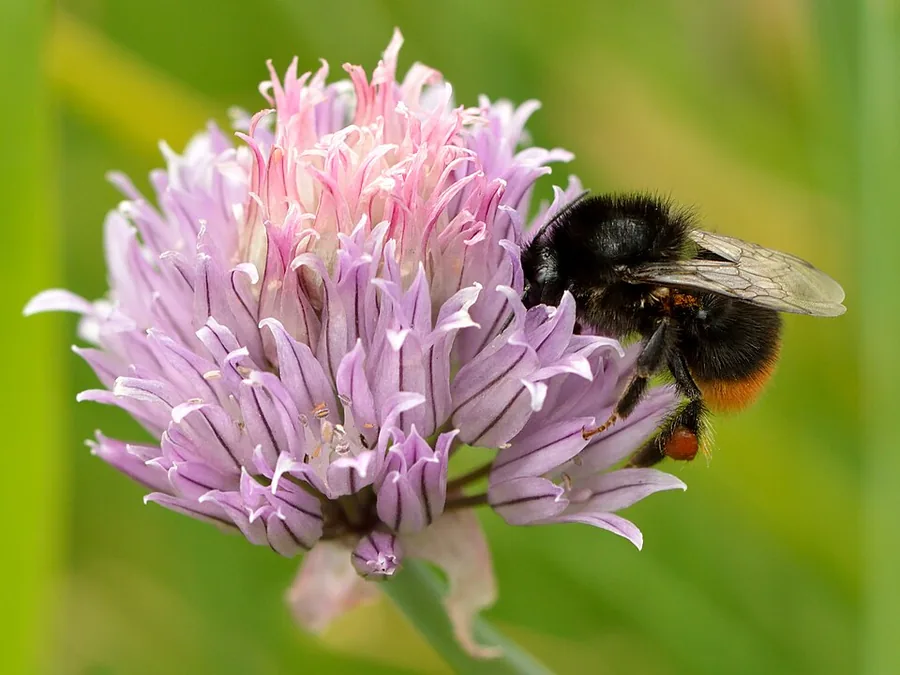
Chives are the mildest of the cultivated onions, raised for their slender, hollow leaves and the gentle allium flavor those leaves carry. The plant builds tidy clumps of grass-like foliage that persist year to year, and in late spring it produces pink-purple pompom flowers that hold ornamental value in a border as readily as culinary value in the kitchen. Both the leaves and the inflorescences are edible.
As a hardy perennial, chives make minimal demands on the grower. The species adapts to a bed, an edging, or a container on a sunny sill, and its cold hardiness extends to USDA zone 3, where it overwinters as dormant roots and bulblets. Harvesting prompts the clump to regenerate fresh leaves from the base.
The single real constraint concerns animals rather than cultivation. Chives belong to the genus Allium alongside onion and garlic, and that shared chemistry renders the entire plant hazardous to cats, dogs, horses, and livestock, even as it remains entirely safe for human consumption.
Care
The short version: chives demand full sun, evenly moist and fertile soil, and harvesting once the clump reaches about 6 inches tall. Because the plant spreads by bulblets and crowds itself over time, divide it every few years to sustain vigor almost indefinitely.
Light
Chives perform best in full sun, where high light drives the dense, upright foliage and concentrates the flavor compounds in the leaves. They persist in partial shade, but reduced irradiance limits photosynthesis, so the leaves grow thin and etiolate toward the brightest available light.
Water
Maintain evenly moist soil for maximum leaf production, particularly during establishment when the root system is still shallow and cannot buffer drought. A mature clump is moderately drought tolerant, yet repeated drying stresses the plant and degrades both flavor and yield, so consistency matters more than volume.
Soil
Grow chives in average, fertile, well-drained soil enriched with organic matter, which supplies steady nutrition and holds moisture without waterlogging. A pH of 6.0 to 7.0 keeps nutrients available, and free drainage is the key safeguard, since saturated soil predisposes the bulblets to rot.
Temperature
The optimal range is the cool 59°F to 77°F (15°C to 25°C), reflecting the plant's cool-season physiology. In cold climates the foliage dies back to dormant rootstock through winter and regrows once soil temperatures rise in spring, which is why the species overwinters reliably outdoors.
Humidity
Ambient humidity of 40% to 60% is sufficient, and there is no benefit to elevating it. Air movement is the more important variable, because stagnant air around damp, congested foliage creates the leaf-surface moisture that rust fungi require to infect.
Feeding
A balanced fertilizer or compost applied in spring meets the season's nutrient demand. Restraint is deliberate here, because excess nitrogen dilutes the flavor, pushing soft, watery leaf growth at the expense of the concentrated allium compounds that give chives their character.
Pruning
Harvest leaves near the base once the clump reaches about 6 inches (15 cm), and cut the whole stand back periodically to trigger a flush of fresh, tender regrowth from the crown. Removing spent flower heads prevents self-seeding, since the dispersed seed otherwise colonizes the surrounding bed.
Repotting
Rather than potting on, chives require division every 2 to 3 years as the clump multiplies. The indicators are a congested mass, thinning leaves, and dieback at the center, all signs that the bulblets are competing for finite resources and the planting needs splitting.
Size & spacing
A mature clump reaches 8 to 16 inches (20 to 40 cm) in height and spreads roughly 8 to 12 inches (20 to 30 cm). Allowing that spacing between plantings sustains air movement through the foliage, the conditions that suppress rust and other foliar fungi.
When to plant
Chives are a cool-season perennial that performs in the temperate growing window and needs no precise scheduling once established. Sow seed indoors in late winter to give slow germination a head start, or set divisions out after the last frost, then harvest leaves through the season as the plant blooms in late spring.
Northern hemisphere
Southern hemisphere
Typical months for a temperate climate: start earlier in warm zones, later where spring frosts linger.
- Sow: 8-10 weeks before the last spring frost
- Plant: Spring, after the last frost
- Harvest: Snip leaves once plants are about 15 cm (6 in) tall and established; pink-purple pompom flowers appear late spring to early summer
Hardiness
USDA hardiness zones: 3–9
Temperature: down to -40°C
Troubleshooting
Chives are seldom troubled, and the disorders that do appear concentrate on the foliage or stem from a clump that has outgrown itself. Identify the symptom below, then intervene early, because the underlying cause is easiest to reverse before it spreads.
Raised orange pustules and tip dieback on the foliage
Raised orange-brown pustules are rust, a foliar fungus that establishes where a crowded clump traps humid, stagnant air against the leaves. Remove the infected foliage to reduce inoculum, divide the clump to restore airflow, and water at the base so the leaf surfaces dry quickly and deny the spores the moisture they need.
Fix:
- Cut back and remove affected foliage
- Improve spacing and air circulation by dividing crowded clumps
- Water at the base to keep leaves dry
Overcrowded clump declining from a bare center
A starved, hollow center marks an overcrowded clump that has exhausted its space, with the densely packed bulblets competing for nutrients and water until the oldest central growth fails. Lift the clump in spring or early fall, separate it, and replant the vigorous outer divisions into refreshed, fertile soil. Watering in thoroughly reestablishes root contact with the soil.
Fix:
- Lift and divide the clump in spring or early fall
- Replant healthy divisions in refreshed, fertile soil
- Water in well after dividing
Silvery scarring and pale stippling on the foliage
A silvery sheen and pale stippling indicate thrips, which rasp the leaf surface and feed on the cells, leaving the reflective scarring behind. Onion fly larvae or simple heat and drought stress can produce similar browning at the tips, so confirm before treating. Dislodge the thrips with a strong jet of water, excise the worst-damaged leaves, and hold even soil moisture through hot weather to limit the stress that compounds the injury.
Fix:
- Rinse plants with a strong jet of water to dislodge thrips
- Remove and discard badly damaged leaves
- Maintain even soil moisture during hot weather
Toxicity
This is the point where culinary value and animal safety diverge. Chives are a wholesome herb for people, but as an Allium they are toxic to cats, dogs, horses, and livestock: the organosulfur compounds oxidize hemoglobin and rupture red blood cells, producing Heinz-body hemolytic anemia. Cats metabolize these compounds least efficiently and are the most sensitive, so the plant and its trimmings must stay out of reach.
Toxic to
Cats · Dogs · Horses · Rabbits · Livestock · Birds
Safe for
People
Cats Severe
Cats are the most severely affected, reflecting their limited capacity to detoxify these compounds. Early signs are vomiting, weakness, and pale gums, progressing to red or brown urine as red blood cells lyse. A racing heart and labored panting signal the hemolytic anemia that makes even a small ingestion dangerous.
Dogs Moderate
A dog that consumes the leaves may vomit, become lethargic, and develop pale gums or bloody urine. Severity scales with the dose, so a larger ingestion raises the likelihood of progression to full hemolytic anemia.
Horses Severe
Horses are highly susceptible to Allium toxicosis. Expect weakness, dullness, and pale mucous membranes, with dark or discolored urine as the same oxidative mechanism destroys their red blood cells.
Rabbits Toxic
Chives must never be offered to rabbits. The organosulfur compounds attack the red blood cells exactly as they do in cats and dogs, and a rabbit's small body mass leaves almost no margin of safety.
Livestock Toxic
Grazing cattle, sheep, and goats are subject to the classic Allium toxicosis, presenting weakness, anemia, and discolored urine. The effect is cumulative, building quietly across repeated feedings before it becomes apparent.
Birds Toxic
Birds have no physiological defense against these compounds, so even a fragment can damage their blood. Keep chives and kitchen trimmings well away from pet birds and backyard flocks.
People Safe
For people, chives are a culinary herb, and both leaves and flowers are edible raw or cooked. The compounds that harm animals pose no threat to human health at normal dietary amounts.
All parts are toxic to pets whether fresh, dried, or cooked; even small or cumulative amounts can be dangerous, particularly to cats. Wash hands after handling and keep trimmings and harvested leaves out of reach.
Helpline numbers

United States
ASPCA Animal Poison Control: (888) 426-4435 (fee applies)

United Kingdom
Animal PoisonLine: 01202 509000 (fee applies)

Australia
Animal Poisons Helpline: 1300 869 738
Varieties
Commerce moves mostly the unimproved species, but a few named selections are worth distinguishing by their flowering and their seeding behavior.
'Forescate'
Forescate is selected for its vivid rose-pink flowers and the strength and vigor of its foliage.
'Profusion'
Profusion is a sterile cultivar that flowers heavily yet sets no seed, which eliminates self-sowing across the garden.
Common chives (species)
The unimproved species is the standard culinary form, identifiable by hollow, grass-like leaves of mild onion flavor and the characteristic pink-purple pompom flowers.
Companions
The strong onion scent of chives can steer some pests away from neighbors like carrots, but the same plant chemistry sets back legumes, so keep it clear of beans and peas.
Plant near
Carrots: Strongly scented alliums like chives are reputed to help deter pests such as carrot fly, and onions/alliums are commonly paired with carrots in extension companion guidance.
Keep apart
Beans: Alliums (onion, garlic, chives) stunt the growth of beans and should not be interplanted with them.
Peas: Like beans, peas are legumes whose growth is inhibited by nearby alliums such as chives.
How to propagate
Chives propagate readily by two routes, and the choice turns on how quickly you need a cropping plant: vegetative division for an immediate result, or seed for a fresh population.
DivisionEasy
Spring or early fall · A few weeks to reestablish; divisions are productive the same or following season
Division is the fastest route to additional plants and doubles as routine maintenance. Lift an established clump every 2 to 3 years, separate it into smaller bunches of bulblets, and replant immediately so the roots reestablish quickly. The divisions settle within a few weeks and crop the same or the following season.
SeedModerate
Start indoors 8-10 weeks before the last frost, or direct sow after the last frost · About 80-90 days to a usable harvest from seed
Seed is the slower method, since germination and early growth proceed gradually. Sow indoors 8 to 10 weeks before the last frost to compensate for that lag, or direct sow into warm, moist soil afterward, thinning the seedlings as they develop. Allow roughly 80 to 90 days from sowing to a harvestable clump.
Myths
As a mild-flavored culinary allium, chives present no risk to companion animals.
Flavor mildness has no bearing on toxicity. Chives are an Allium, the genus that includes onion and garlic, and the ASPCA lists them as toxic to cats and dogs. Even a mild-tasting herb can trigger Heinz-body hemolytic anemia in animals, because the harmful compounds are unrelated to the taste, so keep it off the menu for pets.
The toxicity of chives resides solely in the bulb.
The toxic organosulfur compounds are distributed throughout the plant tissue, not concentrated in the bulb, so the hollow leaves and the flowers carry them as well. Every part can poison a pet, which means the whole plant must be treated as hazardous.