Bulb · Amaryllidaceae
Daffodil
Narcissus pseudonarcissus
Set the bulbs in fall and they deliver the first real color of spring, year after year.
Full sun
Every 7–14 days
USDA 4–8
12–18 in · 30–46 cm
Overview
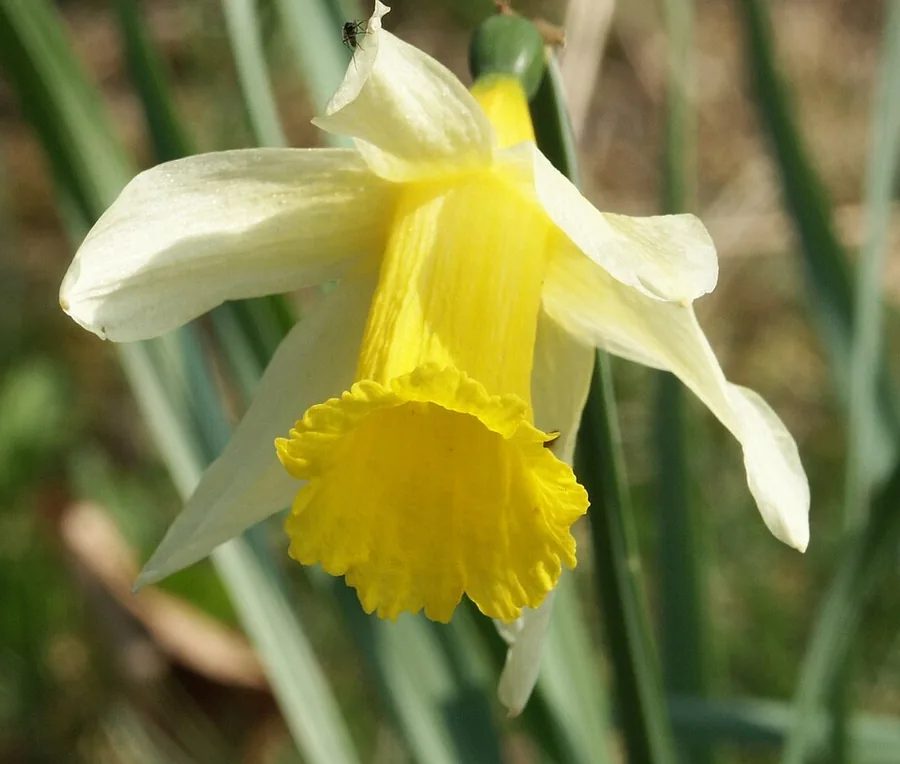
The daffodil is the bulb most growers begin with, and the recommendation rests on its reliability. A single autumn planting yields trumpet flowers in early spring, ahead of most of the garden, because the bulb completes its root growth over winter before the canopy and competing perennials resume. As a member of the genus Narcissus it is fully perennial and increases by offset, widening into clumps over successive seasons.
Its low demand follows directly from its biology. The bulb is hardy to -29°F (-34°C), adapts to most well-drained soils, and resists deer and rodents because the alkaloids that make every part poisonous also deter browsing. Supply sun and drainage and the remaining requirements are minimal.
The genus spans far more than the single yellow trumpet. Certain divisions carry several flowers per stem, others contrast white perianth segments with a colored corona, and some are fully double. Across all of them one practice governs return bloom: allow the leaves to yellow and senesce naturally, because that period of photosynthesis is how the bulb feeds next year's flowers.
Care
The short version: full sun to part shade, a well-drained soil that never stays saturated, a light low-nitrogen feed in fall and again in spring, and a full post-bloom senescence period before any foliage is removed.
Light
Daffodils flower most fully in full sun, since light drives the photosynthesis that recharges the bulb, though they accept partial shade and so suit positions under deciduous trees that leaf out after the bulbs have bloomed. The more direct sun they receive, the stronger the stems and the larger the flowers.
Water
Keep the soil moist but never saturated during active growth, with supplemental water in a hot or dry spring to prolong flowering. Once the foliage dies back the bulb enters dormancy and needs almost no water, because a wet dormant period is the principal trigger for bulb rot.
Soil
Plant in well-drained loam, clay, or organically rich soil, treating drainage as the non-negotiable factor. A pH of 6.0 to 7.0 is ideal, but it is standing water around the bulb, more than any nutritional shortfall, that accounts for most losses.
Temperature
These bulbs are hardy across a wide range, tolerating -29°F to 86°F (-34°C to 30°C). A cold winter period is not merely survivable but required, since the chilling is what initiates flower development within the bulb.
Humidity
Ambient humidity needs no management, so there is no target figure to maintain. The relevant factor is free air movement around the foliage, because still, damp conditions among crowded leaves favor the fungal diseases to which the species is susceptible.
Feeding
Apply a low-nitrogen complete fertilizer such as 10-10-10 with bone meal, incorporated in fall and again as shoots emerge in spring. Withhold further feeding once flowering begins, because excess nitrogen at that stage promotes the soft tissue on which bulb rot establishes.
Pruning
Deadhead spent flowers, but retain the foliage for at least six weeks after bloom, until it yellows and browns of its own accord. Cutting or tying the green leaves early interrupts the photosynthesis by which the bulb replenishes its reserves for the following year.
Repotting
Daffodils perform best left in place and require lifting only every 5 years, or sooner once a clump becomes too congested to flower. Reduced or smaller blooms, tightly packed bulbs, and abundant leaves with few flowers are the diagnostic signs that division is due.
Size & spacing
Mature plants stand 12 to 18 inches (30 to 46 cm) tall with a spread of 9 to 12 inches (23 to 30 cm). Plant the bulbs 6 to 8 inches (15 to 20 cm) deep, about two to three times their height, and 4 to 8 inches (10 to 20 cm) apart.
When to plant
The daffodil's cycle is keyed to soil temperature, not the calendar alone. Plant the bulbs in mid-autumn, roughly six weeks before the first frost and once the soil has fallen below 60°F (16°C), so they root through winter and then flower in early spring once the soil warms.
Northern hemisphere
Southern hemisphere
Typical months for a temperate climate: start earlier in warm zones, later where spring frosts linger.
- Plant: Mid-autumn, about 6 weeks before first frost, once soil temperature stays below 60 degrees F
- Harvest: Early spring
Hardiness
USDA hardiness zones: 4–8
Temperature: down to -34°C
Troubleshooting
A vigorous daffodil rarely fails, and where problems arise they usually originate in the bulb below ground. The recognizable signs are rot, scorched or spotted foliage, and a clump whose flowering drops away. Identify the disorder from the descriptions below and intervene before it reaches adjacent bulbs.
Stunted plants and bulbs that turn soft and rot
The cause here is basal rot, a Fusarium that enters through the basal plate and digests the bulb from the bottom up, which is why the plant stunts and yellows before its time. Wet soil keeps the fungus active and surplus nitrogen feeds the soft tissue it prefers, so both push the infection along. A lifted bulb shows a soft brown base and white to pink mycelium between the scales, so discard every infected one, replant only firm bulbs in fresh, free-draining ground, and reduce the feeding.
Fix:
- Discard infected bulbs
- Plant only firm, healthy or hot-water-treated bulbs
- Improve drainage and replant in a new site
Distorted leaves with soft, light bulbs and poor bloom
Two internal feeders produce this picture, and both consume bulb tissue, which is why the bulb ends up light, soft, and flowerless. Stem and bulb nematodes feed within the scales and leave concentric brown rings visible on a crosscut, while narcissus bulb fly larvae tunnel out the center and leave a single fat grub. Because the damage sits inside the bulb, the only reliable response is to dig and destroy infested bulbs and replant certified clean stock.
Fix:
- Dig and destroy infested bulbs
- Plant only treated, healthy bulbs
Tan flower lesions that enlarge in wet spells
These tan flecks that widen into browned petals and yellow-streaked leaves are fire disease, named for the scorched look it leaves. Its spores need surface moisture to germinate and spread, so damp, crowded plantings move it fast from bloom to bloom. Remove and destroy infected tissue, open the spacing so foliage dries, and clear spent flowers, since those decaying blooms are where the next round of spores forms.
Fix:
- Remove and destroy infected plants and flowers
- Apply a protective fungicide
Spotted, scorched-looking tips on emerging leaves
The reddish-brown spots ringed with yellow on emerging leaf tips are leaf scorch, a fungal infection that often rides in on the bulb and shows first where new growth meets the air. Removing the marked foliage takes out the active lesions, planting hot-water-treated bulbs starts a clean stock, and keeping the leaves dry denies the spores the film of moisture they need to infect.
Fix:
- Remove affected foliage
- Plant hot-water-treated bulbs
- Apply a labeled fungicide
Toxicity
Every part of the daffodil is poisonous, with the toxin concentrated in the bulb. It contains lycorine and other alkaloids together with irritant calcium oxalate crystals, and its close resemblance to an onion has caused accidental human poisonings. Keep bulbs and plants away from pets, livestock, and children, and wear gloves when handling them.
Toxic to
Cats · Dogs · Horses · Rabbits · Livestock · Birds · People
Cats Severe
In cats the alkaloids irritate the gut quickly, so drooling and vomiting appear within the hour and diarrhea often follows. The bulb holds the highest toxin load, and a large ingestion can depress blood pressure and disturb the heart's rhythm, producing tremors and an irregular beat that warrant urgent care.
Dogs Severe
Dogs are most exposed because they dig and chew the bulb, the most concentrated part, so heavy drooling, vomiting, and abdominal pain come first. A larger dose carries the alkaloids past the gut into the nervous and cardiovascular systems, bringing convulsions, low blood pressure, and an erratic heartbeat, so veterinary contact should not be delayed.
Horses Severe
Horses seldom graze daffodils, but the same alkaloids act strongly when they do, producing salivation, retching, and colic as the digestive tract reacts. A substantial dose extends to the nervous system and heart, where it can provoke tremors and dangerous rhythm disturbances.
Rabbits Severe
Because lycorine is present throughout the plant, a rabbit that nibbles any part takes in the same toxin that affects larger animals, leading to drooling, digestive upset, and tremors. Their small body size leaves little margin, so daffodils should be kept out of reach and never given as forage.
Livestock Severe
Cattle, goats, and sheep are poisoned by ingesting foliage or bulbs exposed in a pasture, with the alkaloids first irritating the gut to cause drooling and diarrhea. As the dose rises the effect reaches coordination and the heart, producing staggering and, in severe cases, an unsteady beat.
Birds Severe
The alkaloids are toxic to birds, and their small body mass means even a fragment of bulb represents a large effective dose. Both ornamental birds and backyard flocks should be kept well away from daffodils and their bulbs.
People Caution
No part of the daffodil is edible, and the bulb poses the main risk because its resemblance to an onion invites accidental ingestion. Swallowing any part irritates the gut into vomiting and drooling, and the calcium oxalate and sap in cut stems can inflame the skin on contact.
Bulbs can be mistaken for onions but are poisonous; keep bulbs away from pets and children. Wear gloves when handling, since the sap can cause skin irritation known as daffodil itch.
Helpline numbers

United States
ASPCA Animal Poison Control: (888) 426-4435 (fee applies)
Poison Control: (800) 222-1222



Canada
Poison Centres: 1-844-764-7669
Varieties
The genus holds thousands of registered cultivars, classified into divisions by flower structure. A small number of long-standing forms recur in gardens and together illustrate the range across those divisions.
King Alfred
This is the classic large trumpet daffodil, uniformly golden yellow, and the form most people visualize at the name.
Thalia
A triandrus cultivar, it bears several nodding, pure white flowers per stem and reads as a softer, woodland type.
Actaea
A poeticus daffodil, it surrounds a small, red-rimmed yellow cup with crisp white petals.
Tahiti
A double-flowered cultivar, it replaces the single trumpet with densely ruffled yellow and orange segments.
How to propagate
Daffodils increase by offset on their own, so propagation is mainly a matter of dividing established bulbs at the right point in the cycle. Seed is also possible but slow, and is reserved for those willing to wait years.
Offsets & pupsEasy
After foliage yellows and dies back, in late spring or early summer · 1-2 years to reach flowering size
The reliable method exploits the bulb's natural habit of forming offsets around the basal plate. Once the foliage has yellowed and died back in late spring or early summer, the parent is dormant, so lifting a crowded clump and separating the daughter bulbs causes no setback. Replant at proper depth at once, or store cool and dry until fall, and most offsets reach flowering size in 1 to 2 years.
DivisionEasy
Every 5 years when clumps become crowded, after foliage dies back · 1-2 years
Dividing addresses the decline that follows congestion, where crowded bulbs compete and flowering thins, usually about every 5 years. Lift and separate them after the foliage has died back, since the dormant bulb tolerates handling, and the spaced divisions recover vigor and reestablish over 1 to 2 years.
SeedDemanding
Sow ripe seed in autumn · 5 years or more to flowering
Seed is the demanding route because a bulb must build to flowering size before it blooms. Sow ripe seed in autumn and the resulting seedlings need 5 years or more to reach that stage, which is why the method is largely confined to breeders developing new varieties.
Myths
Daffodil bulbs are safe to eat because they look like onions.
The resemblance is the precise reason for the danger, and documented poisonings have followed cooking a daffodil bulb in place of an onion. The bulb concentrates the most lycorine and other alkaloids of any part of the plant. No part of a daffodil is food, so keep the bulbs well away from the kitchen.