Bulb · Amaryllidaceae
Giant Ornamental Onion
Allium giganteum
Set the bulbs in fall and giant allium repays the chilling with tall scapes carrying drumstick umbels above the early-summer border.
Full sun
Every 7–10 days
USDA 4–8
3–6 ft · 0.9–1.8 m
Overview
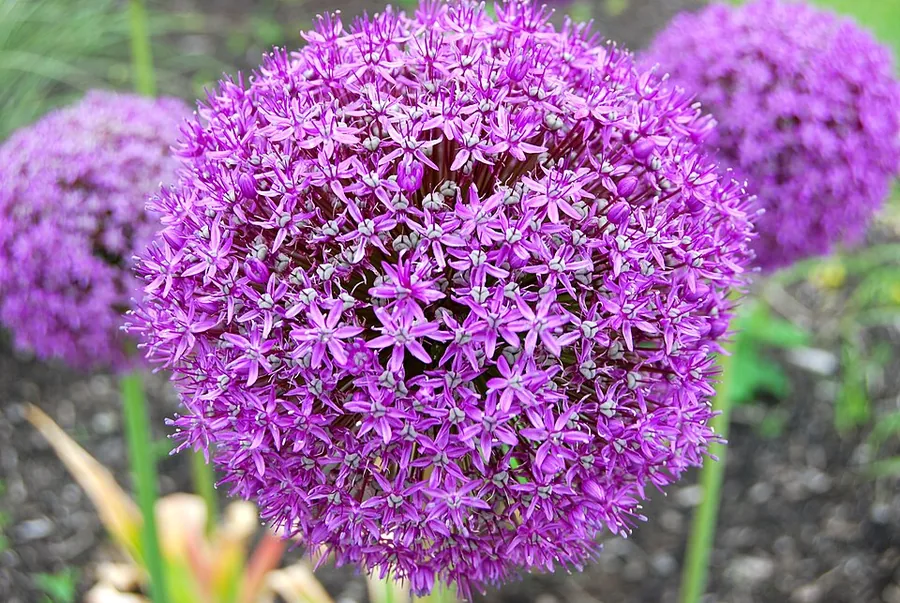
The horticultural appeal of Allium giganteum rests on its large spherical umbels, which lift on leafless scapes in early summer well above surrounding plantings. It belongs to the Amaryllidaceae and shares its genus with culinary onion and garlic, yet selection here favors the inflorescence rather than the edible bulb. Because the flowering stems carry no foliage, the umbel reads as a clean globe floating at or above eye level.
As a long-lived perennial bulb, it persists year after year and tolerates winters to -29°F (-34°C), a cold tolerance that is more than incidental. The chilling period through winter is what allows the bulb to initiate good flowers, so dormant fall planting positions the bulb to root, vernalize, and then send up scapes in late spring. Each globe holds color for two to three weeks, after which the strappy foliage senesces and dies back, returning energy to the bulb for the next cycle.
Toxicity is the defining caution. Every part holds the organosulfur compounds characteristic of the genus, so the plant is dangerous to cats, dogs, horses, and livestock exactly as a chewed onion would be. Used in an open, sunny bed, it is a striking and undemanding bulb, but it must be sited beyond the reach of any animal inclined to graze it.
Care
The short version: full sun and sharply drained soil drive sturdy scapes and ward off rot, deep fall planting supplies the chilling the bulb needs, even moisture sustains active growth, and staking carries the tall stems through wind.
Light
Site giant allium in full sun, because high light builds the carbohydrate reserves that produce sturdy scapes and well-filled umbels. Light afternoon shade is acceptable, but inadequate light yields weak, leaning stems and a reduced flower count.
Water
Maintain even soil moisture during active growth, then allow the bulb to weather summer drought once the foliage has senesced. Irrigation near every 7 to 10 days suffices, and standing water must be avoided because saturated soil drives the bulb rot this species is prone to.
Soil
Plant into average, well-drained soil, whether loam, sand, or clay, provided water passes through freely rather than pooling. The bulb accepts a broad pH window from 5.5 to 8.0, so most cultivated beds fall within its tolerance.
Temperature
This cold-hardy bulb withstands winters to -29°F (-34°C) and summer heat to 86°F (30°C). The winter cold is functional rather than merely tolerated, since the chilling period is what allows the bulb to set quality flowers.
Humidity
Ambient outdoor air meets its needs, so no humidity target applies. The operative factors are drainage and air movement, because damp, still conditions around the bulb favor the rot organisms that cause loss.
Feeding
Incorporate a balanced or low-nitrogen bulb fertilizer into the soil at fall planting, followed by a second application in early spring. Excess nitrogen is counterproductive, directing growth into soft foliage at the expense of flowering.
Pruning
Remove the spent scapes after flowering, but allow the foliage to wither in place, since the senescing leaves translocate reserves back to the bulb for next season. In exposed sites, stake the tall stems before they lodge.
Repotting
Lift and divide congested clumps every 3 to 4 years in fall, prompted by a decline in flower number or size. Overcrowding restricts each bulb's resources, so reduced and smaller blooms signal that division is due.
Size & spacing
Mature plants stand 3 to 6 feet (90 to 183 cm) tall, which places them toward the rear of a border. Space bulbs 9 to 12 inches apart at a depth of 5 to 8 inches, giving each clump the room to develop without competition.
When to plant
The species runs on a fall-to-summer cycle dictated by its chilling requirement. Plant the bulbs in autumn so roots establish before the ground freezes, allow winter to satisfy vernalization, and the globes open across June and July for roughly two weeks.
Northern hemisphere
Southern hemisphere
Typical months for a temperate climate: start earlier in warm zones, later where spring frosts linger.
- Plant: Plant bulbs in fall about 5-8 inches deep and 9-12 inches apart
- Harvest: Late spring to early summer (June-July), blooms lasting 2-3 weeks
Hardiness
USDA hardiness zones: 4–8
Temperature: down to -34°C
Troubleshooting
Most disorders in giant allium originate at the bulb or in exposure to wind. Excess soil moisture drives rot, bulb mites pit the scales, and the unbranched scapes are vulnerable to lodging without support. Identify the symptom below and intervene early, since bulb-borne problems spread readily through a planting.
Soft, mushy bulbs and collapsing plants
Saturated, slow-draining soil drives bulb rot, and where the ground stays persistently wet a black rot fungus can complete the destruction. A lifted bulb is soft, discolored, and foul-smelling. Remove and discard the affected bulbs, reduce irrigation, and replant only the firm survivors into soil that drains freely.
Fix:
- Remove and discard affected bulbs
- Improve soil drainage and reduce watering
- Replant healthy bulbs in well-drained amended soil
Distorted, stunted growth from pitted bulbs
Bulb mites feed within the bulb scales, and the resulting tissue damage manifests as distorted new growth and a scarred, pitted bulb. Examine suspect bulbs closely for the minute mites and their characteristic feeding marks. Cull heavily infested stock, plant only firm clean bulbs, and rotate the planting site to break the cycle.
Fix:
- Discard heavily infested bulbs
- Plant only firm, healthy, mite-free bulbs
- Practice crop rotation and good sanitation
Tall stems leaning or breaking
Because the heavy umbels sit atop long unbranched scapes, wind can bend or fracture them, with failure most likely at peak bloom weight. The mechanism is straightforward: wind loading on unsupported scapes exceeds what the stem can bear. Site the planting in shelter and stake the scapes before anthesis.
Fix:
- Stake tall stems for support
- Site plantings in locations sheltered from strong winds
Toxicity
The entire plant should be regarded as inedible to animals. Bulbs, foliage, and flowers all contain the organosulfur compounds that render onions and garlic dangerous, and these cause oxidative damage to red blood cells, producing hemolytic anemia. Cats show the greatest sensitivity, with dogs, horses, and grazing livestock also genuinely at risk, so position the plant where none can access it.
Toxic to
Cats · Dogs · Horses · Rabbits · Livestock · Birds · People
Cats Severe
Among all species, cats are the most acutely affected. Even a minor ingestion can provoke vomiting and initiate red blood cell breakdown, which presents as weakness, tachycardia, panting, and darkened urine.
Dogs Severe
A dog that ingests any portion may vomit and then become weak and lethargic as its red blood cells are destroyed. Pale gums, rapid respiration, and discolored urine are signs to act on, and veterinary attention should be sought promptly.
Horses Severe
Horses sustain the same red blood cell damage when they graze foliage or bulbs, leaving them weak and dull. The anemia can accumulate through repeated small ingestions rather than requiring a single large meal.
Rabbits Toxic
The same onion-family compounds are toxic to rabbits, so the entire plant should be kept well clear of them. No quantity is safe to offer.
Livestock Toxic
Cattle, sheep, and goats can develop hemolytic anemia from consuming alliums, whether fresh in pasture or dried within hay. Exclude them from plantings and remove any trimmings within reach.
Birds Toxic
Birds are likewise sensitive to onion-family toxins, so poultry and pet birds must be denied access to the bulbs, leaves, and flowers.
People Caution
This is an ornamental onion cultivated for its flowers, not a culinary crop, and it is not intended for consumption. Handling poses no problem, but wash the hands afterward and keep inquisitive children away from the bulbs.
Keep all parts, including bulbs, foliage, and flowers, out of reach of pets and livestock. Store bulbs securely and clean up trimmings; wash hands after handling.
Helpline numbers

United States
ASPCA Animal Poison Control: (888) 426-4435 (fee applies)
Poison Control: (800) 222-1222



Canada
Poison Centres: 1-844-764-7669
Varieties
Several large-flowered alliums circulate under the giant-onion label, alongside close relatives offered as substitutes. The following are the cultivars and species worth distinguishing.
Globemaster
This hybrid delivers the most imposing display, producing dense violet globes of 8 to 10 inches borne on robust scapes.
Allium hollandicum (aflatunense)
A related ornamental onion bearing smaller rose-purple umbels, frequently marketed as an economical substitute for the true giant allium.
Allium cristophii (Star of Persia)
A lower-growing relative distinguished by broad, open umbels that resolve into metallic pink-violet stars.
Companions
Plant near
Roses: Tall allium scapes rise through and complement roses and other border plants while filling early-summer gaps.
Peonies: Allium bloom coincides with and extends color in the perennial border alongside peonies.
How to propagate
Giant allium increases readily, either from purchased bulbs or by dividing existing stock. The bulk of the operation falls in autumn, in step with the plant's dormancy.
Bulbs & cormsEasy
Fall · One growing season to bloom
The most direct method begins with dormant bulbs set out in autumn. Plant them at a depth of 5 to 8 inches and 9 to 12 inches apart, and they will produce their first flowers in the following growing season.
Offsets & pupsEasy
Fall · 1-2 seasons
Established bulbs generate small offset bulblets at their bases. Lift the parent in fall, detach the offsets, and replant them to extend a planting, accepting that they require a season or two to attain flowering size.
DivisionEasy
Fall · 1-2 seasons
Excavate a congested clump in autumn at intervals of a few years and separate it to sustain bulb vigor. Each division reroots over a season or two and resumes flowering on its own developmental schedule.
SeedModerate
Fall to spring · Several years
The species self-seeds readily, and seed may be sown at any point from fall through spring. This is the protracted route, as seed-raised plants need several years to reach the bulb size required for flowering.
Myths
Ornamental flowering alliums are merely decorative and safe for pets, unlike culinary onions and garlic.
Ornamental alliums occupy the same genus as onion and garlic and therefore contain the identical toxic organosulfur compounds. Every structure, from bulb to flower, can induce the oxidative breakdown of a pet's red blood cells. In hazard to cats, dogs, and horses, they are indistinguishable from the onions in the pantry.