Ornamental · Paeoniaceae
Peony
Paeonia lactiflora
Sit the crown shallow in full sun, leave it undisturbed, and a peony will outlast the gardener who planted it.
Full sun
Every 7–10 days
USDA 3–8
1–3 ft · 0.3–0.9 m
Overview
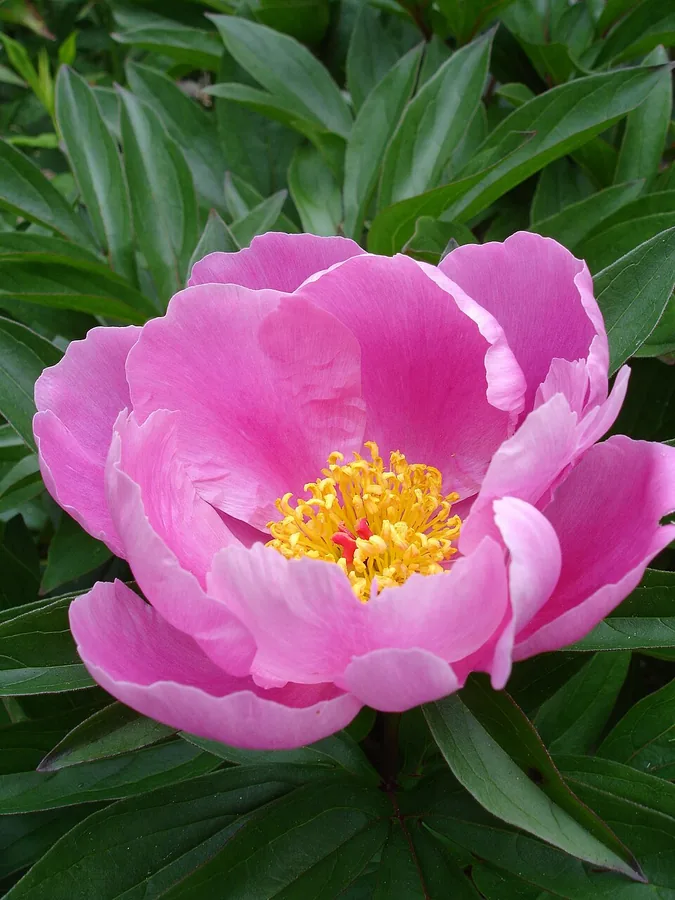
Among garden perennials, the peony is exceptional for longevity: a clump placed in a suitable site can persist longer than the gardener who established it. It behaves as a herbaceous perennial, emerging each spring, carrying large, full flowers in late spring, then maintaining sound green foliage through summer before dying back to the crown for winter. Flower color spans soft pinks to clear whites, and a good many cultivars are genuinely fragrant.
Two variables govern success, and both come down to how the crown is set. Because flower initiation depends on the eyes sitting near the surface, burying them too deep suppresses bloom for years, whereas correct depth paired with full sun and free-draining soil leaves the plant largely self-sufficient. The peony also invests heavily in a permanent root system and resents disturbance, so the planting site should be treated as final.
The genus is adapted to cold winters, and that adaptation is functional rather than incidental: the plant requires a period of winter chilling to initiate flower buds. This is why it performs reliably across USDA zones 3 to 8 and underperforms where winters remain mild. Growth is slow and the return is deferred, but few perennials reward the gardener over so many consecutive decades.
Care
The short version: site the plant in full sun with the eyes only 1 to 2 inches deep in rich, free-draining soil, water deeply about once a week through the growing season, and keep nitrogen low so the plant partitions energy into flowers rather than foliage.
Light
A peony given full sun, meaning at least 6 hours of direct light daily, flowers freely and resists disease better, since strong light supports both bud initiation and rapid drying of the foliage. It withstands partial shade, but insufficient light is a principal reason an otherwise healthy plant fails to bloom.
Water
Water deeply about once a week through the growing season, then let the surface dry before the next application, which matches the plant's preference for moisture without saturation. The roots rot in waterlogged soil, so drainage is as important as the irrigation itself, and keeping water off the foliage limits the leaf wetness that favors blight.
Soil
Plant into rich, well-drained soil amended with organic matter, which supplies fertility while allowing water to move through. A pH of 6.0 and 7.0 suits the plant, and the single condition it will not tolerate is a wet, poorly drained site where the roots stand in water and rot.
Humidity
Ambient outdoor humidity is adequate, so no target figure applies. Air movement is the decisive factor, because still, humid air within a crowded stand sustains the leaf wetness that botrytis and powdery mildew exploit.
Feeding
Apply a low-nitrogen balanced fertilizer in spring, and keep the rate modest. Excess nitrogen drives vegetative growth at the expense of flowers, so heavy feeding produces foliage rather than the bloom the plant is grown for.
Pruning
Cut the stems to ground level in fall and remove every trace of debris, which is the most effective single measure against botrytis blight, since the fungus overwinters on that material. Deadheading spent flowers through the season keeps the plant tidy and removes tissue the mold can colonize.
Size & spacing
A mature peony reaches 1 to 3 feet (30 to 91 cm) in height with a comparable spread. Allow each plant 1 to 3 feet (30 to 91 cm) of clearance so air circulates through the stand and leaf-wetness periods stay short enough to suppress disease.
When to plant
The peony runs on an autumn establishment cycle rather than a spring one. Setting or dividing the roots in September or October lets the plant lay down roots before the ground freezes, after which it delivers its main flush of bloom from late spring into early summer, with each plant flowering for about 2 weeks.
Northern hemisphere
Southern hemisphere
Typical months for a temperate climate: start earlier in warm zones, later where spring frosts linger.
- Sow: Not typically started indoors; propagated by division of dormant roots.
- Plant: Plant or divide roots in September to October so plants establish before winter.
- Harvest: Blooms late spring to early summer (May to early June); individual plants flower for about 2 weeks.
Hardiness
USDA hardiness zones: 3–8
Temperature: down to -40°C
Troubleshooting
Most peony disorders reduce to two underlying conditions, incorrect planting depth and prolonged leaf wetness in crowded, still air. Reading the early expression on the buds and lower leaves lets you identify the cause before it forfeits a season of bloom. Match the symptom below, then correct the condition behind it.
Shoots blacken and buds rot under a gray fuzz
The agent here is botrytis blight, the gray mold Botrytis paeoniae, which colonizes soft tissue during cool, wet spells and rots young shoots and buds before they open. Because the pathogen overwinters on old plant material, sanitation drives control: excise the withered buds and blighted stems on sight, then cut every stalk to the ground in fall and carry the debris away. Wider spacing lowers the leaf-wetness period that the fungus depends on, so space for airflow and water at the base rather than over the canopy.
Fix:
- Remove and destroy withered buds, spent flowers, and blighted shoots
- Cut stalks to the ground in fall and remove all debris
- Improve air circulation and avoid overhead watering
Healthy foliage but few or no flowers
Nine times in ten this is a depth problem, because a peony eye buried more than 2 inches down cannot muster the trigger it needs to initiate flower buds. Shade below the six-hour threshold, the shock of a recent division, and surplus nitrogen each work against bloom in the same direction. Lift the crown in fall and reset the eyes only 1 to 2 inches under the surface, secure a site with at least 6 hours of sun, and give young or freshly divided plants the several seasons they need to build reserves.
Fix:
- Replant in fall with buds only 1 to 2 inches below the soil surface
- Move to a site with at least 6 hours of direct sun
- Allow recently divided plants a few years to mature
- Avoid high-nitrogen fertilizers
White powdery dust on the leaves late in the season
The white bloom on the foliage is powdery mildew, a surface fungus that establishes where shade and stagnant air raise humidity around the leaf, which is why it peaks in late summer and fall. It seldom kills a peony, but the colonized tissue photosynthesizes poorly and the plant loses vigor over successive seasons. Remove and destroy the affected leaves in autumn to cut inoculum, open the planting for air movement, and hold peonies in full sun.
Fix:
- Remove and destroy affected leaves in fall
- Improve spacing and air circulation
- Site plants in full sun
Toxicity
The peony is an ornamental, not a food plant, and it contains a compound called paeonol that concentrates in the roots and bark. Toxicity is only mild, but a pet or grazing animal that chews the roots or stems can present with vomiting, diarrhea, and a dulled mood. Keep cats, dogs, horses, and small children from chewing the plant.
Toxic to
Cats · Dogs · Horses · Rabbits · Livestock · Birds · People
Cats Mild
A cat that chews the roots or stems tends to drool, vomit, and refuse food, all consistent with paeonol irritating the gut. Since the compound concentrates below ground, a meaningful dose usually requires a fair mouthful rather than a passing taste.
Dogs Mild
In dogs the paeonol in the roots and stems provokes vomiting, loose stools, and a dull, low mood once enough is swallowed. Small nibbles typically clear without intervention because the ingested amount stays below the threshold that produces signs.
Horses Mild
A horse that reaches the roots can develop an upset stomach and diarrhea, frequently paired with a flat, listless demeanor. The woody parts hold the toxin, so it takes a substantial quantity to produce clinical signs.
Rabbits Caution
The same paeonol that unsettles other animals makes peony an unsound choice around rabbits, whose digestive tract cannot readily void an irritant. Prudence favors keeping the roots and stems out of reach entirely.
Livestock Caution
Cattle, goats, and sheep rarely select peony, yet the paeonol load in the roots is enough to upset a grazing animal that does sample it. Fencing the plant off from pasture removes the exposure.
Birds Caution
Documentation for birds is sparse, and the presence of an active toxin gives no basis to presume safety. On that reasoning, keep inquisitive pet birds away from the plant.
People Caution
No part of the peony is a food crop, and the roots in particular can provoke nausea and gastric upset if eaten. Cultivate it strictly for the flowers and keep small children from mouthing the plant.
Keep pets from chewing roots and stems; gastrointestinal upset is most likely with large ingestions.
Helpline numbers

United States
ASPCA Animal Poison Control: (888) 426-4435 (fee applies)
Poison Control: (800) 222-1222



Canada
Poison Centres: 1-844-764-7669
Varieties
The genus runs to thousands of named cultivars, yet a small group of long-established selections recurs across gardens. These are the ones worth recognizing by name.
Sarah Bernhardt
A classic double that flowers late, carrying fragrant, soft pink blooms after the bulk of the season's peonies have finished.
Do Tell
A Japanese-form cultivar whose pale pink guard petals frame a densely packed, deep rose-pink center.
Festiva Maxima
An old and highly fragrant double white, distinguished by an occasional fleck of crimson deep in the petal center.
How to propagate
Peonies multiply slowly, but the method is straightforward once the principle is clear: divide the dormant root in autumn and reset the eyes at a shallow depth.
DivisionModerate
September to October while dormant · Several years to reach full bloom after dividing
Divide during dormancy in September or October, when the plant has drawn its reserves back into the root and can tolerate the disturbance. Lift the clump and section it so each division retains 3 to 5 eyes attached to a substantial piece of storage root, then reset the eyes only 1 to 2 inches deep. Each division spends the next several years rebuilding root mass before it reaches full bloom, so plant it and allow it to establish undisturbed.
Myths
Peony buds require ants in order to open.
The relationship runs the other way: ants forage the sugary nectar the developing buds exude, and the buds gain nothing from them in return. Flower opening is driven by the plant's own tissue, so the buds unfurl on schedule whether or not ants are present, and the insects do no damage while feeding. Peony bloom is independent of ants entirely.