Ornamental · Sarraceniaceae
American Pitcher Plant
Sarracenia
Give it full sun, rain-pure water, and a cold winter rest, and the pitcher plant catches its own dinner.
Full sun
Every 1–3 days
1460–1825 days
USDA 6–8
Overview
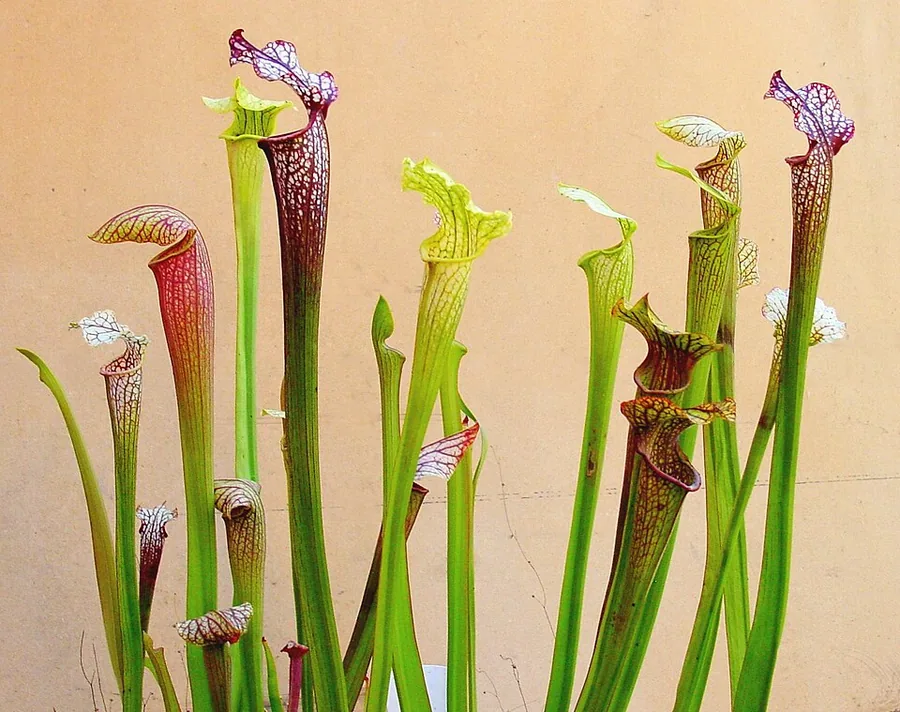
The American pitcher plant inverts the conventional plant strategy: rather than drawing nutrients from fertile soil, it captures and digests insects to supply itself. This adaptation arose because Sarracenia inhabit nutrient-poor acidic bogs, where the substrate yields almost nothing. Each pitcher is a modified leaf, a slick-walled trap whose nectar bait draws prey toward the base.
As temperate species native to the wetlands of eastern North America, their entire culture follows from that origin. They require bright sun, saturated roots through the growing season, and a genuine cold rest in winter. Omit the winter dormancy and the plant declines steadily, regardless of how carefully it is grown the rest of the year.
This makes them exacting rather than difficult. Supply rainwater in place of tap, a peat-and-sand substrate in place of potting soil, and a sunlit position in a water tray, and they perform as durable, long-lived perennials that return larger each spring. Mismanage the water regime or the dormancy and the result is predictable: brown pitchers and a rotting crown.
Care
The short version: full sun, a permanently saturated pot standing in a tray of rain or distilled water, a lean peat-and-sand substrate that never receives fertilizer, and a cold winter rest that allows the plant to enter dormancy.
Light
Provide full sun, ideally 6 or more hours of direct light daily. That intensity drives the red and purple veining, an anthocyanin response, and maintains turgid, upright pitchers. Under shade the traps lodge, lose pigment, and capture far less prey.
Water
Maintain the medium constantly wet through the growing season by standing the pot in a shallow water tray, replicating bog conditions, while keeping the rhizome and crown above the waterline. Use only mineral-free water, namely distilled, reverse-osmosis, or rainwater, because the dissolved salts in tap water accumulate and scorch tissue in a plant adapted to mineral-poor ground. In winter, reduce input and hold the substrate merely damp rather than flooded.
Soil
Establish the plant in a lean carnivorous mix of sphagnum peat moss with sand or perlite, approximately equal parts. The pH should remain acidic, between 4.0 and 6.0. Avoid ordinary potting soil entirely, and add no fertilizer or lime, since each raises mineral content lethal to the plant.
Temperature
These plants tolerate a broad thermal range, roughly 5°F to 95°F (-15°C to 35°C), spanning a hot bog summer and a freezing winter. That cold tolerance is functional rather than incidental, as the chill is the cue that initiates dormancy.
Humidity
Average humidity within the 40% to 70% band is sufficient, and the water tray beneath the pot keeps the air around the pitchers adequately moist. Misting or pursuing a higher reading is unnecessary.
Feeding
Withhold all feeding. The pitchers trap and digest their own insects to obtain nitrogen, so fertilizer in the substrate, or fatty matter dropped into a trap, only burns the plant. Given prey and sunlight, its nutritional requirements are met.
Pruning
In early spring, just before new growth and flowers appear, excise the dead brown pitchers. Retain that old foliage through winter, where it insulates the crown against cold. Remove spent flower stalks once flowering has finished.
Repotting
Repot every 2 to 3 years in early spring, the optimal point for dividing the rhizome as well. Move up when the rhizome crowds the pot rim, roots emerge from the drainage holes, or the medium has decomposed and lost its water-holding capacity. Renew the peat-and-sand each time.
Size & spacing
Mature specimens reach 6 to 36 inches (15 to 91 cm) in height according to species, and spread 6 to 24 inches (15 to 60 cm) wide. The tall trumpet forms and the low purple types occupy opposite extremes of that range.
When to plant
Pitcher plant phenology tracks the seasons closely. Flowering occurs in spring as the new pitchers emerge, the traps operate at full capacity through the warm months, and the entire plant then browns and rests through a cold winter before the cycle resumes.
Northern hemisphere
Southern hemisphere
Typical months for a temperate climate: start earlier in warm zones, later where spring frosts linger.
- Sow: Late winter; seed needs about 4-8 weeks of cold-moist stratification before sowing
- Plant: Spring, after the last hard frost
- Harvest: Spring (flowers open in spring as or just before new pitchers emerge)
Hardiness
USDA hardiness zones: 6–8
Temperature: down to -23°C
Troubleshooting
The great majority of pitcher plant problems resolve to water quality, light, or an omitted winter rest. Reading the condition of the pitchers and the rhizome usually distinguishes a normal seasonal transition from genuine pathology. Match the presentation below before intervening.
Necrotic tips, checked growth, and surface salt crust
Necrotic tips alongside a pale crust on the medium indicate mineral salt toxicity, the cumulative result of tap water, fertilizer, or ordinary potting soil in a plant adapted to nutrient-poor ground. Convert to distilled, reverse-osmosis, or rainwater and leach the medium repeatedly to drive accumulated salts out. Where garden or potting mix is present, repot into fresh peat-and-sand, and never apply nutrients to the substrate.
Fix:
- Switch to distilled, reverse-osmosis, or rainwater only
- Flush the medium repeatedly with mineral-free water to leach salts
- Repot into fresh peat-and-sand mix if ordinary potting soil was used
- Never fertilize the soil
Softened, blackened rhizome and plant collapse
A soft, malodorous rhizome is diagnostic of crown rot, the consequence of a saturated crown, stagnant air, or a winter held too warm. Lift the plant, excise all rotted tissue back to firm material, and reset the sound pieces in fresh damp peat-and-sand. Irrigate by the tray method from below and keep the crown clear of the waterline, because a crown that sits saturated is exactly the condition that invites the rot.
Fix:
- Lift the plant and cut away all rotted tissue
- Repot firm sections into fresh damp peat-and-sand mix
- Keep the crown above the waterline and wet only from below via the tray method
Lax, pale pitchers showing weak pigmentation
Pitchers that lodge over and lose their red and purple veining are signalling a light deficit, since the anthocyanin pigment that produces that coloration develops only under strong light. Site the plant in full sun, 6 or more hours of direct light, and the next pitchers will form turgid and well pigmented. Transition it in stages from a dim position, because tissue grown in low light has no protective pigment and scorches under abrupt full sun.
Fix:
- Move to full sun with 6 or more hours of direct light
- Acclimate gradually if moving from a low-light spot to avoid scorch
Autumn and winter dieback of the pitchers
What looks like decline is winter dormancy, a programmed response. Falling photoperiod and cooler air cue the plant to withdraw resources, so the old pitchers senesce and brown while the rhizome remains firm and viable below ground. The browned foliage acts as insulation over the crown, so leave it intact through winter, hold the medium just damp, and clear the spent pitchers in early spring before the new flush emerges.
Fix:
- Treat as normal seasonal behavior, not disease
- Keep the medium just damp (not deeply flooded) through dormancy
- Trim the dead pitchers in early spring before new growth
Toxicity
Reassurance for pet owners: the American pitcher plant is not toxic. It contains no documented poison, and the digestive fluid held within the pitchers is far too dilute to harm an animal or a person. The plant is fragile, however, so the genuine reason to site it out of reach is to protect the brittle traps rather than the inquisitive animal investigating them.
Safe for
People · Cats · Dogs · Horses · Rabbits · Livestock · Birds
Cats Safe
With no toxic compound documented, a cat that bats at or chews a pitcher is at no risk of poisoning. The only exposed liability is the brittle foliage itself.
Dogs Safe
A dog may investigate or nibble the plant without harm, because the digestive fluid held in the pitchers is too weak to act as a poison. At most, a large volume of ingested plant matter could cause brief gastric upset.
Horses Safe
No constituent of the plant is toxic to horses, and the related California pitcher plant carries an explicit ASPCA non-toxic designation.
Rabbits Safe
A rabbit may browse a stray pitcher with no poisoning risk, as the plant contains no harmful toxin.
Livestock Safe
Grazing stock face no toxic hazard from these bog plants, and encounters are unlikely in any case, since Sarracenia occupy wet, acidic ground well removed from pasture.
Birds Safe
Neither the foliage nor the trapping fluid presents a toxic threat to birds. A small bird is far likelier to rob the pitchers of their trapped prey than to suffer any harm.
People Safe
Handling or incidental contact is harmless, and the weak fluid within the pitchers is not poisonous. The plant carries no edible part and is cultivated ornamentally rather than as a crop.
No toxic principle is known; the digestive fluid in the pitchers is mild. The plants are fragile, so keep them out of reach mainly to protect the plant rather than the pet.
Varieties
Sarracenia comprises a handful of distinct species, ranging from towering yellow trumpets to ground-hugging purple cups. Several are common in cultivation, while a couple are rare enough to hold legal protection.
Sarracenia flava (Yellow trumpet)
Its tall yellow-green trumpets attain roughly 90 cm beneath a flaring lid, and it raises nodding bright yellow flowers in spring.
Sarracenia leucophylla (White-topped pitcher plant)
The upright pitchers bear distinctive white, red-veined upper sections, and the species characteristically produces a strong second flush of growth in autumn.
Sarracenia purpurea (Purple or Northern pitcher plant)
Low, squat purple pitchers lie near the ground and accumulate rainwater; this is the most cold-hardy species, with a range extending north into Canada.
Sarracenia oreophila (Green pitcher plant)
Classified as Federally Endangered and listed on CITES Appendix I, which places legal restrictions on its collection from the wild and its trade.
Sarracenia rubra subsp. jonesii (Mountain sweet pitcher plant)
A Federally Endangered taxon producing slender red-veined pitchers and fragrant flowers, persisting at only a few Carolina sites.
How to propagate
Sarracenia can be increased by a rapid route or a protracted one: dividing an established rhizome, or raising seedlings that need several years to reach flowering size.
DivisionEasy
Early spring before active growth, typically while repotting · 1-2 growing seasons
Division is the rapid, dependable method of increase. Working in early spring before active growth resumes, and conveniently at repotting, sever the rhizome into sections so each retains its own roots and an active growth point, then set them into damp peat-and-sand. Each division needs a season or two to establish and accumulate size.
SeedModerate
Sow in late winter or early spring after 4-8 weeks of cold-moist stratification · 4-5 years to flowering size
Seed propagation rewards patience. The seed requires 4 to 8 weeks of cold-moist stratification to break dormancy and germinate, so sow in late winter or early spring once that chilling period is complete. The resulting seedlings develop slowly and will not reach flowering size for 4 to 5 years.
Myths
Feeding pitcher plants hamburger or fertilizer makes them grow faster.
The plant secures its own nitrogen by capturing insects in its pitchers, so supplemental feeding serves no purpose. Fatty foods and fertilizer scorch the tissue, and the substrate must never be enriched. Let the pitchers catch their own meals.
Pitcher plants can be watered with ordinary tap water like other houseplants.
Dissolved minerals and salts from tap water accumulate in the medium and prove toxic to these bog species over time, since they are adapted to mineral-poor water. Use only distilled, reverse-osmosis, or rainwater.
Carnivorous pitcher plants are dangerous or poisonous to pets.
Their predatory form belies their safety: Sarracenia carry no toxin that harms animals. The closely related California pitcher plant holds an ASPCA non-toxic classification for cats, dogs, and horses, and the digestive fluid within the pitchers is far too weak to injure a pet.
Pitcher plants are tropical and should be kept warm all year.
These are temperate bog plants rather than tropicals, and continuous warmth through winter erodes them gradually. They need a cold winter dormancy, the rest period that lets them regenerate vigorously each spring.