Ornamental · Asteraceae
African Daisy
Osteospermum ecklonis
Match it to full sun, sharp drainage, and cool temperatures, and the African daisy flowers prolifically.
Full sun
Every 3–7 days
50–75°F · 10–24°C
USDA 10–11
Overview
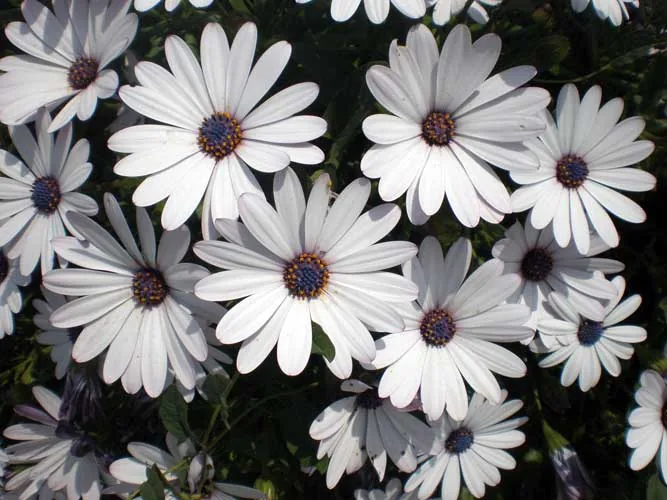
Osteospermum ecklonis sits within the Asteraceae, the sunflower family, and originates in southern Africa, the source of the regional names Cape daisy and Cape marguerite. Throughout most of the country it is cultivated as an outdoor flowering annual, forming a low, mounding to trailing cushion of gray-green foliage above which the capitula are held. Each flower head rises on a slender peduncle and presents a bright whorl of ray florets encircling a disk of contrasting color.
One behavior distinguishes it from a true daisy. The capitula close at night and under low light and reopen with returning sun, a movement that explains why a planting reading as bare at dawn fills out by mid-morning. Functionally it is a tender perennial, persisting through winter only in zones 10 and 11; in colder regions it is replanted annually and grown for a single season.
Its reputation for easy culture is well founded. Supplied with sun and free-draining soil and kept deadheaded, it flowers from late spring through autumn. Its principal limitation is intolerance of a hot, humid summer, during which flowering can stall until cooler conditions resume it.
Care
The short version: full sun and a loose, well-drained medium are the two decisive factors. Maintain even soil moisture short of saturation, fertilize sparingly, and remove spent flower heads to sustain successive bloom.
Light
Osteospermum requires full sun, a minimum of 6 hours of direct exposure daily, to flower to its potential. It accepts partial sun, but reduced light yields lax, etiolated growth at the expense of bloom. Higher light also dries the foliage, which suppresses powdery mildew.
Water
Maintain the medium evenly moist but not saturated, since standing water rapidly induces root rot through oxygen exclusion. An established plant withstands brief drought, yet consistent moisture supports superior flowering. Permit the surface to dry slightly between irrigations, on the order of every 3 to 7 days according to temperature.
Soil
Establish it in loose, well-drained soil amended with modest organic matter, because sharp drainage is the determinant of plant health here. It is indifferent to acidity across a pH of 5.5 to 7.5. Heavy, saturated clay is the single condition warranting correction before planting.
Temperature
This cool-season plant performs optimally between 50°F and 75°F (10°C to 24°C). Flowering decelerates as a hot, humid summer develops and resumes as conditions moderate. Frost terminates the plant in most regions.
Humidity
Ambient outdoor humidity is adequate, so no target value applies. Air circulation is the governing factor, since stagnant air around crowded plants is the precondition for powdery mildew establishment.
Feeding
Fertilize conservatively. A balanced slow-release fertilizer or a little compost through the growing season, applied seasonally, suffices. Overfeeding generates abundant foliage with few flowers, as excess nitrogen biases the plant toward vegetative development.
Pruning
Deadhead spent capitula as they decline to maintain continued flowering. Early tip-pinching induces lateral branching for a denser habit. Cut back any sprawling, leggy stems from late summer into autumn to restore the mound.
Size & spacing
A mature specimen attains 12 to 35 inches (30 to 90 cm) in height and 9 to 24 inches (23 to 61 cm) in spread. Allocate each plant its full spread so air moves through the canopy and the foliage remains dry.
When to plant
Osteospermum is an outdoor subject that prefers warm soil paired with cool air. Sow seed under cover 6 to 8 weeks before the last frost, transplant after frost has passed and the soil has warmed, and expect flowering from late spring into fall, most prolific while temperatures remain low.
Northern hemisphere
Southern hemisphere
Typical months for a temperate climate: start earlier in warm zones, later where spring frosts linger.
- Sow: 6 to 8 weeks before the last spring frost
- Plant: after the last spring frost when soil has warmed
- Harvest: late spring through fall, blooming most heavily in cool weather
Hardiness
USDA hardiness zones: 10–11
Temperature: down to -1°C
Troubleshooting
The majority of disorders in cultivated African daisy reduce to two causes: excessive soil moisture or summer heat stress. Detecting the earliest expression on the flowers and lower foliage permits intervention before the condition advances. Identify the matching presentation below and respond while remediation remains effective.
Basal collapse with progressive yellowing
The leading cause is root rot, where waterlogged soil excludes oxygen from the root zone and the roots break down into brown, mushy tissue. Verticillium wilt, a vascular pathogen, produces a comparable wilt and chlorosis. Allowing the soil to dry between irrigations, removing any plant that has collapsed, and not replanting susceptible species in contaminated ground are the appropriate responses.
Fix:
- Improve drainage and let soil dry between waterings
- Remove and discard severely affected plants
- Avoid replanting susceptible species in infected soil
Deformed shoots coated in sticky exudate
Soft-bodied aphids colonize the shoot tips and lower leaf surfaces, feeding on phloem sap and excreting the sticky residue that marks an infestation. A forceful jet of water dislodges most of the colony mechanically. Where populations rebuild, insecticidal soap provides control, and resident ladybugs supply ongoing biological suppression.
Fix:
- Spray off with a strong jet of water
- Apply insecticidal soap if populations persist
Bloom set falls off in hot, humid conditions
As a cool-season bloomer, Osteospermum reduces flower production when high heat and humidity arrive, a response many cultivars share. Surplus nitrogen compounds the problem because it diverts the plant's resources into vegetative growth rather than flower buds. Scaling back the feed and continuing to deadhead restores the display once temperatures fall.
Fix:
- Site in a spot with cooler conditions and good air flow
- Reduce fertilizer and avoid high-nitrogen feeds
- Deadhead regularly to promote rebloom when cool weather returns
Powdery white colonies on the foliage
The chalky deposit is powdery mildew, a fungal disease that establishes where humidity is high and air movement is poor around closely set plants, then advances across the leaf lamina. Increasing plant spacing improves circulation and limits its spread. Directing water to the soil rather than the canopy and removing the most affected leaves reduce the inoculum further.
Fix:
- Improve air circulation and spacing
- Avoid overhead watering
- Remove affected foliage
Toxicity
The toxicological profile is favorable for households with animals or children. African daisy is non-toxic, and authoritative sources clear it for cats, dogs, and horses. Incidental ingestion by a pet or a young child produces no harm, making it a safe selection for areas used by animals and children.
Safe for
People · Cats · Dogs · Horses · Rabbits · Livestock · Birds
Cats Safe
Classified as non-toxic to cats, so incidental ingestion of the foliage poses no clinical risk.
Dogs Safe
Dogs may share the planting and chew the occasional leaf with no toxic consequence.
Horses Safe
The species carries no compounds of concern, and authoritative sources clear it for horses.
Rabbits Safe
Non-toxic to rabbits, though leafy material should remain a minor fraction of the overall diet.
Livestock Safe
Cattle, goats, and sheep are not at risk of poisoning from grazing in its vicinity.
Birds Safe
Aviary birds and backyard poultry can forage around the plant without adverse effect.
People Safe
Non-toxic to humans and suitable for planting in areas frequented by young children.
Varieties
Although the common name spans several plants, the garden Osteospermum resolves to the species itself and a limited set of named selections. The following warrant identification by name.
Osteospermum ecklonis
The parent species underlying most modern hybrids, it presents a woody-based, mounding to trailing habit with white ray florets surrounding a blue-purple disk.
Bright Lights series
A compact hybrid series validated in university trial gardens, selected for saturated flower color and an extended period of cool-season bloom.
Wildside
A named selection documented in plant-finder records for the atypical coloring of its flowers.
How to propagate
African daisy is propagated either vegetatively or from seed, and the appropriate method follows from the cultivar in hand. Named hybrids reproduce true to type only from cuttings.
Stem cuttingsModerate
During active growth in the growing season · Roots typically form in about 4 to 5 weeks under mist or a humidity tent
Because cuttings reproduce the parent genotype exactly, most named hybrids are propagated vegetatively from tip cuttings rather than by seed. Collect material during active growth, treat the cut surface with rooting hormone, and insert it into a moist soilless medium. Held under mist or within a humidity tent, the cuttings root over approximately 4 to 5 weeks.
SeedModerate
Sow indoors 6 to 8 weeks before the last spring frost · Several weeks to transplant size before moving outdoors after frost
Seed propagation succeeds with certain cultivars, although the majority of garden hybrids remain cutting-grown. Sow under cover 6 to 8 weeks before the last spring frost; the resulting seedlings require several weeks to attain transplant size before they can be set out once frost risk has passed.
Myths
African daisies bloom best in the heat of summer.
The physiology runs the opposite way. Osteospermum reaches peak flowering under cool conditions, and numerous cultivars effectively cease blooming through a hot, humid summer. Manage it as a cool-season plant to extend the flowering period substantially.
Every plant called African daisy is the same one, and it is toxic.
The common name is applied to several taxonomically unrelated plants, which is the origin of the confusion. The garden subject here is Osteospermum in the Asteraceae, and authoritative sources classify it as non-toxic to cats and dogs.