Ornamental · Asteraceae
Blazing Star
Liatris spicata
Set the corms once and blazing star returns each summer with tall purple spikes for pollinators.
Full sun
USDA 3–8
2–4 ft · 0.6–1.2 m
Overview
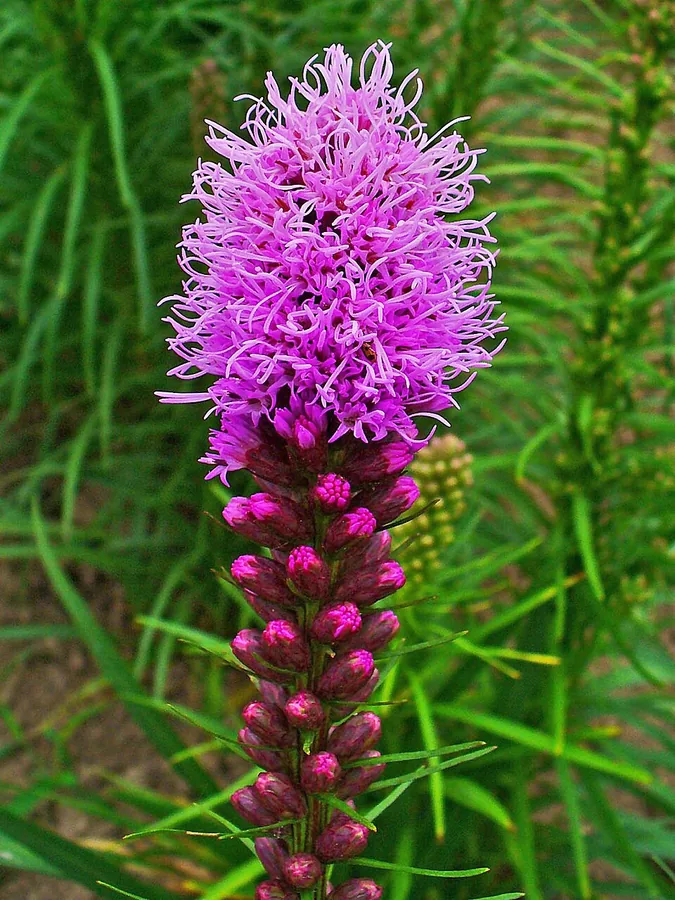
Blazing star is a North American prairie perennial that forgoes the broad, flat capitula of many composites in favor of tall, slender spikes. Each stem carries dense purple florets massed into a plumed column, and a planting in flower draws butterflies and bees from a considerable distance. It grows from a corm, regenerates from that storage organ year after year, and demands little maintenance once established.
Its defining trait appears at anthesis. Where most spike inflorescences open acropetally from the base, blazing star flowers from the top of the spike downward, so the apex is fading while the lower buds are still expanding. The narrow, grass-like foliage and rigid stems supply strong vertical structure that few herbaceous perennials match, whether grown as the full-height species or a reduced selection such as 'Kobold'.
The plant is undemanding wherever light and drainage are adequate. Given full sun and free-draining soil, it withstands heat, drought, and low-fertility ground once its root system is in place. Its one intolerance is waterlogged soil in winter, which induces corm rot more reliably than any pest or pathogen.
Care
The short version: full sun and average, well-drained soil, regular irrigation through the establishment season and much less thereafter, and a site that never remains saturated over winter.
Light
Site blazing star in full sun. It persists in partial shade, but reduced light produces etiolated, weaker stems that lean, so the greater the exposure, the more rigid and upright the growth.
Water
Irrigate through the first growing season to establish the root system. Thereafter it is fairly drought tolerant and requires little supplemental water, and it endures dry conditions far better than wet, particularly over winter.
Soil
It accepts almost any well-drained soil, including loam, sand, and clay, and tolerates low fertility. A pH between 6.0 and 8.0 is suitable, so drainage, rather than richness, is the decisive factor.
Humidity
Ambient outdoor humidity meets its needs, and no target range applies. Air movement is the more relevant variable, since crowded, stagnant conditions are what allow powdery mildew and rust to establish.
Feeding
As a prairie species adapted to lean soils, it is not a heavy feeder. A single light feeding before growth resumes in spring suffices, and excess fertility only produces soft, lodging-prone stems unable to support the spikes.
Pruning
Remove the spent flower stalks after bloom, but leave the foliage and hollow stems intact over winter to provide habitat for native bees and seed for songbirds, then cut them back in early spring. Tall stems in rich, moist soil may require staking.
Size & spacing
Mature plants reach 2 to 4 feet (60 to 120 cm) in a narrow clump. Space them about 12 to 15 inches apart to maintain air circulation and give the spikes room to stand.
When to plant
Blazing star is hardy in zones 3 to 8. Set out corms or young plants in early spring, or plant container-grown stock again in early fall, and the flower spikes develop in mid- to late summer.
Northern hemisphere
Southern hemisphere
Typical months for a temperate climate: start earlier in warm zones, later where spring frosts linger.
- Sow: Early spring; seed germinates in 20-45 days and benefits from 4-6 weeks cold moist stratification
- Plant: Plant corms or container plants in early spring; container-grown plants may also be set out in early fall, spaced 12-15 inches apart
- Harvest: Blooms mid- to late summer (July-August), with dense purple flower spikes opening from the top down
Hardiness
USDA hardiness zones: 3–8
Temperature: down to -40°C
Troubleshooting
Blazing star presents few genuine problems, and most resolve to a single factor: soil that retains excess moisture. Inspect the stems and foliage over the season and intervene early, before a localized fungal infection or a rotting corm advances. Identify the symptom below, then act while the response is still effective.
Abrupt wilting from a decayed crown or corm
Saturated, poorly drained soil sets up stem and corm rot (from Sclerotinia sclerotiorum and related pathogens), and ground that stays wet through winter is the classic predisposing condition. Once the corm has rotted the tissue cannot recover, so excavate the plant with the surrounding infected soil. The durable remedy is drainage, since siting blazing star clear of any spot that holds water removes the wet conditions the rot requires.
Fix:
- Improve drainage and avoid wet sites
- Remove and discard affected plants and surrounding infected soil
Tall flower stems lodging or bending under their spikes
Fertile or moist soil drives soft, elongated growth whose tissue lacks the rigidity to bear a full spike, and inadequate light in shade compounds the weakness. Correcting the site to full sun and average, well-drained soil firms the stems, while staking supports the tallest, and a compact selection such as 'Kobold' sidesteps the problem by growing shorter.
Fix:
- Stake or provide support for tall stems
- Site in full sun and average, well-drained soil rather than rich, moist beds
- Choose compact cultivars such as 'Kobold'
A white powdery coating developing on the foliage
The coating is powdery mildew (Erysiphe cichoracearum), a foliar fungus favored by the crowded, poorly ventilated stands and stagnant air typical of late season. Because the pathogen colonizes leaf surfaces where humidity lingers, spacing or thinning the clump to restore air movement checks its spread, and removing the most affected foliage reduces the inoculum left to infect new growth.
Fix:
- Improve air circulation by spacing and thinning plants
- Remove and dispose of badly affected foliage
Rust-colored pustules erupting on the leaf undersides
Raised, rust-toned pustules on the lower leaf surface are the spore structures of rust fungi (Coleosporium laciniariae and Puccinia liatridis). Since these spores are dispersed from that infected tissue, removing and destroying marked leaves cuts the source, and wider spacing that speeds foliage drying after rain denies the fungus the surface moisture it needs to establish.
Fix:
- Remove and destroy infected leaves
- Improve spacing and air circulation
Toxicity
For households with pets or children, the record is reassuring: blazing star is non-toxic across the board. The ASPCA lists it as safe for cats, dogs, and horses, and no constituent of the leaves, stems, or corms poisons people or grazing animals. The most a large ingestion is likely to cause is transient gastric upset.
Safe for
People · Cats · Dogs · Horses · Rabbits · Livestock · Birds
Cats None
Classified by the ASPCA as non-toxic to cats, so incidental browsing warrants no concern. Any vomiting after a cat consumes a large quantity is mechanical irritation from the coarse foliage rather than a toxic response.
Dogs None
Equally free of toxic compounds in the foliage, stems, and corms, so it poses no poisoning risk to dogs. The likeliest outcome of a large ingestion is transient, mild gastrointestinal upset.
Horses None
Horses may graze in proximity to blazing star without hazard, as the plant contains no constituents toxic to equines.
Rabbits None
Rabbits and comparable small mammals can browse the foliage safely, consistent with its status as a native wildflower they encounter in meadow habitat.
Livestock None
Cattle, goats, and sheep are unaffected by blazing star on pasture, since it holds no toxins injurious to grazing stock.
Birds None
Birds face no risk from it, and songbirds such as goldfinches actively forage the mature seed heads through autumn and winter.
People None
No portion of blazing star is toxic to humans. It is cultivated as an ornamental rather than a food crop, so there is no occasion to eat it, though incidental contact or tasting carries no harm.
Varieties
The named blazing stars are selected primarily for flower color or for a more restrained height. The following are the selections most commonly offered.
Kobold
A compact, deep-purple selection whose reduced stature keeps the spikes self-supporting, which recommends it for the front of a border.
Floristan White
A white-flowered form valued chiefly as a cut flower, its spikes retaining their form and lasting well once in the vase.
Floristan Violett
A violet-flowered selection whose stems are rigid enough to withstand cutting and handling, accounting for its use in the florist trade.
Alba
A pure white form reaching roughly 18 inches, shorter than the species and thus suited to a compact planting.
How to propagate
Blazing star propagates readily by division of an established clump or from seed, though the two methods differ markedly in the time each takes to reach flowering.
DivisionEasy
Spring, just as leaves emerge · Establishes over one to two seasons; clumps can be divided every few years
Division of an established clump is the dependable route to additional plants and preserves the parent's traits. In spring, as the new leaves emerge, lift the clump and separate the corms and tuberous roots by pulling or cutting so that each division retains at least one eye. Because the disturbed divisions re-root gradually, allow one to two seasons for them to bulk up to flowering size.
SeedModerate
Early spring indoors or direct sow, or fall sow outdoors · Seedlings typically bloom in their second or third year
Seed carries an innate dormancy that must be broken before germination proceeds. Provide 4 to 6 weeks of cold, moist stratification, or sow outdoors in fall so winter supplies the chilling, after which germination follows over 20 to 45 days. The resulting seedlings require their second or third year of growth before producing an initial flower spike.
Myths
Blazing star is toxic to dogs and cats.
The ASPCA classifies blazing star among the species that are not toxic to dogs and cats. As with the ingestion of any plant material, a large quantity may provoke mild gastric upset, but no toxic principle is present.
Liatris spikes open from the base upward like most spike-forming flowers.
The inflorescence follows the reverse pattern of nearly all other spike flowers. It opens acropetally from the top of the spike downward, so the apical florets are already senescing while the basal buds are only beginning to expand.