Ornamental · Asteraceae
Ageratum
Ageratum houstonianum
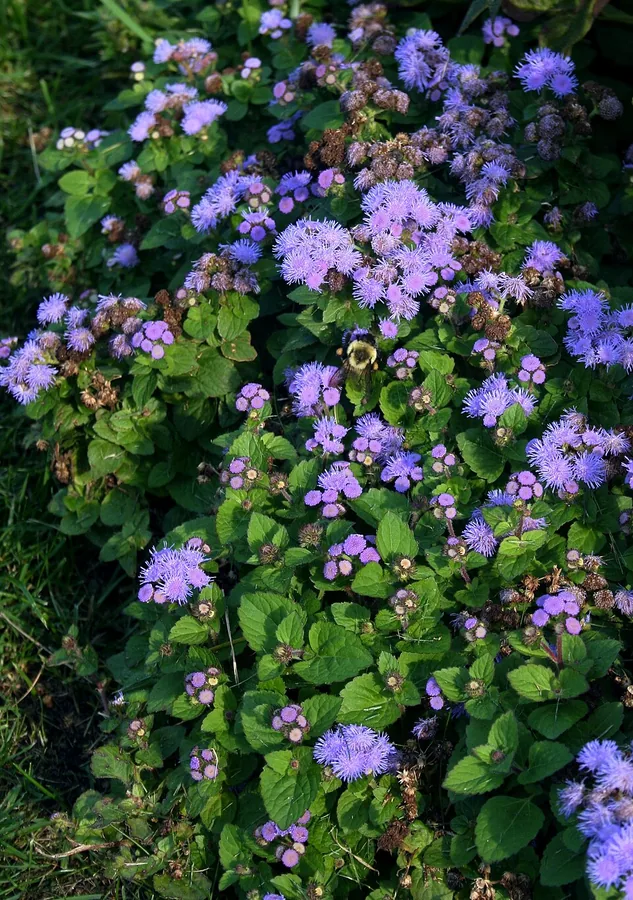
Floss flower carries soft blue blooms from late spring to frost when given full sun and steady moisture.
Full sun
Every 2–4 days
50–86°F · 10–30°C
55–70 days
Overview
Ageratum, the floss flower, is a low-growing annual in the Asteraceae family valued for its fuzzy clusters of soft blue, lavender, and purple. Those powder-puff heads are tight corymbs of disc florets, and because the plant flowers on new growth it produces bloom from late spring until frost with little interruption. Its low stature suits the front of a border, an edging run, or a container where the canopy spills past the rim.
Growth habit stays compact and mounded, with bedding selections holding close to the soil and taller cutting forms drawn up for the vase. Sharing the family of asters and sunflowers, ageratum diverges from those open ray-flower faces and instead reads as a soft haze of cool color. True blue is uncommon among annuals, which accounts for its recurring use in summer plantings.
Maintenance demand is modest once the plant establishes a root system, but two requirements are non-negotiable: even moisture and warmth. Soil that dries fully triggers rapid wilting, because the species lacks drought reserves. Supplied with sun, consistent water, and air movement through the canopy, the plant returns months of bloom for minimal input.
Care
The short version: full sun, eased by light afternoon shade in hot-summer climates, set in rich well-drained soil held evenly moist, with a monthly feeding across the growing season to sustain continuous blue flowering.
Light
Flowering peaks under full sun, since high light drives the photosynthate that supports continuous bloom; the plant tolerates partial shade and benefits from afternoon shade where summer heat is extreme. Under deep shade, flower production falls and stems elongate into loose, leggy growth.
Water
Hold the soil evenly moist on roughly a 2 to 4 day cycle, because the species wilts quickly once the root zone dries. Moisture must be consistent rather than excessive, so drainage is as critical as watering frequency, since saturated soil drives root rot.
Soil
Use a rich, well-drained medium amended with organic matter, which both retains moisture and preserves the air spaces roots need. A pH of 6.0 and 7.5 is optimal, a range most garden soils reach after a modest compost amendment.
Temperature
Active growth runs from about 50°F to 86°F (10°C to 30°C), the warm band this species requires. It carries no frost tolerance, and freezing temperatures kill it outright, so transplanting should wait until spring weather is settled.
Humidity
Ambient outdoor humidity is adequate and no target value applies. Air circulation matters more than moisture in the air, because stagnant, humid conditions within a crowded canopy create the microclimate powdery mildew exploits.
Feeding
Apply a balanced general-purpose fertilizer about once a month during the growing season. Moderate, regular feeding maintains foliar nitrogen and sustained flowering, whereas heavier dosing forces soft, weak growth at the expense of bloom.
Pruning
Structural pruning is unnecessary. Deadheading is optional rather than required, but removing spent flower clusters tidies the planting and redirects energy toward fuller, more continuous bloom.
Size & spacing
Mature height spans 6 to 30 inches (15 to 76 cm) by selection, dwarf bedding forms remaining low while cutting forms grow taller. Spacing of 6 to 18 inches (15 to 46 cm) preserves airflow between plants and suppresses the humidity that mildew requires.
When to plant
Treat ageratum as a frost-tender annual whose development tracks soil and air warmth. Sow indoors in late winter, about 6 to 8 weeks before your last frost, transplant only after the frost-free date in spring, and the plant flowers from late spring through the first killing frost.
Northern hemisphere
Southern hemisphere
Typical months for a temperate climate: start earlier in warm zones, later where spring frosts linger.
- Sow: Late winter, about 6 to 8 weeks before last frost
- Plant: After all danger of frost has passed in spring
- Harvest: Late spring or June through frost
Hardiness
USDA hardiness zones: 2–11
Temperature: down to -46°C
Troubleshooting
Nearly every ageratum disorder resolves to one of two causes: insufficient air movement through the canopy, which favors fungal disease, or excess water at the roots, which starves them of oxygen. Early identification keeps the remedy simple. Match the symptom below and intervene before it moves through the planting.
Progressive wilt and chlorosis ending in collapse
Progressive yellowing, wilt, and collapse despite irrigation indicate root rot driven by waterlogged, poorly drained soil that deprives roots of oxygen. Excavation at the crown reveals soft, brown, decomposing roots. Recovery is not possible at that stage, so remove the plant and correct drainage before replanting the site.
Fix:
- Improve soil drainage before or at planting
- Reduce watering frequency and avoid waterlogging
- Remove severely affected plants
Powdery white fungal film across leaf and stem surfaces
A dusty white film is powdery mildew, an obligate fungal pathogen that colonizes leaf surfaces under warm, humid, still air around crowded plants. Increase canopy airflow, irrigate at the soil line to keep foliage dry, and remove the most heavily infected leaves. Full sun and consistent root-zone moisture limit reinfection.
Fix:
- Improve air circulation by spacing plants properly
- Avoid overhead watering and water at the base
- Remove and discard heavily infected foliage
Honeydew-slicked foliage, deformed shoots, insect colonies
Honeydew deposits and distorted new growth signal aphids or whiteflies drawing sap from foliage and flower buds. Examine leaf undersides for soft-bodied aphids or minute white flies that disperse on disturbance. A forceful water spray dislodges most colonies, and insecticidal soap suppresses persistent populations.
Fix:
- Rinse pests off with a strong spray of water
- Apply insecticidal soap if infestations persist
- Encourage natural predators
Chlorotic stippling and delicate webbing on foliage
Fine chlorotic stippling with light webbing identifies twospotted spider mites, whose populations escalate on drought-stressed plants in hot, dry conditions. Tapping foliage over white paper reveals the moving specks. Restoring adequate irrigation relieves the stress that favors them, rinsing reduces numbers, and a miticide is warranted only for resistant infestations.
Fix:
- Keep plants adequately watered to reduce stress
- Rinse mites off leaves with water
- Apply miticide or insecticidal soap if needed
Toxicity
This species is unsuitable for grazing. Ageratum synthesizes pyrrolizidine alkaloids, hepatotoxins that injure liver tissue and accumulate with repeated ingestion rather than clearing the body. A pet that takes a single leaf typically shows no more than transient gastrointestinal upset, but horses, rabbits, and grazing livestock must be excluded entirely, and no part of the plant should be regarded as food.
Toxic to
Cats · Dogs · Horses · Rabbits · Livestock · Birds · People
Cats Mild
Ingestion of a leaf in cats generally produces no more than drooling, vomiting, diarrhea, or lethargy. Larger or repeated quantities warrant concern, since the hepatotoxic alkaloids accumulate over time.
Dogs Mild
Dogs that sample the plant usually present mild gastrointestinal signs, possibly vomiting, soft stools, or reduced activity. The clinical risk lies in repeated or substantial ingestion, which progressively damages the liver.
Horses Toxic
As sensitive grazers, horses accumulate pyrrolizidine alkaloids that produce hepatic fibrosis over weeks of feeding. Monitor for weight loss, jaundice, and altered, depressed behavior, and exclude the plant from their access.
Rabbits Toxic
Continuous foragers by nature, rabbits face genuine exposure to the same hepatotoxins. Withhold all ageratum trimmings and exclude the plant from any enclosure a rabbit can browse.
Livestock Severe
Cattle, sheep, and goats sustain the most severe outcomes. Chronic alkaloid toxicosis presents as inappetence, depression, jaundice, edema, ascites, and irreversible liver damage, so grazing stock must have no access.
Birds Toxic
The hepatotoxic alkaloids that harm grazing species pose the same hazard to birds. Regard the plant as off-limits to poultry and pet birds rather than permit repeated exposure.
People Caution
No part of ageratum is edible. Its pyrrolizidine alkaloids are documented to injure the human liver, so keep it from children's mouths and refrain from brewing or consuming any portion.
Keep grazing animals away; contains liver-damaging pyrrolizidine alkaloids.
Helpline numbers

United States
ASPCA Animal Poison Control: (888) 426-4435 (fee applies)
Poison Control: (800) 222-1222



Canada
Poison Centres: 1-844-764-7669
Varieties
Named ageratum selections divide cleanly by form: taller stems bred for cutting and low mounding habits bred for bedding. The cultivars below are the ones encountered most often.
Blue Horizon
A tall cutting selection reaching about 30 inches, its medium-blue heads carried on stems long enough for vase work.
Blue Danube
A compact dwarf bedding cultivar with a low, dense habit topped by lavender-blue flowers.
Hawaii series (e.g. Leilani Blue)
Low mounding bedding ageratums selected for uniform, near-continuous blue flower cover across a planting.
How to propagate
Ageratum is propagated from seed, and the seed behaves predictably once its single germination requirement is met. Sowing a tray indoors before the season yields ample transplants for a bed.
SeedEasy
Start indoors in late winter, about 6 to 8 weeks before the last frost; transplant or direct sow outdoors after frost danger passes. · Roughly 1 to 2 weeks to germinate; flowering in about 8 to 10 weeks from sowing.
Sow ageratum under cover in late winter, about 6 to 8 weeks before the last frost, then transplant or direct sow once the frost-free date arrives. The seed is fine and needs light to germinate, so surface-sow it and leave it uncovered. Germination follows in 1 to 2 weeks, with first flowering about 8 to 10 weeks after sowing.
Myths
Ageratum is entirely nontoxic and harmless to companion animals and humans.
It is not. The tissue contains pyrrolizidine alkaloids that injure the liver, so an ingesting pet can develop gastrointestinal upset and grazing livestock can sustain cumulative, lasting damage. Classify ageratum as toxic and prevent animals from feeding on it.
Ageratum ceases to bloom unless spent heads are removed continually.
Not so. Because the plant flowers continuously on new growth, bloom persists across the season regardless of whether spent heads are removed. Deadheading is optional, a maintenance choice that improves fullness and uniformity rather than a requirement the plant depends on.