Ornamental · Asteraceae
Bidens
Bidens ferulifolia
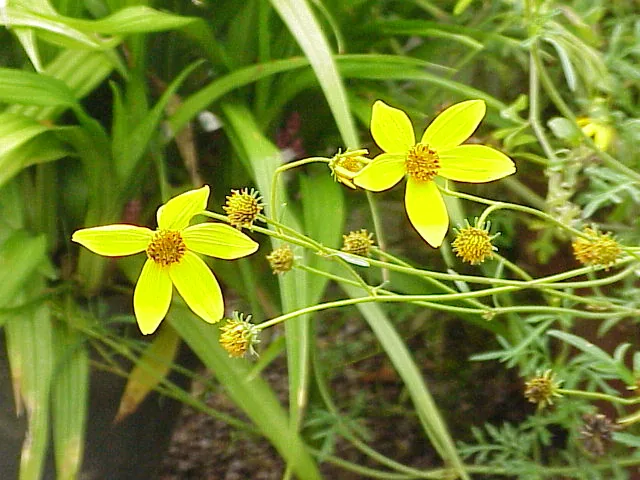
Set it in full sun and average soil, and bidens carries golden flowers from spring right through to frost.
Full sun
Every 2–4 days
USDA 8–11
10–15 in · 25–38 cm
Overview
Bidens is a low, spreading member of the daisy family raised for months of steady bloom rather than for any culinary use. It cascades from baskets and containers and threads through the front edge of a border, blanketed in small flowers that run gold in most forms. Its appeal lies in how little it demands relative to how much color it returns.
Once established, bidens carries genuine heat and drought tolerance, holding its flowers when less resilient plants stall in summer stress. Its growth is fast yet low, seldom topping knee height, so it fills gaps and trails over edges rather than building upward. Newer named selections extend the color range past gold into white, pink, and two-tone forms.
At root it is a tender plant, grown as a warm-season annual in most gardens and set out fresh each spring once the cold has broken. Give it sun and ground that drains and it largely tends itself. A single shearing at midsummer prompts a renewed flush of flower.
Care
The short version: full sun, average well-drained soil, and consistent water that never sits. Feed container plants across the season, pinch the plant once at midsummer to drive branching, and it flowers on without any deadheading.
Light
Bidens demands full sun, and flowering scales directly with the light it receives, since the energy for bloom comes from that exposure. It tolerates a little afternoon shade, but in true shade the stems stretch toward the light and the flower count drops with them.
Water
Let the soil surface dry between waterings rather than holding it wet, because saturated soil starves the roots of air and is the one stress bidens will not tolerate. It manages heat and drought well once established, but pots and baskets lose moisture quickly and need more frequent watering through summer.
Soil
Average, well-drained ground is the whole requirement, with nothing rich or amended called for. A pH anywhere between 6.0 to 7.0 suits it, so most garden soil serves as long as water drains freely through it.
Temperature
Bidens grows readily through warm weather and accepts a broad band, from roughly 36°F to 86°F (2°C to 30°C). It cannot survive a hard frost, however, which is why most gardeners treat it as a fresh planting each spring.
Humidity
Ordinary outdoor humidity suits it, so there is nothing to monitor or correct. The more important factor is air moving freely around the plant, since still, crowded growth holds the moisture that lets mildew and mold establish.
Feeding
Plants set in the ground seldom need feeding, but containers and baskets exhaust their limited root volume quickly. Give those a balanced water-soluble feed every two weeks through the growing season to sustain continued flowering.
Pruning
Bidens flowers without deadheading, so spent blooms can be left in place. When it sprawls or runs leggy by midsummer, shear or pinch it back, which redirects the plant into branching and returns it thicker and freshly in flower.
Size & spacing
Plants stay low, standing about 10 to 15 inches (25 to 38 cm) tall while spreading 12 to 24 inches (30 to 61 cm) across. Allow each one room to trail and the planting closes into an unbroken sheet of flower.
When to plant
Bidens has zero frost hardiness, so all its timing keys off warmth. Sow seed indoors in late winter, move plants out only once the last frost has cleared and the soil has warmed enough for roots to grow, and the display runs from late spring through to the first autumn frost.
Northern hemisphere
Southern hemisphere
Typical months for a temperate climate: start earlier in warm zones, later where spring frosts linger.
- Sow: 6 to 8 weeks before the last spring frost
- Plant: after the last spring frost when soil has warmed
- Harvest: late spring through fall until frost
Hardiness
USDA hardiness zones: 8–11
Temperature: down to -12°C
Troubleshooting
Bidens stays largely trouble-free, yet a handful of pests and molds appear when conditions tip in their favor. Most announce themselves first on the new growth or the flowers. Match what you see to the entries below and act early, while the problem is still small.
Stippled, bronzing foliage with thin webbing in heat
Spider mites thrive in hot, dry air and feed by puncturing leaf cells one at a time, which is why the surface reads as fine stippling that dulls to bronze. To confirm them, tap a leaf over white paper and watch the dislodged specks move. Rinsing the foliage knocks populations down, and insecticidal soap or a labeled miticide handles a persistent outbreak.
Fix:
- Rinse foliage with water to reduce populations
- Apply insecticidal soap or a labeled miticide if infestation persists
Gray fuzzy mold settling on flowers in damp spells
Cool, wet weather is what wakes up botrytis, the gray mold that colonizes spent blooms and the soft tissue rotting beneath them. Pick off and bin the affected flowers and leaves promptly, since the mold spreads from that decaying material. Open up the spacing so foliage dries quickly after rain and you remove the dampness it depends on.
Fix:
- Remove and discard affected flowers and foliage
- Increase spacing and air circulation to dry foliage
Soft insects massing on sticky young shoots
Those colonies are aphids, and they congregate at the growing tips because the youngest tissue carries the highest sugar load in its sap. As they feed they excrete the excess as honeydew, the sticky film you notice. Knock the colony loose with a forceful jet of water first, then treat with insecticidal soap on any stragglers.
Fix:
- Spray plants with a strong stream of water to dislodge aphids
- Apply insecticidal soap to affected growth as needed
Powdery white coating spreading over the leaves
That chalky surface is powdery mildew, a fungus that takes hold where plants sit crowded and the air around them goes still. Thinning and spacing the plants breaks up that stagnant pocket so the foliage dries, and stripping the worst-coated leaves removes the source of new spores. Keeping the planting in full sun with moving air is what stops it returning.
Fix:
- Improve air circulation by thinning and spacing plants
- Remove and discard heavily affected foliage
Toxicity
For a household with pets or grazing animals, bidens is reassuring: it carries no known toxin. Its absence from the ASPCA list of poisonous plants means a nibbled leaf calls for no alarm. That said, it is grown for display and not for eating, so there is no cause to make a habit of it.
Safe for
People · Cats · Dogs · Horses · Rabbits · Livestock · Birds
Cats Safe
Because bidens is absent from the ASPCA toxic plant list, a cat that samples a leaf faces no toxic effect. The only caveat is mechanical: any plant eaten in volume can provoke a bit of drooling or a passing stomach upset, so gentle discouragement does no harm.
Dogs Safe
Dogs share space with bidens safely, as the plant holds no recognized toxin. A dog that chews a stem may feel mildly queasy simply from the bulk of plant fiber, the same response any greenery can trigger, but nothing of consequence follows.
Horses Safe
Horses can graze in the vicinity of bidens without risk. The plant carries no poisonous compound, and no cases of it harming horses have been documented.
Rabbits Safe
A rabbit may nibble bidens with no toxic concern. As with any lush green, an abrupt large portion is best avoided to spare the gut, but the plant itself contains nothing damaging.
Livestock Safe
Cattle, goats, and sheep can browse around bidens without harm, since it contains no toxin that acts on grazing animals.
Birds Safe
Bidens presents no danger to birds, which commonly work over the spent flower heads for seed. Backyard hens can forage around the planting freely.
People Safe
Bidens is raised as an ornamental for its flowers rather than for eating, yet it is non-poisonous to handle and to live alongside. Children need not be kept clear of it, though it is not a plant intended for the plate.
Varieties
The wild species runs gold, but breeding has stretched bidens into fresh colors and tidier habits. These named selections are the ones worth seeking out.
Blazing Fire
Its bicolor flowers carry red-orange at the throat that grades to gold toward the petal tips, and it proved a uniform, reliable performer in University of Georgia trials.
White Delight
Departing from the genus default of yellow, this selection opens creamy white flowers for a softer effect, and it was assessed in the University of Georgia trials.
Pretty in Pink
A pink-flowered form that swaps the customary gold for a quieter tone, likewise evaluated through the University of Georgia trials.
Mexican Gold Improved
A refined version of the classic golden-yellow species, reworked and trialed at the University of Georgia for stronger garden performance.
How to propagate
Bidens multiplies easily, whether the aim is faithful copies of a favorite hybrid or a tray of seedlings to fill out the beds.
Stem cuttingsEasy
Spring through summer during active growth · About 2 to 4 weeks to root
Taking cuttings is how you reproduce a named hybrid faithfully, because the new plant is genetically identical to its parent and holds every trait. Cut a soft tip while the plant is in vigorous growth in spring or summer, when rooting hormones run highest, and roots form in roughly 2 to 4 weeks.
SeedEasy
Start indoors 6 to 8 weeks before the last spring frost · Germinates in roughly 1 to 2 weeks at warm temperatures
The species and open-pollinated forms grow readily from seed, though seed from named hybrids rarely comes true to type. Start it indoors 6 to 8 weeks before the last frost and hold the tray warm, since these seeds need warmth to germinate, and the seedlings emerge in about 1 to 2 weeks.
Myths
Ornamental bidens will poison dogs and cats.
Bidens is not listed anywhere in the ASPCA toxic plant database, and the ornamental Bidens ferulifolia is regarded as non-toxic to pets. A dog or cat that chews a leaf is in no danger, though encouraging any pet to graze on garden plants is still a habit best avoided.
Garden bidens will spread aggressively by clinging seeds the way weedy beggarticks do.
The name beggarticks comes from the wild species, whose two-pronged seeds latch onto fur and clothing to disperse. The garden ferulifolia hybrids behave differently: grown as warm-season annuals and frequently bred as low-seeding selections, they lack the seed dispersal that lets their weedy relatives colonize a yard.