Ornamental · Asteraceae
Calendula
Calendula officinalis
Sited in full sun on lean soil, pot marigold flowers from spring through to frost.
Full sun
Every 3–7 days
39–75°F · 4–24°C
45–65 days
Overview
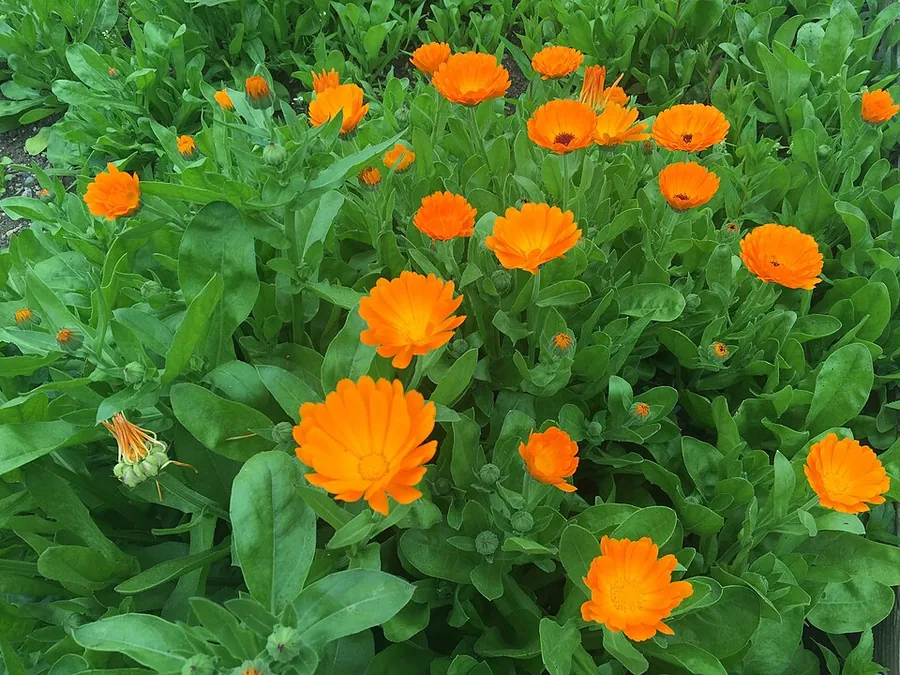
Calendula, or pot marigold, is a cool-season annual in the family Asteraceae, valued for its sustained flowering on minimal inputs. A single sowing carries bloom from spring into fall, after which the plant self-sows and returns the following season. The yellow to orange flower heads are edible, a long-standing culinary use that explains their appearance in salads and as a food colorant.
Its cultural requirements are modest. Average, well-drained soil and a position in full sun meet its needs, and restrained fertilization improves flowering because excess nitrogen favors foliage over blooms. The plant slows in genuine summer heat, yet a hard cutback frequently triggers a renewed flush once temperatures moderate in fall.
These traits make it a sound choice for the inexperienced or time-limited gardener. Periodic deadheading sustains bloom, dry foliage suppresses mildew, and with little intervention calendula holds the front of a border or kitchen bed reliably.
Care
The short version: full sun, average well-drained soil, and sparing fertilizer suit it best. Keep moisture even and applied at the base, deadhead spent flowers, and the plant flowers as a cool-season annual from spring through fall.
Light
Flowering is heaviest in full sun, though the plant accepts partial shade, which is useful where summer temperatures climb. Light intensity correlates directly with bloom, so the brightest available position gives the best display.
Water
Maintain evenly moist soil with regular irrigation over a substrate that drains freely, since standing moisture at the roots is harmful. Apply water at the base rather than overhead, because surface moisture on the foliage favors powdery mildew. Overall demand is medium.
Soil
Average, well-drained soil meets its needs, and it tolerates clay, loam, sand, or richer ground without complaint. A pH between 5.5 and 7.0 is suitable. Drainage is the limiting factor here, well ahead of fertility.
Temperature
This is a cool-season species, optimal in the range of 39°F to 75°F (4°C to 24°C). It stalls and deteriorates in midsummer heat and then recovers as conditions cool in fall.
Humidity
Ambient outdoor humidity is adequate, so no specific target applies. Air movement is the operative variable, since crowded, moist plantings are the ones that develop mildew.
Feeding
Apply only light feeding during the growing season, or none. Calendula flowers best on lean soil, and excess fertilizer produces foliage at the cost of bloom.
Pruning
Deadhead spent blooms as they fade to sustain flowering and restrain self-seeding. If the plant declines under summer heat, a hard cutback often induces a fall rebloom.
Size & spacing
Mature plants reach roughly 12 to 24 inches (30 to 61 cm) in height with a comparable spread. Spacing to that width promotes air movement and reduces the conditions mildew exploits.
When to plant
As a cool-season annual, calendula performs best in the moderate temperatures that bracket summer. Sowing indoors in late winter or direct sowing around the last frost establishes the planting, and flowering then continues from spring until a hard frost ends the season.
Northern hemisphere
Southern hemisphere
Typical months for a temperate climate: start earlier in warm zones, later where spring frosts linger.
- Sow: About 6 to 8 weeks before the last spring frost
- Plant: Direct sow or transplant just before to around the last spring frost; a cool-season annual best in spring and fall
- Harvest: Blooms spring through summer, continuing almost nonstop until first heavy frost in cool climates
Hardiness
USDA hardiness zones: 2–11
Temperature: down to -46°C
Troubleshooting
Calendula is durable, and most disorders register first on the leaves or new growth where they are easy to read. Early identification usually allows a straightforward correction. Match the symptom below, then intervene before it advances.
Mosaic mottling and leaf distortion with declining vigor
Persistent yellow-green mottling and leaf distortion that neither water nor feeding corrects indicate cucumber mosaic virus, a systemic pathogen that aphids transmit as they move between plants. No treatment cures an infected plant, so prompt removal and destruction is the only way to protect the rest of the stand. Suppressing the aphid vectors and washing hands between plants interrupts the routes by which the virus spreads.
Fix:
- Remove and destroy infected plants to limit spread
- Control aphid vectors
- Avoid handling healthy plants after touching infected ones
Powdery white fungal film over leaf and stem surfaces
A dusty white film is powdery mildew, a fungal infection that establishes when crowding and poor air movement trap humidity around the foliage. Because the spores need that still, moist microclimate, thinning and spacing the planting deprives them of it, and watering at the base rather than overhead denies the leaf-surface moisture they germinate on. Strip and discard heavily colonized leaves to lower the spore load on the rest of the stand.
Fix:
- Improve air circulation by thinning and spacing plants
- Water at the base to keep foliage dry
- Remove and discard severely affected leaves
Soft-bodied insect colonies and honeydew on tender growth
Soft green or black colonies on the buds and shoot tips are aphids, sap feeders that concentrate on the tenderest tissue and excrete the sticky honeydew you see. A forceful jet of water physically dislodges them, and insecticidal soap clears a heavier population. Since excess nitrogen drives the soft, succulent growth aphids prefer, restraint with feeding limits them, and resident lady beetles will continue the work as predators.
Fix:
- Spray plants with a strong stream of water to dislodge aphids
- Apply insecticidal soap if populations are high
- Encourage beneficial insects such as lady beetles
Irregular feeding holes in foliage and petals
Irregular holes accompanied by a dried slime trail point to slugs and snails, nocturnal grazers that do the most harm to soft young tissue. Hand-collecting them at dusk removes the active feeders directly, and clearing damp garden debris strips away the cool, moist daytime refuges they depend on. Where pressure persists, traps or iron-phosphate baits reduce the population further.
Fix:
- Hand-pick slugs and snails in the evening
- Remove garden debris that provides shelter
- Use traps or iron-phosphate baits if damage is heavy
Toxicity
The safety profile here is reassuring. The ASPCA records pot marigold as non-toxic to cats, dogs, and horses, and the petals are edible for people. Neither a grazing animal nor a curious child is at risk, so the species can be sited anywhere in the garden.
Safe for
People · Cats · Dogs · Horses · Rabbits · Livestock · Birds
Cats None
The ASPCA classifies pot marigold as non-toxic to cats, so an exploratory nibble presents no clinical risk.
Dogs None
Dogs are equally unaffected. The species here is the garden pot marigold rather than the bedding type, and the ASPCA rates it safe.
Horses Safe
Calendula contains no documented toxic compounds, so grazing horses face no recognized hazard from it.
Rabbits Safe
Rabbits can consume both foliage and petals safely, and the flowers are commonly cultivated as a non-toxic forage.
Livestock Safe
Cattle, goats, and sheep tolerate calendula without incident, and no cases of poisoning are on record.
Birds Safe
Backyard birds can feed on the seed heads and petals with no toxicological concern.
People Safe
The petals are edible, used in salads and as a saffron-style colorant, so there is no consumption risk for people.
Varieties
Calendula is offered in several flower forms and color ranges worth distinguishing before sowing. The following are the ones most commonly encountered.
Double-flowered types
These bear densely petaled heads in yellow through deep orange in place of the open single daisy form.
Single-flowered types
These produce open daisy-form blooms with a single whorl of ray florets surrounding a flat central disk.
Yellow to orange color forms
These range from bright yellow to deep orange, and their edible ray petals serve as a culinary garnish or natural colorant.
How to propagate
Calendula increases by seed almost exclusively, and it does so with very little assistance, germinating quickly and reseeding itself for the next season.
SeedEasy
Start indoors about 6 to 8 weeks before the last frost, or direct sow outdoors around the last spring frost · Germinates in about 5 to 15 days; first blooms in roughly 45 to 65 days from seed
Calendula propagates readily from seed, among the most reliable of garden annuals to raise this way. Sow indoors 6 to 8 weeks ahead of the last frost or direct sow around frost at a depth of 1/4 to 1/2 inch. Germination follows in 5 to 15 days, with first flowers in 45 to 65 days from sowing. Left in place, the plant sets and drops viable seed, reseeding modestly without becoming invasive.
Myths
Calendula is simply the botanical label for the ordinary bedding marigold, a plant with mild toxicity to cats and dogs.
Pot marigold is Calendula officinalis, taxonomically distinct from the Tagetes bedding marigolds it is routinely confused with. The ASPCA lists it as non-toxic to dogs and cats, so the toxicity concern attached to that confusion does not apply.
Abundant nutrients and enriched soil are prerequisites for a good calendula bloom.
The plant performs well on average, well-drained soil and has low nutrient demands. Heavy feeding actually works against the flowers because surplus nitrogen drives vegetative growth at the expense of flowering, so fertilize sparingly.