Ornamental · Asteraceae
Black-eyed Susan
Rudbeckia hirta
Sited once in full sun, this golden daisy renews itself each year through the seed it sets.
Full sun
Every 7–10 days
USDA 3–8
2–4 ft · 0.6–1.2 m
Overview
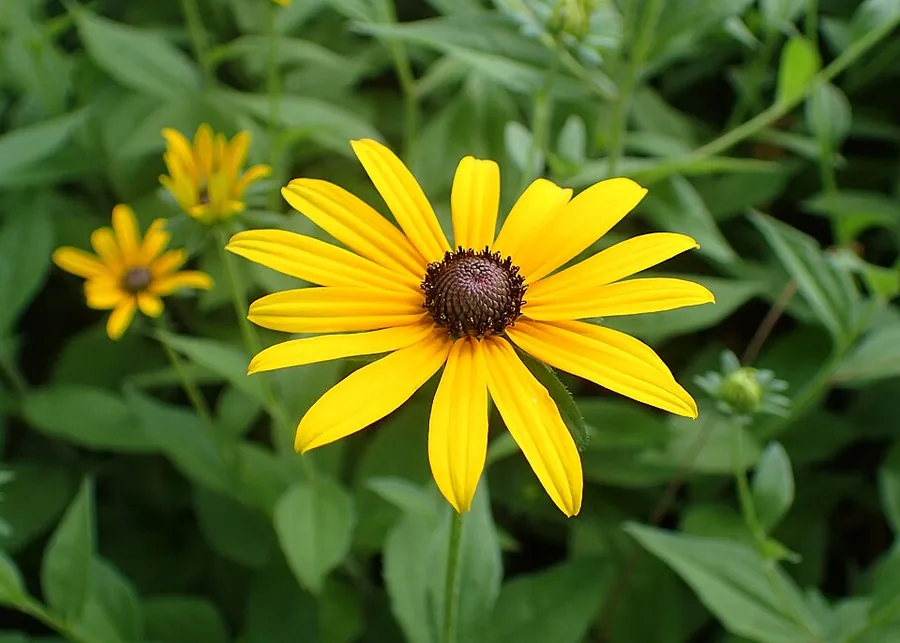
Black-eyed Susan is the golden daisy that colonizes roadsides and meadows across much of North America. Each capitulum sets a ring of ray florets around a dark brown central disc, the eye that gives the plant its common name. As a member of the aster family it combines fast growth with undemanding culture, which accounts for its frequent use in wildflower plantings and cut-flower beds.
Its spread can mislead, because Rudbeckia hirta is short-lived by nature. Most individuals perform as an annual, a biennial, or a brief perennial that declines after a season or two. Continuity comes from the seed each plant releases in fall, so a single planting effectively re-establishes itself from one year to the next without intervention.
Provided with sun and adequate drainage, it needs little further input. It withstands heat and intermittent drought once the root system develops, flowers from early summer well into fall, and supplies birds with seed from its persistent heads through winter when the spent flowers are left standing.
Care
The short version: full sun and average, well-drained soil, with a deep watering roughly weekly until the root system establishes. Feed sparingly, deadhead through summer to sustain flowering, and allow self-seeding to carry the planting forward.
Light
Black-eyed Susan flowers most freely in full sun, defined here as six or more hours daily. It tolerates limited afternoon shade, but greater light translates directly into more bloom and stronger, more self-supporting stems.
Water
Maintain even soil moisture during establishment, supplementing rainfall every 7 to 10 days as needed. Once rooting is deep the plant tolerates drought well. The condition it will not withstand is waterlogged, poorly drained soil, where root function fails.
Soil
It accepts almost any well-drained soil, clay, loam, or sand alike, provided fertility remains moderate. A pH of 6.0 to 7.5 spans its preferred range. Rich, heavy ground is best avoided, because lean substrate channels energy into flowering rather than vegetative growth.
Humidity
Ambient outdoor air is sufficient, so no target figure applies. Air movement is the governing factor, since crowded, still conditions raise leaf-surface humidity and predispose the plant to powdery mildew.
Feeding
The species performs best under modest nutrition. Feed lightly, if at all, during the growing season, because excess nitrogen drives foliage at the expense of flowers. Lean soil and restrained feeding yield the strongest bloom.
Pruning
Deadheading spent flowers through summer redirects energy from seed set into continued blooming, extending the display into fall. As flowering declines, cut the stems back, or leave the seed heads standing to provide bird forage and winter structure.
Size & spacing
Mature plants reach 2 to 4 feet (60 to 120 cm) in height with a spread of 12 to 24 inches (30 to 60 cm). Allocate that spacing so air circulates freely and the conditions that favor mildew are suppressed.
When to plant
Black-eyed Susan is governed by warm-season conditions. Sow seed indoors in late winter or direct sow once frost has passed, and the plants flower from June through September, with the window extending into fall under regular deadheading.
Northern hemisphere
Southern hemisphere
Typical months for a temperate climate: start earlier in warm zones, later where spring frosts linger.
- Sow: About 6 to 8 weeks before last spring frost (around March 1 in the St. Louis area)
- Plant: After last spring frost, or direct sow at last frost date
- Harvest: June to September, extending into fall with deadheading
Hardiness
USDA hardiness zones: 3–8
Temperature: down to -40°C
Troubleshooting
This is a resilient plant, and most of its disorders present on the foliage or at the lower stem. Early detection generally allows a straightforward correction. Match the sign below to the cause, then intervene before it advances.
Stems wilting and collapsing at the soil line
This collapse points to southern blight, a soil-borne Sclerotium fungus that becomes aggressive in warm, humid conditions and can kill a plant within days. White fungal threads and small tan sclerotia at the stem base confirm the diagnosis, as the sclerotia are the survival bodies that let it persist. An infected plant cannot be salvaged, so excavate it with the surrounding soil that holds the sclerotia, correct the drainage, and keep mulch off the stems where the fungus enters.
Fix:
- Remove and destroy infected plants and surrounding soil
- Improve drainage
- Avoid mulch piled against stems
Ragged feeding holes opened in young foliage
The culprits are slugs and snails, which favor soft, undeveloped tissue and feed most heavily when moisture lets them stay active. A silvery slime trail beside the damage confirms them, since the mucus dries into a visible track. Hand-pick after dark when they emerge, clear the debris that holds daytime moisture and shelters them, and ring vulnerable seedlings with a barrier or trap to interrupt their approach.
Fix:
- Hand-pick slugs and snails
- Reduce excess moisture and mulch near crowns
- Use barriers or traps around young plants
A white powdery film advancing across the foliage
The film is powdery mildew, a fungal infection that establishes late in the season when crowding and stagnant air raise the humidity right at the leaf surface. The damage stays largely cosmetic and seldom kills an established plant. Remove the most heavily colonized leaves, widen the spacing to restore airflow, and direct water at the base, since dry foliage denies the fungus the surface moisture it needs to spread.
Fix:
- Improve air circulation by spacing plants
- Remove and discard affected foliage
- Water at the base to keep leaves dry
Toxicity
For households with animals the verdict is favorable: black-eyed Susan is not toxic. It does not appear on the ASPCA poison list, so pets, livestock, and children can share space with it safely. The single qualification is the bristly foliage, which can irritate sensitive skin, so gloves are advisable when cutting it back.
Safe for
People · Cats · Dogs · Horses · Rabbits · Livestock · Birds
Cats Safe
Because black-eyed Susan is absent from the ASPCA toxic list, a cat that samples a leaf faces no real risk. The coarse, hairy surface may provoke a brief bout of drooling, which is a mechanical response rather than a sign of poisoning.
Dogs Safe
A dog can sniff and chew the plant without ingesting any toxin. The bristly foliage may abrade a sensitive mouth, but that irritation is purely physical and resolves on its own.
Horses Safe
Horses graze around Rudbeckia without consequence, as the plant contains no compound documented to harm equines. Grazing near it produces no recorded ill effect.
Rabbits Safe
Rabbits can browse the foliage without harm. The coarse texture, rather than any chemical deterrent, is what discourages most of them from feeding on it.
Livestock Safe
Cattle, goats, and sheep can occupy the same pasture without risk, since the plant holds nothing poisonous to ruminants. It functions as a safe component of mixed grazing.
Birds Safe
Birds seek out the seed heads in autumn, treating the seeds as forage rather than a hazard. Leaving the spent inflorescences intact supplies finches with feed into winter.
People Safe
The plant is safe to handle, though the stiff, hairy stems and leaves can leave sensitive skin a little itchy through simple mechanical contact. Wearing gloves during cutting back removes the only practical concern.
The bristly, hairy foliage and stems may cause mild skin irritation in sensitive individuals; wear gloves when handling.
Varieties
Numerous Rudbeckia selections are available, but a few merit attention for their flower size, coloration, or persistence. The following are worth knowing by name.
Prairie Sun
A 2003 All-America Selections winner, this cultivar bears large 5-inch blooms grading from gold to lemon around an atypical light green cone rather than the species' dark central eye.
Indian Summer
Its stout stems support unusually large golden-yellow flowers measuring 6 to 9 inches across.
Rudbeckia fulgida
The orange coneflower is the reliable rhizomatous perennial of the genus, persisting through zones 3 to 9 by vegetative spread where the short-lived R. hirta rarely endures.
How to propagate
Black-eyed Susan is among the most easily propagated ornamentals, whether raised from seed or increased by dividing an established perennial clump.
SeedEasy
Start indoors about 6 to 8 weeks before last frost, or direct sow at the last spring frost date · Blooms the first year from early spring sowing
Seed is the most efficient method, given how readily the species germinates. Sow indoors 6 to 8 weeks before your last frost to gain a head start, or direct sow into the bed once frost has passed, and an early spring sowing reaches bloom within the first season. Thereafter the population maintains itself through the seed each plant drops in fall, producing volunteers in successive years.
DivisionEasy
Spring or fall for perennial clumps · Re-establishes within one growing season
Division applies to the perennial members such as R. fulgida, because short-lived R. hirta rarely forms a clump substantial enough to split. Lift and divide an established clump in spring or fall to renew its vigor and curb crowding, and the divisions re-establish within a single growing season.
Myths
Black-eyed Susan is a true long-lived perennial that comes back reliably for years.
Botanically Rudbeckia hirta behaves as an annual, biennial, or short-lived perennial. Its apparent persistence comes from self-seeding rather than a durable rootstock, since each generation sets seed and senesces while the resulting seedlings recolonize the site. For genuine return from the same crown, R. fulgida is the appropriate substitute.
Black-eyed Susan is poisonous to dogs and cats.
Rudbeckia is absent from the ASPCA toxic plant database, and it is classified as non-toxic to companion animals. The one qualification is mechanical: the bristly foliage can irritate sensitive skin on contact.