Ornamental · Apocynaceae
Annual Vinca
Catharanthus roseus
Meet its need for heat, full sun, and sharply drained soil, and Catharanthus roseus flowers from late spring to frost.
Full sun
Every 5–10 days
50–95°F · 10–35°C
USDA 10–11
Overview
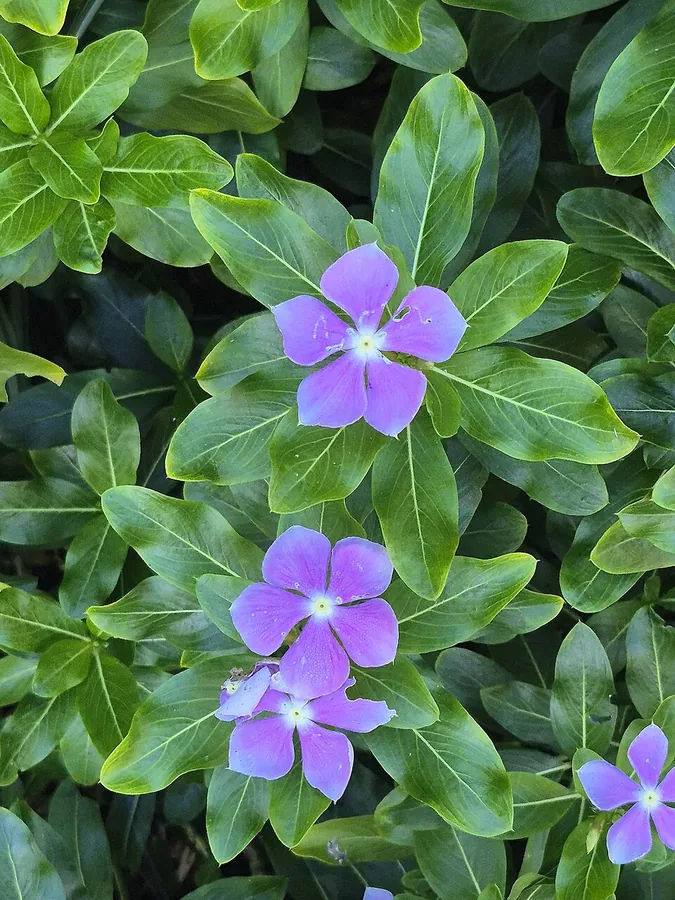
Annual vinca, botanically Catharanthus roseus, is a warm-season bedding species suited to hot, sunny, dry sites where less resilient annuals fail. It flowers continuously from late spring until frost, carrying blooms from white through pink to deep blackberry-purple over glossy dark green foliage. The common name Madagascar periwinkle causes frequent confusion, but this is not one of the trailing periwinkle groundcovers.
Its resilience and its vulnerability share a single root. Because the species is heat and drought tolerant, excess soil moisture rather than drought is the limiting factor in cultivation. Saturated soil favors the root and stem rot pathogens that are this plant's principal weakness, and infection is generally fatal once established.
Managed as a warm-season annual, its requirements are straightforward. Plant only after summer heat is reliable, site it in full sun with rapidly draining soil, and irrigate on demand rather than on a schedule. Under those conditions it delivers months of sustained bloom with minimal input.
Care
The short version: site it in full sun and sharply draining soil, and delay planting until the season is genuinely warm. Irrigate deeply but only after the upper soil dries, keep foliage dry to limit pathogens, and fertilize sparingly.
Light
Site annual vinca in full sun to maximize flowering, with only limited tolerance for partial shade. Higher light produces denser growth and heavier bloom, whereas shade reduces branching density and mutes flower color.
Water
Irrigate deeply and infrequently, intervening only when weekly rainfall falls below roughly an inch. Allowing the top half of the soil to dry between waterings, and keeping the foliage dry, denies the root rot and foliar pathogens the persistent moisture they require.
Soil
Use well-drained soil, sandy or organic loam, with clay acceptable only where drainage is adequate, since free drainage is what limits the root rots. Maintain a slightly acidic pH of 5.5 to 6.5, the range in which the species performs best.
Temperature
The species is thermophilic, functioning between 50°F to 95°F (10°C to 35°C) and performing best toward the upper end. Cold suppresses growth and cool, damp conditions promote rot, so it is most productive through the peak of summer heat.
Humidity
Ambient outdoor humidity is adequate, and no target value applies. Air circulation is the operative factor, because stagnant, humid air within crowded plantings allows leaf spot and gray mold to establish.
Feeding
Apply a balanced general-purpose fertilizer monthly during the growing season, and do so sparingly. Excess feeding produces soft, susceptible growth and raises the risk of root rot rather than yielding additional flowers.
Pruning
No pruning is required, because modern hybrids are self-cleaning and shed spent flowers without pinching or deadheading. The single useful intervention is removing declining leaves and flowers, which reduces inoculum for the foliar diseases.
Size & spacing
Mature plants are compact, reaching 6 to 18 inches (15 to 46 cm) in height with a comparable spread of 8 to 18 inches (20 to 46 cm). Spacing that permits free air movement between plants lowers canopy humidity and suppresses both the rots and leaf spots.
When to plant
Growth in this species is temperature-driven, so timing follows soil warmth rather than the calendar alone. Sow seed indoors in March under warm conditions, then delay transplanting until late May or early June, after the last frost and once soil temperature exceeds 60°F (16°C). Cold, wet soil at transplant checks growth and encourages rot; adequate warmth yields continuous bloom from late spring to frost.
Northern hemisphere
Southern hemisphere
Typical months for a temperate climate: start earlier in warm zones, later where spring frosts linger.
- Sow: March in warm temperatures
- Plant: Late May to early June, after frost and when soil temperatures exceed 60°F
- Harvest: Blooms from late spring or early summer (May to June) continuously until frost
Hardiness
USDA hardiness zones: 10–11
Temperature: down to -1°C
Troubleshooting
The dominant disorders of annual vinca are moisture-driven, tracing to water at the roots or on the foliage. Saturated soil drives the Phytophthora and Rhizoctonia rots from below, while splash and surface wetness spread the foliar Alternaria and Botrytis diseases. Identify the disorder below, then reduce moisture and remove infected tissue to slow spread.
Dark stem lesions with wilting and collapse
Wilting plants bearing dark brown to black stem lesions indicate Phytophthora stem blight and root rot, the most destructive disease of annual vinca, promoted by saturated soil and overhead irrigation. On examination the outer root cortex sloughs from the central core while foliage yellows and scorches. Rogue out and destroy infected plants, incorporate composted pine bark to improve drainage, and apply potassium salts of phosphorous acid or a copper spray.
Fix:
- Remove and discard infected plants entirely
- Improve drainage by amending with composted pine bark
- Apply potassium salts of phosphorous acid as a soil drench or a copper-based spray
Decline and collapse despite adequate soil moisture
Yellowing and collapse in moist soil points to Rhizoctonia stem and root rot, favored by deep planting or frequent shallow irrigation. Root inspection reveals brown lesions and stunting, confirming that moisture is not the deficiency. Remove diseased plants together with all root tissue, then apply thiophanate methyl or chlorothalonil as a spray or drench.
Fix:
- Remove diseased plants completely including all roots
- Use thiophanate methyl or chlorothalonil as a spray or drench
Banded, target-like foliar lesions advancing upward
Concentric, banded spots on the foliage are diagnostic of Alternaria leaf spot, dispersed by overhead irrigation and splash. Lesions begin on the lowest leaves as pinhead flecks, enlarge to about an eighth of an inch with the characteristic banding, and progress up the canopy. Remove severely affected plants, irrigate at the base before dawn, and apply weekly chlorothalonil where the disease intensifies.
Fix:
- Remove heavily infected plants
- Apply weekly chlorothalonil sprays for serious infections
- Clear dead plants after frost
Profuse gray mold colonizing senescing tissue
Dense gray sporulation on dead and dying tissue identifies Botrytis blight, or gray mold, which develops under cool, humid conditions in crowded plantings. The pathogen colonizes senescing leaves and flowers first before advancing. Remove declining tissue continuously, and reserve a thiophanate methyl spray for severe outbreaks.
Fix:
- Remove declining leaves and flowers continuously
- Apply thiophanate methyl spray only if severe
Toxicity
This species is meaningfully toxic and warrants respect. All tissues contain vinca alkaloids, including vincristine and vinblastine, compounds also used in chemotherapy, and no part is edible. Ingestion by pets, livestock, or people produces drooling, vomiting, and diarrhea, with tremors, low blood pressure, and seizures possible at higher doses. Exclude it from anyone likely to ingest plant material.
Toxic to
Cats · Dogs · Horses · Rabbits · Livestock · Birds · People
Cats Toxic
A cat that ingests any tissue typically hypersalivates, then vomits and develops diarrhea, becoming lethargic. Larger quantities may induce low blood pressure with tremors or seizures, warranting immediate veterinary attention.
Dogs Toxic
In dogs, ingestion of leaves or flowers prompts salivation, vomiting, and diarrhea. Incoordination, depression, and low blood pressure may follow, and tremors or seizures should be treated as an emergency.
Horses Toxic
Grazing horses develop gastrointestinal upset, loose manure, and lethargy from the alkaloids. Sufficient intake can produce muscle tremors and marked weakness, so the plant should be excluded from pasture and paddock.
Rabbits Toxic
The same alkaloids are distributed throughout all tissues, so a browsing rabbit is liable to hypersalivation, diarrhea, and a depressed, low-energy posture. The species should not be accessible to a hutch or a free-ranging rabbit.
Livestock Toxic
Cattle, goats, and sheep grazing annual vinca ingest vinca alkaloids that provoke gastrointestinal upset and loss of condition. Heavier consumption can cause incoordination and tremors, so grazing animals should be fenced away from it.
Birds Toxic
Birds are also susceptible, as the alkaloids are present in leaves, stems, and flowers alike. Even minimal ingestion of petals can produce vomiting and weakness, so the plant should be kept from aviaries and poultry.
People Caution
No portion of annual vinca is intended for consumption. Ingestion of leaves or flowers can cause salivation, nausea, vomiting, and diarrhea, with tremors or low blood pressure after larger amounts, so it should be kept from children and pets inclined to sample it.
Keep away from pets; all parts contain alkaloids. Typical exposure causes GI upset, with neurologic signs possible at higher doses.
Helpline numbers

United States
ASPCA Animal Poison Control: (888) 426-4435 (fee applies)
Poison Control: (800) 222-1222



Canada
Poison Centres: 1-844-764-7669
Varieties
Breeding in annual vinca has concentrated on disease resistance and on larger, more numerous flowers. The following series are the ones most frequently offered.
Cora Group (Cora XDR)
Specify this series on sites with a history of rot, as it was selected for resistance to several strains of Phytophthora, the root and aerial blight pathogens most damaging to the crop.
Pacifica Group
A compact, densely branched bedding series producing large flowers in a broad spectrum of colors.
Titan Group
A mounding series whose oversized flowers continue performing through sustained summer heat.
Jams 'N Jellies Blackberry
Selected for atypically dark flowers, a deep blackberry-purple offset by a distinct white eye.
How to propagate
Propagation is by seed, and the operative variable is temperature. Begin early under warm indoor conditions, and delay transplanting until ambient and soil temperatures have risen reliably.
SeedModerate
Sow indoors in March in warm conditions; transplant outdoors in late May to early June after frost · Several weeks to germinate and establish before transplanting outdoors
Annual vinca is propagated from seed, with germination and early growth governed by warmth. Sow indoors in March and hold the medium consistently warm, since a cool substrate suppresses germination. Permit the seedlings several weeks to germinate and develop, then retain them indoors until late May or early June, after frost and once soil exceeds 60°F (16°C).
Myths
Annual vinca and the trailing groundcover periwinkle are the same plant.
They are distinct species united only by family. Annual vinca is Catharanthus roseus, an upright to mounding warm-season bedding plant, whereas the trailing evergreen groundcovers are Vinca minor and Vinca major in a separate genus. Shared membership in Apocynaceae accounts for the resemblance, which does not extend further.
Annual vinca requires frequent watering and deadheading to sustain bloom.
The requirement is the reverse. Being heat and drought tolerant, it flowers continuously from late spring to frost without deadheading. Supplemental irrigation yields no additional bloom and instead promotes the root and stem rots that constitute its principal weakness.