Ornamental · Apocynaceae
Butterfly Weed
Asclepias tuberosa
Position it in full sun on lean, fast-draining ground, withhold extra care, and let the monarchs locate it.
Full sun
USDA 3–9
1–3 ft · 0.3–0.9 m
Overview
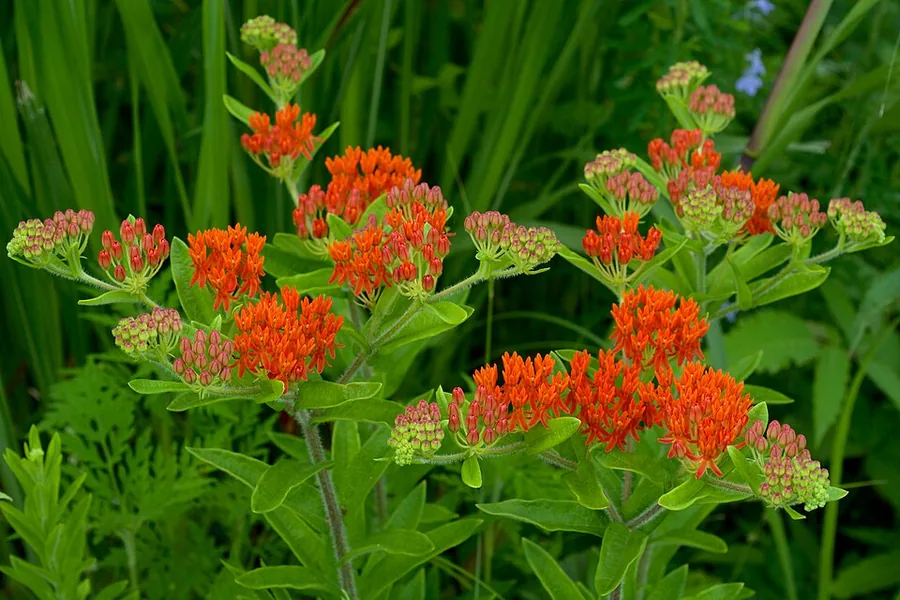
Butterfly weed is the orange-flowered milkweed that performs best under low cultural inputs. As a native perennial of dry meadows and roadside ground, it is adapted to lean substrates and high light, and an established plant relies on a deep taproot to ride out drought with little intervention. The flat-topped umbels open from late spring into summer and supply nectar to butterflies, bees, and other pollinators across the flowering period.
Its ecological role is what separates it from a conventional ornamental. As a member of Asclepias, it functions as a host plant for monarch caterpillars, which feed on the foliage and sequester its cardenolides as a defense against their own predators. That same compound class is what renders every part toxic on ingestion, the recognized trade-off behind its standing in a wildlife planting.
Successful cultivation depends on restraint rather than effort. The taproot develops slowly, so the plant needs a season or two to establish and reach flowering size, and it tolerates neither transplanting nor enrichment. Set it into the dry, sunny position it requires at planting, omit fertilizer and supplemental irrigation, and flowering and vigor improve from one year to the next.
Care
The short version: full sun, lean and dry well-drained soil, and minimal irrigation once the plant is established. Withhold fertilizer, leave the deep taproot undisturbed, and allow a season or two before it reaches flowering size.
Light
Butterfly weed requires full sun, no fewer than six hours daily, to flower fully. It survives in partial shade, but the reduced light yields a laxer habit and markedly fewer blooms, so an open, unshaded exposure is where it performs to potential.
Water
Irrigate young plants until they root in, after which the taproot makes an established specimen drought tolerant, so water rarely. The species declines in saturated ground because sustained wetness rots the crown, which is why the soil should dry completely between any applications.
Soil
Lean soil outperforms fertile soil for this plant. It thrives in average to poor, dry to medium, well-drained soil and accepts clay, sand, loam, or shallow rocky ground provided drainage is sharp, since drainage governs success more than texture does. A pH of 6.0 to 7.0 falls comfortably within its range.
Temperature
A cold-hardy native, it withstands a broad thermal range of -40°F to 100°F (-40°C to 38°C), which corresponds to USDA zones 3 to 9. Top growth dies back each winter and the plant regenerates from the taproot the following spring.
Humidity
Ambient outdoor humidity meets its needs, and no target value applies. Air circulation is the operative variable, because still, humid air retained against the foliage favors infection by rust and leaf spot.
Feeding
Do not fertilize this species. It evolved on poor, lean soils, and added nutrition is counterproductive, promoting lax growth and reducing flowering, so the soil is best left unamended.
Pruning
Maintenance is minimal. Cut spent stems to the ground in late fall or early spring, and remove the seed pods before they split to restrict self-seeding. Established plants are best left in situ, because the taproot does not tolerate relocation.
Size & spacing
Mature height runs 1 to 3 feet (30 to 91 cm), with a clump width near 12 to 18 inches (30 to 46 cm). Provide that spacing so air circulates freely and the foliage dries promptly between rains.
When to plant
Butterfly weed responds to seasonal cues and to a slow establishment curve. Stratify and start seed in late winter, or sow in fall so the dormant season supplies the cold requirement, then transplant young plants outdoors in spring after the last frost. Flowering extends from late spring through summer, but a seed-grown plant generally needs 2 to 3 years to reach its first substantial bloom.
Northern hemisphere
Southern hemisphere
Typical months for a temperate climate: start earlier in warm zones, later where spring frosts linger.
- Sow: Late winter, about 8 to 10 weeks before last frost, after 30 days cold moist stratification
- Plant: Spring after last frost, or direct sow in fall to allow natural cold stratification
- Harvest: Late spring through summer (roughly May to August)
Hardiness
USDA hardiness zones: 3–9
Temperature: down to -40°C
Troubleshooting
Butterfly weed presents few genuine disorders, and most that occur originate in overcare rather than neglect. Excess soil moisture and excess fertility account for more decline than any pest pressure does. Match the symptom below, then correct the watering regime before resorting to any stronger control.
Blackened, softened stem bases preceding collapse
Collapse from a dark, softened base is crown and root rot, a soilborne pathogen problem driven by prolonged saturation around the root zone. Because this species is adapted to lean, free-draining ground and intolerant of standing moisture, the corrective is to halt irrigation and amend drainage rather than treat the plant itself. Once decay reaches the crown the tissue cannot regenerate, so resiting future plants in full sun on poor, gritty soil is the durable answer.
Fix:
- Improve drainage and stop supplemental watering
- Plant in lean, well-drained or rocky soil in full sun
Post-transplant decline in a previously established plant
Decline that follows lifting or relocating traces to damage of the deep, fleshy taproot, the storage organ this species relies on to reestablish. Severing or disturbing that root strips the plant of its reserves, which is why mature clumps so often fail to recover from a move. The practical conclusion is to fix the planting position before the root descends and to raise additional plants from seed sown directly where they are wanted.
Fix:
- Leave established plants undisturbed
- Start new plants from seed in place rather than transplanting
Yellow-orange colonies packed onto the soft growing points
Those concentrated yellow-orange masses are oleander aphids, a sap-feeder that favors the tender expanding tissue at the shoot tips. A forceful jet of water dislodges them physically, repeated every two or three days for roughly a week to break the colony. Light infestations are best left alone, because broad-spectrum sprays would take out the monarch larvae and the ladybugs and lacewings that keep aphid numbers in check.
Fix:
- Knock aphids off with a strong spray of water every two or three days for about a week
- Tolerate minor infestations to protect monarch larvae and beneficial insects
Raised orange pustules or discrete dark spots on the leaves
Raised pustules that release an orange powder indicate rust, whereas discrete dark lesions indicate a leaf spot fungus. Both are favored by extended leaf wetness combined with stagnant air, the conditions that let fungal spores germinate on the leaf surface. Stripping the infected foliage removes inoculum, while watering at the base and spacing plants shortens the period leaves stay wet, which suppresses further spread.
Fix:
- Remove and discard affected foliage
- Improve air circulation by spacing plants
Toxicity
This is a milkweed, and the genus carries a real toxicological hazard. Every part holds cardiac glycosides that produce gastrointestinal upset and, at higher intake, disrupt cardiac function, so the plant is toxic to cats, dogs, horses, rabbits, livestock, birds, and people. It also remains an essential larval host for monarchs, so the objective is to cultivate it for that role while preventing pets, grazing animals, and children from ingesting it.
Toxic to
Cats · Dogs · Horses · Rabbits · Livestock · Birds · People
Cats Mild
Expect gastrointestinal signs first in a cat, namely vomiting, diarrhea, reduced appetite, lethargy, and weakness; substantial ingestion can progress to seizures, respiratory distress, a weak or rapid pulse, dilated pupils, and measurable cardiac effects.
Dogs Mild
In a dog the early picture is digestive, with vomiting, diarrhea, appetite loss, lethargy, and weakness; a large dose may advance to seizures, breathing difficulty, a weak or rapid pulse, dilated pupils, and cardiac involvement.
Horses Moderate
Affected horses typically show depression, weakness, vomiting, and diarrhea, and at higher intake the syndrome extends to staggering, seizures, a weak or rapid pulse, respiratory difficulty, and cardiac failure.
Rabbits Toxic
Rabbits should be excluded from the plant. The same cardenolides that affect cats and dogs act quickly in a small grazing herbivore, producing digestive upset, weakness, and an irregular heartbeat.
Livestock Severe
Cattle and sheep can develop weakness, staggering, posterior paresis, seizures, and coma within hours, a progression that may culminate in death from cardiac and respiratory failure.
Birds Toxic
Poultry and pet birds should be kept clear of the foliage and seed. The same heart-active compounds are concentrated relative to a bird's small body mass, so pecking at leaves or seeds poses a genuine hazard.
People Caution
No part of the plant is edible. Ingestion of any amount can cause gastrointestinal upset and cardiac disturbance, and the sap is an irritant to skin and eyes, so gloves are advisable and children should be kept from chewing the leaves or pods.
Keep grazing animals away from the plant, as livestock such as cattle, sheep, and horses can be seriously poisoned. Wear gloves when handling, as sap may cause skin and eye irritation.
Helpline numbers

United States
ASPCA Animal Poison Control: (888) 426-4435 (fee applies)
Poison Control: (800) 222-1222



Canada
Poison Centres: 1-844-764-7669
Varieties
Most growers plant the wild orange form, but a few named selections circulate in the trade. These are the entries worth distinguishing.
Hello Yellow
A color selection that replaces the typical orange with a clear, luminous yellow flower head.
Blonde Bombshell
A yellow-flowered cultivar selected for an erect, vigorous habit and a heavy flowering display.
subsp. interior
The wild interior subspecies of the central United States, separable by characters of leaf shape and leaf base.
How to propagate
Butterfly weed is propagated almost exclusively from seed, since the deep taproot makes routine vegetative methods unreliable. Sow it into its permanent position and allow adequate time for establishment.
SeedModerate
Sow after about 30 days of cold moist stratification in late winter, or direct sow in fall for natural stratification · Typically 2 to 3 years from seed to first flowering
Seed remains the standard means of propagation, with germination governed by a dormancy that cold breaks. Supply roughly 30 days of cold, moist stratification, either by sowing in late winter after a chilling period or by sowing in fall so the dormant season provides it, and germination rates rise accordingly. Sow into the final position because the descending taproot resists transplanting, and anticipate 2 to 3 years from seed to first flowering.
DivisionModerate
Early spring, only on younger plants if at all · Slow; the deep taproot resents disturbance
Division is an unreliable method and seldom justifies the effort. The deep taproot tolerates disturbance poorly, so divided sections reestablish slowly and the technique should be confined to young plants worked in early spring, if attempted at all. Root cuttings offer a more dependable vegetative option because they avoid lifting and severing an established crown.
Myths
Butterfly weed oozes milky sap and leaves a sticky mess like other milkweeds.
Among the milkweeds this species is the exception, producing little to no milky latex; its sap is essentially clear, so handling does not leave the usual sticky residue. The tissue still contains cardenolides and the sap can irritate skin and eyes, which is reason enough to wear gloves.
Every milkweed is equally and dangerously toxic.
Cardenolide concentration varies markedly across the genus rather than holding constant. Quantitative comparisons place A. tuberosa near the low end of that gradient, so it is considerably less toxic than most congeners, yet low concentration is not zero, and the plant remains toxic to pets and grazing livestock.