Ornamental · Apocynaceae
Milkweed
Asclepias syriaca
Grow it for the monarchs: give it sun and lean soil, and a native milkweed largely sustains itself.
Full sun
Every 7–14 days
USDA 3–9
2–5 ft · 0.6–1.5 m
Overview
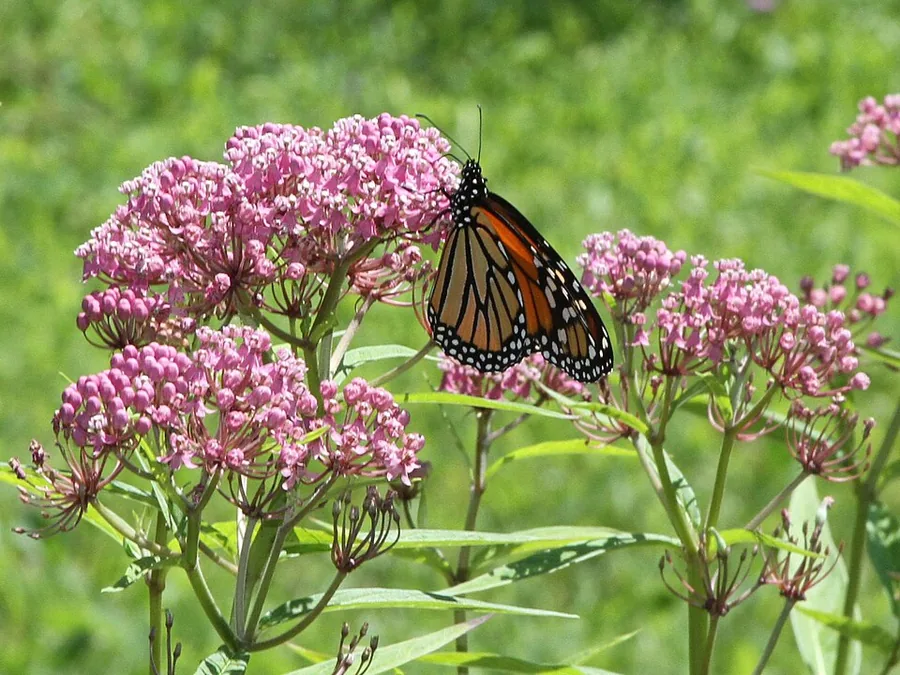
Milkweed is the obligate host of the monarch butterfly, whose larvae feed on no other genus. The cardiac glycosides the caterpillars sequester from the foliage render them unpalatable to birds, which is the ecological basis for cultivating the plant. Through summer, the pink to mauve flower umbels supply nectar to bees and a broad range of other pollinators.
The common name spans several native species, and the two most often grown differ markedly in habit. Common milkweed (A. syriaca) runs on shallow rhizomes and forms broad colonies, an asset in a meadow but a liability in a confined bed. Swamp milkweed (A. incarnata) holds a discrete clump and favors moister ground, which lets it sit within a border without displacing its neighbors.
These are durable, cold-hardy perennials that make few demands once established. The qualification is the milky sap, which contains the same toxins that protect the monarchs and irritates skin and eyes, so gloves are warranted and grazing animals must be excluded.
Care
The short version: milkweed wants full sun and ordinary, well-drained soil, and once established it needs almost no supplemental water or fertilizer. Match the species to the site, allow room for the mature spread, and handle the sap with gloves.
Light
Milkweed is a full sun plant, and flowering is maximized under all-day exposure. It tolerates light partial shade, but reduced light produces leggier stems and diminished bloom, since the plant photosynthesizes less.
Water
Once established, common milkweed is genuinely drought tolerant and subsists on rainfall in dry to medium soil, so supplemental irrigation is minimal. Water new plantings only until the root system takes hold. The exception is swamp milkweed, which requires consistently moist to wet ground to perform.
Soil
Almost any well-drained clay, loam, or sandy soil is adequate, and common milkweed even thrives on the poor, dry sites that defeat more exacting plants. Swamp milkweed is the one that requires moist or wet ground, so the species should be matched to the site rather than the reverse.
Temperature
These are cold-hardy perennials rated to winters as low as -40°F (-40°C) and tolerant of summer heat to roughly 86°F (30°C). That broad thermal range is what accounts for the plant's wide geographic distribution.
Humidity
Ambient humidity is immaterial to milkweed grown outdoors, so no target applies. The plants accept whatever the local atmosphere provides.
Feeding
Withhold fertilizer. These natives are adapted to lean soil, and added fertility yields no benefit while encouraging soft, lax growth, so the planting is best left unfed.
Pruning
Cut spent stems to the ground in late fall or early spring to keep the clump tidy. To reduce self-seeding, remove the pods before they split and disperse their seed. Gloves are advisable, as the sap is an irritant.
Size & spacing
Mature plants stand 2 to 5 feet (60 to 150 cm) tall with a spread of 9 to 36 inches (23 to 91 cm) according to species. Allow the running common milkweed generous room, and space the clump-forming types more closely for a contained stand.
When to plant
Milkweed is governed by the season because its seed requires a cold period to break dormancy. Sow outdoors in fall so winter supplies the chilling, or stratify the seed in the refrigerator and start it indoors in late winter, then expect bloom from early summer, most often in the plant's second year.
Northern hemisphere
Southern hemisphere
Typical months for a temperate climate: start earlier in warm zones, later where spring frosts linger.
- Sow: Start seed indoors 6 to 8 weeks before last frost after 30 days of cold-moist stratification in the refrigerator
- Plant: Transplant after last frost; direct-sow seed in fall or early winter so natural cold stratification occurs over winter
- Harvest: Blooms June to August (common milkweed); swamp milkweed July to September
Hardiness
USDA hardiness zones: 3–9
Temperature: down to -40°C
Troubleshooting
Most issues with milkweed concern its spread and the insects it hosts rather than disease. Because many of those insects belong on the plant, identification should precede any intervention. Work through the entries below, and give the irritant sap the caution it deserves.
Shoots emerging at a distance from the parent clump
The culprit is common milkweed (A. syriaca), which extends shallow rhizomes through the soil and recruits new seedlings once its pods dehisce. Because the spread runs underground and by seed, digging out the stray shoots and cutting the pods before they open both address the actual mechanism. Where colony formation is unwelcome, the clump-forming swamp milkweed is the sound substitution, since it lacks the running rhizomes.
Fix:
- Remove unwanted rhizome shoots by digging them out
- Cut and remove seed pods before they split to limit self-seeding
- Site common milkweed where spread is acceptable, or choose clump-forming swamp milkweed for small beds
Bright orange aphid colonies encrusting stems and buds
The insect at work is the oleander aphid, a milkweed specialist that forms dense yellow-orange colonies and excretes the sticky honeydew you find on the tissue below. A hard jet of water dislodges the colonies mechanically, and hand-wiping clears the rest, which avoids chemical control. That restraint matters, because a contact insecticide does not discriminate and would kill the monarch eggs and caterpillars the planting exists to support.
Fix:
- Dislodge aphids with a strong spray of water
- Wipe off or hand-remove colonies
- Avoid insecticides, which kill monarch eggs and caterpillars
Defoliation and stripped stems from bold-colored specialist feeders
Milkweed supports a guild of insects that sequester its toxins, so accurate identification precedes any action. The black-and-orange milkweed bugs and beetles cause only cosmetic feeding and can be hand-picked when numbers climb, but the yellow, white, and black striped larvae are monarch caterpillars, the very organisms the host plant is meant to feed. Leave those to develop, and never apply a spray to a larval host.
Fix:
- Identify the insect before acting; tolerate monarch caterpillars as this is the plant's purpose
- Hand-pick pest milkweed bugs or beetles if damage is excessive
- Do not spray insecticides on host plants
Dermatitis or ocular irritation following contact with the sap
The milky latex sap carries cardiac glycosides and resinoids, and it is these compounds that produce the contact dermatitis and eye irritation reported for the plant. Washing exposed skin with soap and water and thoroughly flushing the eyes removes the irritant; persistent ocular stinging warrants medical attention. Because the exposure is purely contact, gloves during pruning and keeping the hands clear of the face prevent it outright.
Fix:
- Wash affected skin with soap and water
- Flush eyes with water and seek medical care if irritation persists
Toxicity
Milkweed is a toxic plant, and that toxicity is functional, since it is what protects the monarchs that depend on it. Every part concentrates cardiac glycosides in the milky sap, making it toxic to cats, dogs, horses, rabbits, birds, and livestock, and a documented cause of fatal poisoning in grazing animals. It is not edible for people either, and the sap irritates skin and eyes, so wear gloves and keep children and pets away from the plant.
Toxic to
Cats · Dogs · Horses · Rabbits · Livestock · Birds · People
Cats Moderate
In a cat that ingests the leaves or sap, the early picture is drooling, vomiting, anorexia, and a weak, dull demeanor. As the dose rises, cardiac glycoside toxicity progresses to seizures, labored breathing, a faint pulse, and dilated pupils.
Dogs Moderate
A dog that has chewed any part typically shows vomiting, diarrhea, marked depression, and weakness. Larger ingestions escalate to seizures, respiratory difficulty, and a fast, thready pulse, which is the point at which veterinary care becomes urgent.
Horses Severe
Horses respond severely, presenting colic, diarrhea, weakness, and a depressed, listless attitude. The glycosides disrupt cardiac rhythm and can carry the animal into seizures, respiratory distress, and death.
Rabbits Toxic
The same cardiac glycosides are fully toxic to a rabbit, so no portion of the plant should be fed. Digestive upset and weakness are the expected signs, and both fresh stems and dried trimmings must be kept out of reach.
Livestock Severe
Cattle and sheep can decline within hours, staggering and weak before seizures and collapse follow. A relatively small quantity of green plant has proven lethal to grazing animals inside a day or two, so stock must be excluded entirely.
Birds Toxic
Birds are not exempt from the cardenolides and should be prevented from feeding on any part. Both garden and poultry birds warrant this precaution, so the plant is best fenced away from coops and runs.
People Caution
No part of milkweed is a food, and ingestion in quantity produces gastrointestinal upset, weakness, and an irregular heartbeat. Children must be kept from chewing the pods or stems, and the irritant sap washed from skin and flushed from the eyes.
The milky sap is an eye and skin irritant; wear gloves when handling and keep grazing animals away from plants and trimmings.
Helpline numbers

United States
ASPCA Animal Poison Control: (888) 426-4435 (fee applies)
Poison Control: (800) 222-1222



Canada
Poison Centres: 1-844-764-7669
Varieties
Milkweed is a genus of native species rather than a single plant, and selection turns on whether a spreading colony in a wild setting or a discrete clump in a bed is wanted.
Asclepias syriaca (common milkweed)
Reaching 3 to 5 feet with broad oval leaves and domed pink-purple umbels, this species spreads vigorously by rhizome and establishes large colonies on dry to medium soil.
Asclepias incarnata (swamp milkweed)
A non-running clump former of 3 to 5 feet with narrow leaves and pink to mauve flowers, it is anchored by a deep taproot and demands moist to wet ground rather than spreading by rhizome.
Asclepias incarnata subsp. pulchra (eastern swamp milkweed)
An eastern subspecies of swamp milkweed distinguished by hairier stems and leaves, it is suited to wet meadows and stream banks.
How to propagate
Milkweed is propagated chiefly from seed, which must pass through a cold period before it will germinate, though common milkweed can also be divided at the root.
SeedModerate
Sow outdoors in fall or early winter, or stratify cold-moist for about 30 days and sow indoors 6 to 8 weeks before last frost · Seedlings germinate in spring; plants typically flower in their second year
Seed is the standard method, but the embryo carries a dormancy that only cold, moist conditions and light will break. Either sow outdoors in fall or early winter so the season supplies the chilling, or provide about 30 days of cold-moist stratification in the refrigerator and start it indoors 6 to 8 weeks before last frost. Surface-sow rather than burying, because light aids germination, expect spring emergence, and allow for a second-year bloom in most plants.
DivisionModerate
Early spring as new growth emerges · One growing season
Common milkweed lends itself to division and to rhizome or root cuttings taken in early spring as new growth emerges, and such divisions establish within a single season. Swamp milkweed should be exempted, since its deep taproot resents disturbance and the plant performs best left undisturbed.
Myths
All milkweed is a noxious weed that should be wiped out.
Native milkweeds are foundational pollinator plants and the exclusive larval food of the monarch. Common milkweed can behave weedily in cultivation, yet it remains ecologically valuable, and clump-forming species like swamp milkweed behave themselves in a bed.
Any milkweed helps monarchs, tropical milkweed included.
The non-native tropical milkweed (A. curassavica) persists year-round in mild climates, which disrupts monarch migration and diapause and allows the OE parasite to accumulate. The sound recommendation is to stick to species native to your area instead.