Ornamental · Apocynaceae
Blue Star
Amsonia tabernaemontana
Sited in full sun and sheared after bloom, Blue Star transitions from spring flowers to gold fall color with minimal intervention.
Full sun
Every 7–14 days
USDA 3–9
2–3 ft · 0.6–0.9 m
Overview
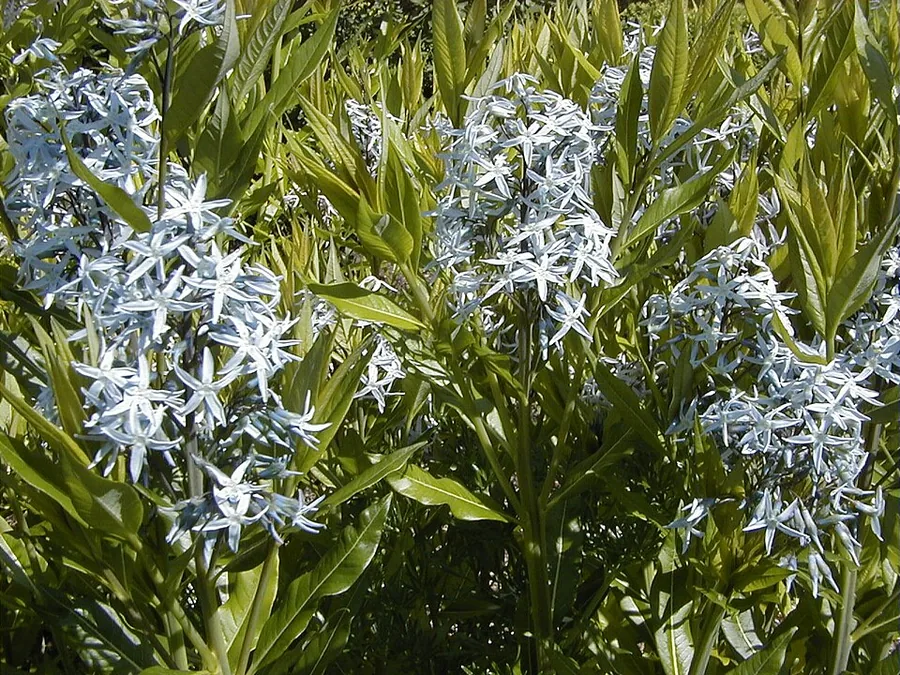
Amsonia tabernaemontana is a durable native perennial valued for its clusters of soft, steel-blue star-shaped flowers in late spring. A member of the dogbane family, it builds a slow-growing, shrubby clump of feathery green foliage that retains its form across the season because growth is woody-based and self-supporting rather than lax. Rated for zone 3 to zone 9, its broad cold and heat tolerance, along with adaptability to clay and to drought once established, explain its reliability across climates.
Flowering accounts for only part of its value. In autumn the narrow leaves develop a clear golden yellow as chlorophyll breaks down and underlying pigments show through, while the bitter, milky latex in the stems deters browsing by deer and rabbits. Grown in full sun the stems stay turgid and upright without staking, which is why it functions as a dependable structural perennial that demands little input.
Care
The short version: full sun, average well-drained soil, and a hard shear once flowering ends. Water needs fall away after establishment and feeding is largely unnecessary, so the controlling task is the post-bloom cutback that prevents the lax, flopping growth seen in low light or rich ground.
Light
Blue Star performs best in full sun, where high light supports dense, turgid growth that remains upright without staking. It tolerates partial shade or partial sun, but reduced light produces etiolated stems that stretch, lean, and flop in proportion to the shade.
Water
Maintain evenly moist soil during establishment, irrigating every 7 to 14 days while the root system develops. Once established the deep roots confer good drought tolerance, and the plant also withstands occasional waterlogging, so irrigation can be reduced.
Soil
The species is adaptable across textures and grows in loam, clay, or sand provided drainage is adequate. It accepts a pH of 6.0 to 8.0, a span that encompasses most cultivated soils.
Temperature
This is among the hardiest perennials available, withstanding winter lows to -40°F (-40°C) and summer highs to 100°F (38°C). That thermal range underlies its dependable performance from zone 3 through zone 9.
Humidity
Ambient outdoor humidity is sufficient, so no target value applies. Good airflow is the more relevant factor, since stagnant air around crowded foliage creates the leaf-surface conditions rust requires.
Feeding
Nutrient demand is low. A light topdressing of compost in spring meets it, whereas rich soil or heavy fertilizer drives soft, nitrogen-rich growth that is structurally weak and prone to flopping.
Pruning
The decisive operation is cutting stems back by one-third to one-half immediately after flowering. This stimulates a rounded, self-supporting habit, and simultaneous deadheading removes developing seed and prevents the self-sowing that follows seed set.
Repotting
Established clumps seldom require lifting and respond poorly to root disturbance. Divide only when the center starts to die out, a sign of crown senescence, or when flowering and vigor decline, an interval that often spans many years.
Size & spacing
At maturity the plant attains roughly 2 to 3 feet (61 to 91 cm) in height with a comparable spread. Spacing each plant about 2 to 3 feet (61 to 91 cm) apart maintains the air movement that suppresses rust.
When to plant
Treated as a hardy perennial, Blue Star regrows from its crown each year. Establish new plants in spring after frost or in fall, expect the blue flowers in late spring, then cut the clump back hard once flowering finishes to redirect energy into compact basal regrowth.
Northern hemisphere
Southern hemisphere
Typical months for a temperate climate: start earlier in warm zones, later where spring frosts linger.
- Sow: Late winter to early spring; seed germinates readily but plants typically flower in their second year.
- Plant: Spring after frost, or fall.
- Harvest: Late spring (April to May), into early summer.
Hardiness
USDA hardiness zones: 3–9
Temperature: down to -40°C
Troubleshooting
Blue Star carries few serious problems, a record reflected in its reputation among growers. In practice only two issues recur: lax, flopping stems and an occasional incidence of rust. Identify the symptom below and the corrective measure follows directly from the cause.
Stems that splay open and flop outward
Flopping results from low light or excessively fertile soil, both of which favor soft elongated growth, and the condition intensifies when the post-bloom cutback is omitted. Shearing the stems by a third to a half after flowering induces denser, self-supporting regrowth. Relocating a shaded clump to brighter conditions restores upright habit because higher light yields sturdier stems.
Fix:
- Cut stems back by one-third to one-half after flowering to encourage a denser, self-supporting habit
- Relocate to a sunnier position if grown in shade
Orange, rusty bumps on the leaves
Powdery orange-to-brown pustules on leaf undersides indicate rust, the principal disease recorded for the species. Remove and dispose of the infected foliage to reduce inoculum. Improving spacing and keeping water off the leaves limits spread, since the pathogen establishes in still, humid conditions on wet leaf surfaces.
Fix:
- Remove and dispose of affected foliage
- Improve air circulation and avoid overhead watering
Toxicity
Blue Star presents low risk in a garden setting. The bitter, milky latex deters deer, rabbits, and most inquisitive pets, and the species is absent from the ASPCA toxic list. The practical concern is contact dermatitis: the latex from cut stems can irritate skin and eyes, so wash your hands after pruning.
Toxic to
Cats · Dogs · Horses · Livestock · Birds · People
Safe for
Rabbits
Cats Caution
No report specific to cats exists, yet the bitter milky latex belongs to the same family as other irritant plants. A cat that chews a leaf may drool or experience brief gastric upset, although the taste generally deters further intake after the first bite.
Dogs Mild
One extension source classifies the milky latex as slightly toxic to dogs, so an ingested stem can cause mild oral or gastric irritation. The bitterness of the latex typically halts most dogs before significant ingestion occurs.
Horses Caution
Nothing specific is documented for horses, but the bitter latex and the plant's dogbane affinity warrant excluding them from access. In practice most horses avoid it unprompted.
Livestock Caution
Grazing stock reject the bitter foliage, making poisoning unlikely. Even so, the milky latex is best excluded from pasture where forage is scarce and animals may eat what they would normally refuse.
Birds Caution
No harm to birds is on record, and the foliage holds no appeal for them. Observation is warranted only where a pet bird habitually samples houseplants and cut greenery.
People Caution
No part of the plant is intended for consumption. The latex from cut stems can irritate skin or eyes, so wash your hands after pruning and prevent small children from chewing the foliage.
Rabbits Safe
Rabbits avoid the plant consistently. The bitterness deters them reliably enough that it is planted deliberately where rabbit pressure is high, and browsing damage is uncommon.
The milky latex released when stems or leaves are cut or torn can be a mild skin or eye irritant; wash hands after pruning.
Helpline numbers

United States
ASPCA Animal Poison Control: (888) 426-4435 (fee applies)
Poison Control: (800) 222-1222



Canada
Poison Centres: 1-844-764-7669
Varieties
Several named selections refine the wild type, chiefly for deeper flower color or more distinctive foliage. The following are the cultivars in general nursery circulation.
Storm Cloud
Storm Cloud is distinguished by stems that emerge nearly black in spring above dark green leaves veined in bright silver.
Blue Ice
Blue Ice is a compact selection bearing flowers of a deeper, more violet-blue cast than the species.
var. salicifolia
The botanical form var. salicifolia carries narrow, willow-like leaves only about a quarter inch wide.
How to propagate
Because the clump expands slowly, propagation is the practical route to more plants. Division, seed, and stem cuttings each work, with differing speed and reliability.
DivisionEasy
Spring or fall while dormant · One growing season
Divide by lifting and splitting the dormant clump in spring or fall, retaining at least one eye, the growth bud, on each section. The divisions reestablish over a single growing season.
SeedEasy
Late winter to spring · Flowers usually in the second year
Seed sown from late winter into spring germinates readily, though seedlings characteristically delay flowering until their second year. Removing unwanted seedheads prevents the self-sowing that otherwise occurs.
Stem cuttingsModerate
Late spring to early summer · Several weeks to root
Stem cuttings, taken from non-flowering shoots in late spring or early summer, require several weeks to form roots. This makes cuttings the slower and less reliable method relative to division.
Myths
Blue Star is dangerously poisonous to people and pets and should be kept out of the garden.
A single extension source characterizes the milky latex as slightly toxic to dogs, and the bitter taste deters consumption by most animals before any meaningful quantity is ingested. It is widely grown as a safe, low-maintenance native ornamental, and it does not appear on the ASPCA toxic plant list.