Houseplant · Apocynaceae
Dischidia
Dischidia nummularia
Match its epiphytic biology with bright light, fast-draining roots, and a full dry-out, and dischidia trails for years.
Bright indirect
Every 7–14 days
64–84°F · 18–29°C
USDA 10–12
Overview
Dischidia is a trailing epiphyte of the wet tropics, anchoring to tree bark and rock rather than rooting in soil. It is most readily recognized by the strands of small, fleshy leaves that spill over a pot edge or a mounted slab of bark. The genus sits within Apocynaceae alongside the milkweeds, and in keeping with that family it conducts a thin milky sap through its stems.
Its defining trait as a houseplant is its water relations. In the canopy the roots return to near-dryness within hours of rainfall, so indoor culture calls for a coarse, airy medium and a genuine dry-out between waterings. Supply that cycle and growth is rapid, producing long trailing stems suited to a hanging pot or a vertical mount.
It demands slightly more than an entry-level houseplant, chiefly in water management and atmospheric moisture. Warmth and high humidity sustain turgid, healthy foliage, whereas waterlogged roots are the single fault it will not tolerate. Once the irrigation is calibrated, the remaining care is undemanding.
Care
The short version: bright, indirect light, a coarse epiphyte mix that sheds water quickly, and a complete dry-out between waterings to mirror its canopy origins. Hold it warm and humid, feed lightly during active growth, and keep the roots from standing in moisture.
Light
Provide bright, indirect light to drive the densest growth, though the plant performs acceptably under medium indirect light. Exclude harsh direct sun, which scorches the foliage, and read elongated, leggy stems as a clear signal of insufficient light.
Water
Allow the medium to dry out completely before rewatering, a cycle that typically falls every 7 to 14 days. As an epiphyte adapted to fast-draining roots, it withstands drought far better than saturation. Overwatering is the principal cause of decline, because waterlogged roots rot quickly once oxygen is excluded.
Soil
Use a coarse, airy epiphyte or orchid mix of bark and perlite that drains freely, matching the open rooting conditions of its native perch. Many growers dispense with a pot and mount it on bark, replicating its natural epiphytic habit.
Temperature
Maintain it within 64°F to 84°F (18°C to 29°C), a range corresponding to ordinary indoor warmth. It lacks cold tolerance, so site it away from chilled glass and drafts that depress leaf temperature.
Humidity
Treat it as a high-humidity species performing best at 60% to 80%, conditions a bathroom, a kitchen, or a humidifier readily supplies. Dry indoor air does not kill it outright but leaves the foliage dull and tired through moisture loss.
Feeding
Apply a dilute balanced liquid fertilizer monthly from spring through summer, the window of active growth when nutrient uptake is highest. Suspend feeding during the cooler, slower months, when growth halts and unused fertilizer simply accumulates.
Pruning
Cut back leggy or overlong trailing stems to redirect energy into fuller, bushier growth from lower nodes. Excise any rotted or damaged stems on sight to remove failing tissue before it compromises the plant.
Repotting
Repot on a 2 to 3 years cycle, or earlier when roots crowd the container, growth slows, or the medium decomposes and retains water. Transfer it into fresh coarse mix and a container only marginally larger to preserve drainage.
Size & spacing
Stems extend from 2 to 36 inches (5 to 91 cm) and the plant spreads roughly 2 to 3 feet (61 to 91 cm). Site it elevated, in a hanging pot or on a high shelf, so the trailing growth can hang freely.
Troubleshooting
Most disorders in dischidia originate in the root zone and the surrounding air, which is why water and ventilation drive nearly every issue. The roots, leaves, and stems each signal trouble early, so reading those signals lets you intervene before damage spreads. Match the symptom below, then correct the underlying condition.
Stems collapse and the base turns soft and mushy
A soft, brown, mushy base with collapsing stems indicates root rot, driven almost always by excess water or a moisture-retentive medium. Because this epiphyte requires its roots to dry between waterings, saturated conditions exclude oxygen and the roots suffocate rapidly. Lift the plant, excise every brown, softened root and stem, repot into fresh airy mix, and withhold water until the medium dries.
Fix:
- Remove the plant and cut away all rotted roots and stems
- Repot into fresh coarse, fast-draining epiphyte mix
- Water only after the medium dries out
Spots appearing on the leaves
Discrete lesions of this kind indicate leaf spot, which establishes where air remains too damp or water persists on the foliage. Irrigate at the base to keep the leaves dry, raise air movement around the plant to speed drying, and remove severely marked leaves to limit further spread.
Fix:
- Water at the base and avoid wetting foliage
- Improve air circulation around the plant
- Remove badly affected leaves
Stems growing long and sparse with gaps between leaves
Elongated, sparsely leaved stems are an etiolation response, the plant reaching for more light. Relocate it to a brighter position under strong indirect light while excluding harsh direct sun that scorches the foliage. Trimming the most extended stems then stimulates denser, fuller regrowth from the remaining nodes.
Fix:
- Move to a brighter spot with bright, indirect light
- Avoid harsh direct sun that scorches leaves
- Trim leggy stems to promote denser regrowth
Toxicity
For a household with pets or children, the toxicity profile here is reassuring: dischidia presents no meaningful poisoning hazard. Its milky sap tastes unpleasant, so an exploratory bite may provoke mild drooling or transient stomach upset, but nothing serious follows. It is safe to grow within reach of cats, dogs, and small children.
Safe for
People · Cats · Dogs · Horses · Rabbits · Livestock · Birds
Cats None
No toxic principle in dischidia is known to poison cats, so an investigative nibble carries no real risk. A cat that consumes a large quantity of any houseplant may show mild gastrointestinal upset, which resolves without intervention.
Dogs None
Dogs may occupy the same space as this plant without concern, since it contains no toxic compound. A dog that ingests a mouthful of stems may drool or regurgitate them, a mechanical response to tough foliage rather than a toxic one.
Horses None
Dischidia holds nothing poisonous to horses, and as a small trailing houseplant it is in any case improbable that it would ever come within a horse's reach.
Rabbits None
Rabbits incur no poisoning risk from this plant. Position it out of reach to preserve the foliage rather than to protect the animal.
Livestock None
Grazing stock such as cattle, goats, and sheep are unharmed by dischidia, which is cultivated indoors and remains beyond their reach regardless.
Birds None
Pet birds may perch and forage in the vicinity of a dischidia safely, as the plant presents no toxic tissue.
People None
The plant constitutes no poisoning hazard to people, children included. It is grown ornamentally rather than for consumption, so there is no occasion to ingest it.
Wear gloves when handling, as the milky sap may irritate skin and eyes.
Helpline numbers

United States
ASPCA Animal Poison Control: (888) 426-4435 (fee applies)

United Kingdom
Animal PoisonLine: 01202 509000 (fee applies)

Australia
Animal Poisons Helpline: 1300 869 738
Varieties
A few dischidia circulate in cultivation, distinguished by leaf form and trailing habit. The following are the species worth identifying by name.
Dischidia nummularia
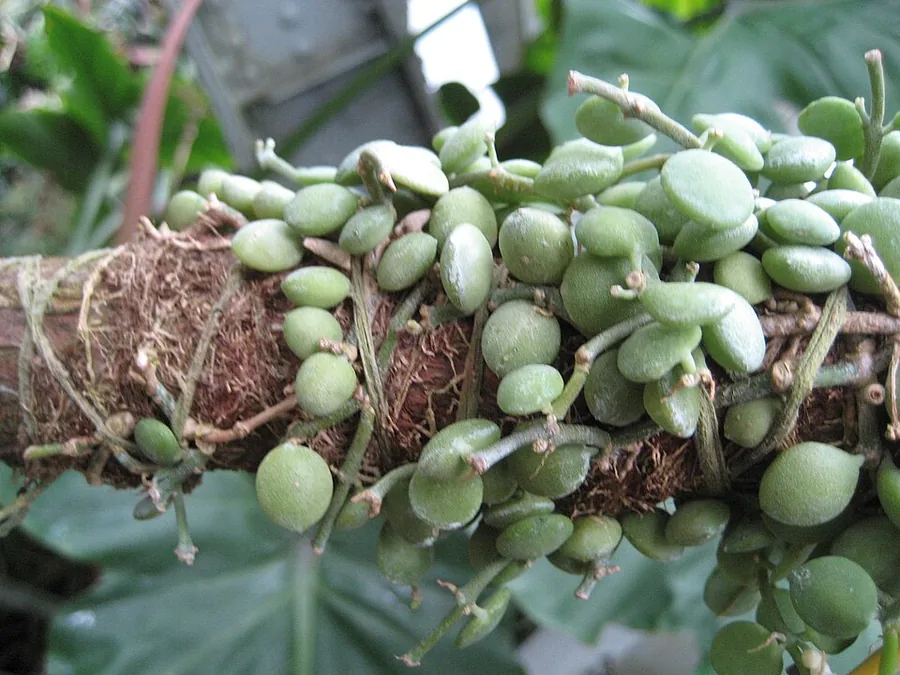
Designated string of nickels for the trailing stems strung with rounded, coin-like paired leaves, this species occurs naturally from southern China through tropical Asia to northern Queensland.
Dischidia ruscifolia
Marketed as million hearts, it bears dense trailing stems closely lined with small heart-shaped leaves.
Dischidia ovata
The watermelon dischidia is identified by oval green leaves marked with silver striping that develops a pinkish-red cast under bright light.
How to propagate
Propagation is straightforward, and one vigorous plant supplies more than enough cuttings to fill additional pots or share.
Stem cuttingsEasy
Spring or summer during active growth · A few weeks to root
Stem cuttings are decisively the most reliable propagation route for dischidia. Collect them in spring or summer during active growth, insert them into a coarse, moist medium, and they form roots within a few weeks. Each rooted cutting then develops into a trailing plant genetically identical to the parent from which it was taken.
Myths
Dischidia are parasites that harm the trees they climb.
The premise is mistaken: these plants are epiphytes, and at times lithophytes, meaning they occupy tree bark or rock purely as a structural support. They extract nothing from that surface and instead obtain water and nutrients from the air and rainfall. A dischidia draws nothing from its host, so it inflicts no harm on the tree.