Houseplant · Apocynaceae
Wax Plant
Hoya carnosa
Give it bright light and a let-it-dry watering habit, and this easy-going wax plant rewards you with clusters of porcelain flowers.
Bright indirect
45–75°F · 7–24°C
USDA 10–12
2–4 ft · 0.6–1.2 m
Overview
The wax plant owes its common name to thick, glossy leaves whose cuticle is heavy enough to feel almost artificial. Botanically it is a climbing epiphyte of the Apocynaceae, native to a corridor of Asia running from southern China to Laos and eastward to Taiwan and Japan, where it ascends host trees rather than rooting in soil. Under cultivation indoors it behaves as an easy, long-lived vine, trailing from a shelf or ascending a modest trellis.
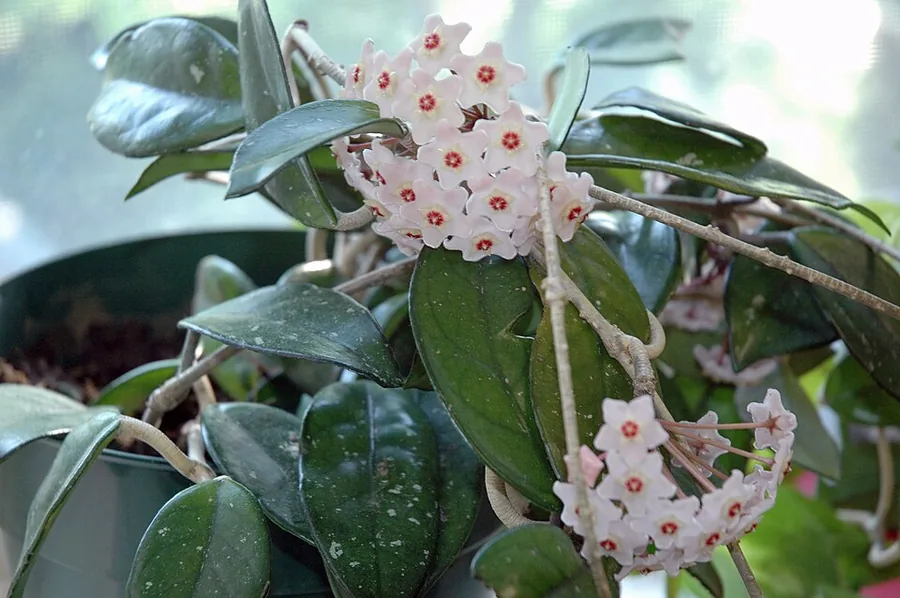
The floral display is the reason most growers keep it. On mature specimens the plant produces rounded umbels of star-shaped, waxy flowers with the finish of carved porcelain, frequently fragrant and exuding a bead of nectar. Reaching that stage requires patience, because a juvenile plant generally needs 2 to 3 years to attain flowering maturity.
Cultivation reduces to two governing factors: adequate light, and restraint at the watering can. Because the semi-succulent leaves function as a water reserve, the plant withstands a lapsed watering far better than a waterlogged root zone, where oxygen is excluded. Satisfy light and drainage and the wax plant demands little else.
Care
The short version: provide bright indirect light with some direct morning sun, irrigate only after the top third to half of the mix has dried, and grow it in a loose, fast-draining medium. Keep it warm, sustain humidity, and preserve the old flower spurs.
Light
Grow the wax plant in bright indirect light, ideally immediately beside a window that supplies a few hours of direct morning sun, since that intensity funds bud initiation. It persists in partial shade, but low light suppresses flowering and degrades the variegation of the patterned cultivars.
Water
Irrigate freely through spring and fall, then allow the top third to half of the mix to dry before the next application. Reduce watering sharply in winter. Overwatering is the leading cause of death in this plant, because saturated media excludes oxygen from the roots, so err toward waiting.
Soil
Use a loose, fast-draining medium rich in organic matter, for instance one part potting soil, one part orchid bark, and one part perlite. The species tolerates a pH span of 6.0 to 8.0, but it will not endure a medium that retains water around the roots.
Temperature
Maintain it within 45°F to 75°F (7°C to 24°C), treating the lower figure as a hard limit rather than a target, because this is a tropical species with no cold tolerance. Steady indoor warmth, away from cold drafts and chilled window glass, suits it best.
Humidity
The plant prefers high humidity and performs best in a moist room such as a bathroom or kitchen. Dry indoor air is not lethal, but it favors spider mites, so a humidifier or pebble tray is a worthwhile winter measure.
Feeding
Fertilize through the growing season, spring to fall, with a liquid feed formulated to support flowering, approximately a 2:1:2 or 3:1:2 NPK ratio. Liquid is preferable to slow-release granules here, because the infrequent watering schedule does not dissolve granules evenly.
Pruning
Prune lightly in early spring to restrain the vine and keep it compact. The non-negotiable rule is to retain the bare flower spurs, since the plant reflowers from those same perennial stalks in successive seasons.
Repotting
Repot infrequently, and only when clearly warranted. The wax plant flowers more freely when slightly pot-bound, so avoid unnecessary upsizing; move it on only when roots crowd the container or the medium dries almost as fast as it is wetted.
Size & spacing
Indoors the vine attains 2 to 4 feet (61 to 122 cm) in length with a spread of 12 to 24 inches (30 to 61 cm). Provide a trellis for climbing or a high shelf for trailing, and allow surrounding space for air movement.
Troubleshooting
Nearly every disorder in this plant resolves to a watering or light imbalance. Diagnose from the leaves and roots before intervening, because a wrinkled leaf and a soft, rotting one require opposite corrections. Match the presentation below, then treat accordingly.
Yellowing foliage over soft, mushy stems and roots
These symptoms indicate root rot, the endpoint of soil that holds water far longer than the roots can tolerate. An oversized pot or a mix with poor drainage keeps the medium saturated, the roots suffocate, and they turn brown and soft. Halt watering, lift the plant, excise every rotted root, and reestablish it in fresh fast-draining mix within a container that has a drainage hole.
Fix:
- Stop watering and let the mix dry
- Unpot and trim away soft, rotted roots
- Repot into fresh fast-draining mix in a container with drainage
- Use the pot-weight test before watering again
Turgid leaves losing firmness and wrinkling
Wrinkling and loss of firmness signal that the semi-succulent leaves have drawn down their stored water because the medium stayed dry too long. A pot that lifts far too light confirms the mix has dried to the point of no available moisture. Water thoroughly until it drains from the base, rehydrating the tissue, then return to a measured let-the-top-dry regimen through the growing season.
Fix:
- Water thoroughly until it drains from the bottom
- Resume regular watering on a let-top-dry schedule
- Check that the mix is not hydrophobic and rewetting properly
Cottony tufts, webbing, or bumps on stems and foliage
This trio of signs identifies the common indoor pests of the genus. Cottony masses in the leaf axils are mealybugs, fine webbing with minute specks indicates spider mites, which proliferate in the low humidity of heated winter rooms, and fixed, immobile bumps are scale. Spot-treat mealybugs with an isopropyl-alcohol swab, follow with insecticidal soap or neem oil, and quarantine the plant while you repeat applications until the infestation clears.
Fix:
- Dab mealybugs with a cotton swab soaked in isopropyl alcohol
- Treat with insecticidal soap, horticultural soap, or neem oil
- For spider mites, raise humidity and treat undersides thoroughly
- Isolate the plant and repeat treatments until clear
Vigorous foliage without flowering
Insufficient light drives most cases of shy flowering, because the plant needs strong light to fund bud development, so relocate it beside a bright window with a few hours of direct morning sun. Physiological maturity matters as well, since a wax plant typically reaches flowering age only at 2 to 3 years old. The third cause is mechanical: removing the bare peduncles strips away the perennial spurs that set the next flush, and the same old spur reflowers season after season.
Fix:
- Move to a brighter spot with bright indirect light plus a few hours of direct morning sun
- Leave all bare flower spurs/peduncles intact - they rebloom from the same spur
- Be patient; young plants need 2-3 years to reach flowering maturity
- Do not move the pot once flower buds appear
Sticky secretion on foliage and adjacent surfaces
During bloom the flowers secrete a sweet, nectar-like sap, so a degree of stickiness at flowering is a normal physiological trait and lifts off with a damp cloth. The alternative source is honeydew, the sugary waste of sap-sucking insects, which points you to the leaf axils and undersides where cottony mealybugs gather. Treat the plant if pests are present; absent any, attribute the residue to the flowers.
Fix:
- If pests are present, treat for mealybugs (see pest entry)
- If from flowers, simply wipe surfaces - the sticky sap is normal
- Wipe leaves with a damp cloth
Toxicity
For households with animals the record is reassuring: the wax plant is non-toxic throughout. The ASPCA and NC State Extension both clear it for cats, dogs, and horses, and no poisoning is documented for other common household species. The only practical caveat is the sticky sap of a cut stem, which can stain but is not toxic.
Safe for
People · Cats · Dogs · Horses · Rabbits · Livestock · Birds
Cats None
Both the ASPCA and NC State Extension classify the wax plant as non-toxic to cats, with no poisoning documented. A leaf sampled out of curiosity carries no toxic risk, though ingesting a large volume of any plant material can provoke mild, self-limiting gastrointestinal upset.
Dogs None
The same toxicity references rate the plant non-toxic to dogs. No compound in the foliage will poison a dog, so a chewed stem warrants observation rather than treatment.
Horses Safe
NC State Extension classifies the wax plant as non-toxic to horses, so it presents no poisoning hazard in a barn or paddock setting.
Rabbits Safe
No toxic constituents are documented for this species, so a rabbit that reaches a trailing stem faces no chemical harm from it.
Livestock Safe
The literature records no poisoning of grazing animals attributable to the wax plant, which excludes it from the livestock hazard list.
Birds Safe
No avian toxicity is documented for this plant, so a parrot that shreds a leaf is exposed to no known hazard.
People Safe
The wax plant is safe around both children and adults. It is not cultivated as an edible, and the sole practical concern is the sticky sap released by cut stems, which can stain skin and surfaces without posing a toxic threat.
Although non-toxic, ingestion of any plant material can still cause mild stomach upset; cut or damaged stems and flowers can exude a sticky/milky sap that may stain
Varieties
Beyond the green wild type, the species has yielded several variegated and novelty selections that collectors seek out. The following are the forms most often encountered.
'Variegata' (incl. f. variegata)
Kew accepts this variegated form, distinguished by leaf margins bordered in creamy white that occasionally flushes pink.
'Tricolor' / 'Krimson Queen'
This selection presents green leaf centers bounded by creamy-white to pink margins.
'Krimson Princess'
It inverts the layout, placing pink and white variegation toward the center of green leaves against darker outer margins.
'Compacta' / 'Krinkle Kurl' (Hindu Rope plant)
Marketed as the Hindu Rope plant, it contorts its crowded leaves into curled, folded, rope-like trailing stems.
How to propagate
Among houseplants the wax plant propagates with unusual ease, and one vine will furnish several new plants with little effort.
Stem cuttingsEasy
Spring to summer · Roots in a few weeks
Sever a tip or stem section bearing a node and at least one leaf, then hold it in water or moist medium during the spring-to-summer growth period. The node initiates roots within a few weeks and yields a plant genetically identical to the parent.
LayeringEasy
Spring to summer · Several weeks
The long vines layer with minimal intervention. Anchor a node against moist medium in spring or summer, and it forms roots over several weeks while remaining connected to and supplied by the parent plant.
Myths
Remove the bare flower stalks once the blooms have faded.
Those bare stalks, correctly the spurs or peduncles, are the perennial structures from which the next flowers arise. Leave them intact and the plant reflowers on the same spur year after year, whereas removing them forfeits the coming flush.
A waxy semi-succulent like this scarcely needs watering.
The thick leaves do buffer water and the plant must never remain saturated, yet it still requires regular irrigation through spring and fall. Allow only the top third to half of the mix to dry between waterings, since prolonged drought withers the leaves and triggers drop.