Houseplant · Apocynaceae
String of Hearts
Ceropegia woodii
Match its bright light and dry-down cycle, and this tuberous vine trails for years.
Bright indirect
59–86°F · 15–30°C
USDA 10–12
3–12 ft · 0.9–3.7 m
Overview
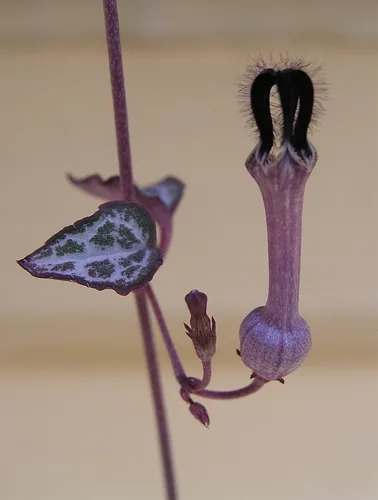
String of hearts is a trailing, tuber-forming semi-succulent native to southern Africa, where it grows over rock as a tuberous vine. Paired heart-shaped leaves, marbled silver over green, sit along slender stems and account for both the botanical interest and the common names rosary vine and chain of hearts. Under indoor culture the stems trail from a raised pot and extend to several feet with age.
Its easy reputation rests on water storage. The leaves and stems hold reserves, which buffers the plant against a missed watering but leaves it poorly equipped to survive a saturated root zone. Given adequate light and a gritty, fast-draining medium, it grows largely unaided and adds length quickly across spring and summer, its active season.
Two conditions govern success: bright indirect light and a full soil dry-down between waterings. Light drives compact internodes and marbling, so a shortfall produces pale, elongated stems; excess water in a poorly drained pot invites root rot. Meet both and the result is a long-lived, low-maintenance plant that propagates readily from its own vines.
Care
The short version: site it in bright indirect light, pot it in a free-draining cactus or succulent mix, and water only once the medium has dried out completely, reducing frequency further through winter dormancy.
Light
Provide bright indirect light, as much as the plant will take short of harsh midday sun. A west- or south-facing window supplies the intensity that drives short internodes and pronounced marbling, which is why strong light keeps the vines compact. In dim light the vines elongate and lose their marbled color.
Water
Allow the medium to dry out completely, then water thoroughly. Because the plant carries its own water in leaf and stem tissue, a pot that stays wet offers no benefit and drives root rot, the leading cause of loss. Through winter dormancy the plant's water demand falls sharply, so reduce watering further.
Soil
Use a free-draining cactus or succulent mix, amended with coarse sand or perlite so water clears the root zone quickly. The species accepts a broad pH span from 6.0 to 8.0, which makes drainage the decisive factor rather than soil reaction.
Temperature
The plant performs across ordinary room temperatures, 59°F to 86°F (15°C to 30°C). Hold it above 60°F (16°C) in winter and shield it from cold drafts, since it has no frost tolerance and chilling injures the tissue.
Humidity
Average indoor air satisfies it, and low humidity presents no problem for a semi-succulent adapted to dry conditions. No misting is required and no humidity target applies.
Feeding
Feed only during the spring and summer growth phase, using a half-strength balanced houseplant fertilizer at most once a month. Withhold fertilizer entirely through winter, when the dormant plant cannot use it.
Pruning
Cutting back long or sparse stems redirects growth into fuller, bushier form by encouraging branching lower down. The removed sections are viable propagation material, since each trimmed strand roots with ease.
Repotting
The plant prefers crowded roots, so repot only when necessary. Reliable indicators are roots occupying the pot, a medium that dries almost immediately after watering, and growth that has stalled.
Size & spacing
35–144 in (90–365 cm) tall
Troubleshooting
Two variables account for most disorders in this plant: light level and watering. Both leave clear signs in the stems and the soil, so a grower who reads them early can correct course before damage sets in. Identify the pattern below, then respond promptly.
Yellowing foliage with soft, decaying stems and roots
Yellow leaves above soft, collapsing stems signal root rot from overwatering, the failure that most often kills this species. Persistently wet medium decays the roots, and the softening advances up the lower stems. Halt watering, let the mix dry completely, and repot into a free-draining cactus or succulent mix after excising the rotted tissue. Where rot is advanced, secure healthy cuttings or tubers as insurance against total loss.
Fix:
- Stop watering and allow the mix to dry out completely
- Repot into a free-draining cactus/succulent mix and remove rotted tissue
- Take healthy stem cuttings or tubers as backup if rot is advanced
Sticky exudate, deformed growth, or insects on the foliage
Sticky residue and distorted new growth indicate feeding by aphids, mealybugs, or scale. These pests appear as white cottony masses, small raised bumps, or clusters of soft-bodied insects on the stems and lower leaf surfaces. Remove them mechanically with a cotton swab of isopropyl alcohol, apply insecticidal soap, and isolate the plant to interrupt spread to nearby specimens.
Fix:
- Wipe off pests with a cloth or cotton swab dipped in isopropyl alcohol
- Treat with insecticidal soap as needed
- Isolate the plant to prevent spread
Elongated, sparsely leaved vines with wide internodes
Elongated stems with widely spaced leaves indicate insufficient light. Without enough intensity the plant extends its internodes searching for it, and the foliage develops pale rather than well-marbled coloring. Relocate it to a brighter position offering bright indirect light and cut back the drawn strands to promote denser, more branched growth.
Fix:
- Move to a brighter spot with bright indirect light, such as a west- or south-facing window
- Trim leggy growth to encourage denser branching
Toxicity
For households with pets or children, string of hearts is treated as non-toxic and safe around cats, dogs, and people generally. The milky latex characteristic of Apocynaceae can irritate sensitive skin, so washing your hands after taking cuttings is sensible, but an incidental nibble carries no real risk.
Safe for
People · Cats · Dogs · Horses · Rabbits · Livestock · Birds
Cats None
String of hearts is classed as non-toxic, so a cat that consumes a heart or two should be unaffected. As with any houseplant, a large mouthful may provoke transient drooling or mild gastrointestinal upset, nothing of clinical concern.
Dogs None
Dogs are not at risk from this trailing vine, which carries no toxin known to affect them. Ingesting the stems may cause brief, self-limiting digestive upset, the ordinary response to any non-food plant material.
Horses None
No toxicity concern applies to horses. As a small potted indoor vine it is unlikely to be encountered, and it contains nothing documented as harmful to them.
Rabbits None
Rabbits face no toxic hazard from string of hearts, whose foliage is not poisonous, so an incidental bite does no harm. Positioning the strands out of reach protects the plant itself.
Livestock None
Grazing stock are not exposed to this indoor container plant and are in any case at no risk, as it holds no compound toxic to them.
Birds None
Pet birds may perch and forage near this vine without hazard, since it carries no toxin recognized as harmful to birds. An occasional sampled leaf warrants no concern.
People None
The plant presents no meaningful risk to people. Its milky latex may leave sensitive skin slightly irritated, so washing your hands after taking cuttings is advisable, and it is not intended for consumption.
As with any houseplant, discourage pets and children from chewing the foliage, and the milky sap of Apocynaceae plants may cause mild irritation in some individuals.
Varieties
Cultivation centers on the plain species, though one named selection appears often enough to warrant description.
Ceropegia woodii 'Variegata'
A named variegated selection, its foliage marbled with pink, cream, and green, that develops more slowly than the standard species.
How to propagate
Few houseplants propagate as readily as this one, because every vine offers usable material. A stem cutting, a single soil-contacting bead, or a layered stem left on the parent will each establish a new plant.
Stem cuttingsEasy
Active growing season (spring to summer) · A few weeks to root, especially with bottom heat
Stem cuttings are the most reliable route. Taken during the spring-to-summer growth period and inserted into a free-draining mix, they root within a few weeks. Supplying bottom heat accelerates root initiation.
Offsets & pupsEasy
Active growing season · A few weeks once in contact with soil
The vines produce small aerial tubers, the bead-like tubercles that gave rise to the name rosary vine. Set one against the medium during active growth and it roots unaided, generating a new plant within a few weeks.
LayeringEasy
Active growing season · A few weeks
Layering exploits the same rooting response without detaching the stem. Pin a trailing shoot so its tubercles contact the soil while it remains attached to the parent, allow a few weeks of active growth for roots to establish, then sever the new plant.
Myths
String of hearts must be watered frequently to remain lush, as a conventional leafy houseplant would.
The premise misreads the plant. As a drought-tolerant semi-succulent it stores water internally and performs best when the soil dries out completely between waterings. Overwatering is the primary cause of death, decaying the roots beyond recovery, and demand drops still further once winter dormancy halts growth, so watering should ease accordingly.