Houseplant · Apocynaceae
Sweetheart Hoya
Hoya kerrii
Water it like a succulent, site it in bright light, and the sweetheart hoya demands remarkably little.
Bright indirect
45–80°F · 7–27°C
USDA 10–12
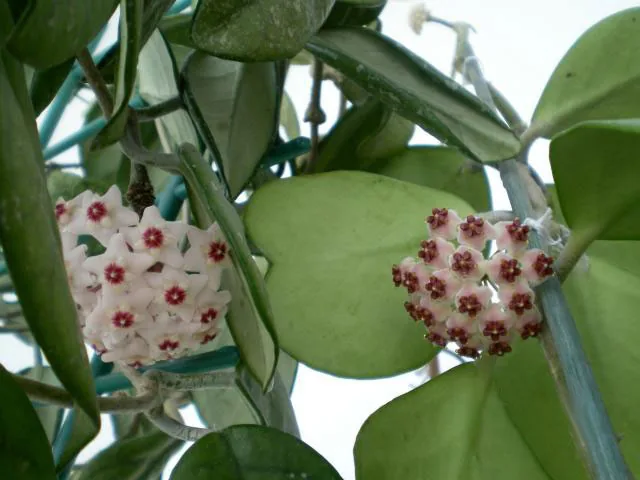
Overview
The sweetheart hoya takes its name from thick, waxy, heart-shaped leaves whose fleshy tissue functions as a water reservoir. It is a slow-growing climber from the forests of Indo-China and Malesia, where it ascends host trees as an epiphyte rooted in bark and debris rather than deep soil. That epiphytic habit shapes its indoor needs: airy media, generous drying, and no waterlogging.
In commerce it appears most often as a single rooted heart in a small pot, marketed near Valentine's Day. That specimen is one leaf, and lacking a node it holds no shoot-forming meristem, so it remains a single leaf. A genuine vining plant derives from a cutting carrying stem and node, which over time extends into long strands of overlapping hearts.
Culture rewards restraint above all. Because the leaves store their own water, the failure mode is overirrigation rather than neglect. Supply bright light, allow full drying, and keep the plant modestly potbound, and it responds with clusters of star-shaped flowers borne on perennial spurs.
Care
The short version: bright indirect light, succulent-style watering only after the mix dries out, a fast-draining medium, and a container the roots can stay slightly crowded in.
Light
Site it in bright indirect light at a south, east, or west window to sustain leaf color and support flowering. It tolerates medium light or partial shade, but growth decelerates and bloom becomes rare under reduced illumination. Exclude harsh direct sun, which scorches the waxy cuticle.
Water
Irrigate it like a succulent, exploiting the water stored in its thick leaves. Allow the medium to dry out completely between waterings, waiting until the top third to half is dry or the leaves begin to pucker. Reduce watering sharply through winter, since overwatering is the primary cause of root rot and directly inhibits flowering.
Soil
Grow it in a fast-draining, open mix that sheds water quickly. A blend of one part potting soil, one part orchid bark, and one part perlite delivers the rapid drying its epiphytic roots prefer. It is indifferent to pH across the range 6.0 to 8.0.
Temperature
Standard interior temperatures suit it, approximately 45°F to 80°F (7°C to 27°C). Maintain it above 45°F (7°C) and shield it from cold drafts, as it has no tolerance for chilling.
Humidity
Average household humidity is adequate, so no target figure applies. The waxy leaf surface limits transpirational loss, making this plant considerably more tolerant of dry indoor air than most tropicals.
Feeding
Apply a dilute liquid houseplant fertilizer monthly through the active growth period from spring to fall. A formulation with an NPK ratio around 2:1:2 or 3:1:2 matches its needs. Suspend feeding over winter dormancy.
Pruning
A slow grower requires little pruning. The governing rule is to retain the bare flower spurs after the blooms fade, because the plant reflowers from those same spurs, and their removal forfeits the following season's display.
Repotting
Repot only every few years, since hoyas flower more freely when kept slightly potbound. Advance to a larger container when roots emerge from the drainage holes, water passes straight through, or the medium dries almost immediately after irrigation.
Troubleshooting
Nearly every disorder in this plant resolves to one of three variables: soil moisture, light, or the expectation that a single leaf can behave as a whole plant. Identify the sign below, then correct the variable before a minor lapse escalates to rot.
Darkened, softening basal tissue followed by total collapse
A soft, blackened base signals root rot, driven by excess moisture or a substrate that retains it. Because the succulent leaves already carry a substantial water reserve, a saturated mix deprives the roots of oxygen and they fail quickly. Withhold water, excise all necrotic tissue, and repot into a fast-draining substrate in a container with drainage holes. Where the crown is lost, salvage a healthy nodal cutting and restart the plant from that.
Fix:
- Stop watering and let the soil dry out
- Remove rotted tissue and repot into a fast-draining mix in a pot with drainage holes
- Take a healthy cutting (with a node) to start over if the base is lost
Foliage turning thin, creased, and visibly dehydrated
Puckering reflects lost turgor in the water-storing leaves and has two opposite drivers, so assess the substrate first. Dry mix over firm roots indicates the reserves ran down, and a thorough watering restores turgor. Wet mix over mushy roots indicates overwatering has compromised the roots so they can no longer absorb water, in which case the correction is improved drainage and a drying interval, not more water.
Fix:
- If too dry, water thoroughly and resume a regular let-it-dry cycle
- If overwatered, correct drainage and let the soil dry before watering again
Sap deposits, malformed shoots, or insects along stems and foliage
Sticky residue and deformed growth follow feeding by sap-sucking insects, and on hoyas that means mealybugs, aphids, spider mites, and scale. Confirm the culprit by its sign: white cottony masses, small soft-bodied insects, fine webbing with stippling, or fixed bumps along the stems. Dislodge the population, treat with insecticidal soap or horticultural oil, then quarantine the plant and re-treat on a cycle until inspection comes back clean.
Fix:
- Wipe off pests and treat with insecticidal soap or horticultural oil
- Isolate the plant and repeat treatment until clear
A single potted leaf that never initiates stems or vines
The novelty potted heart is typically a leaf with no node, and because meristematic tissue capable of initiating a shoot sits at the node, a bare leaf simply lacks the growth point to extend a stem. The leaf can persist plump and green for years on its stored reserves, yet it will not vine. To obtain a trailing specimen, propagate instead from a stem cutting bearing at least one node.
Fix:
- Accept that the leaf will likely remain a single leaf (it can stay green and alive for years but will not vine)
- If you want a vining plant, obtain a stem/tip cutting that includes at least one node
A well-grown specimen that fails to set flowers
Insufficient light is the leading reason a healthy specimen withholds bloom, so reposition it near a south, east, or west window under bright indirect light. Reduce irrigation as well, since a chronically wet root zone suppresses flowering. Bear in mind that single leaves and juvenile plants have not reached reproductive maturity and cannot bloom regardless of culture. Critically, retain the old flower spurs, because the plant initiates successive blooms from those same spurs.
Fix:
- Move to a brighter spot with bright indirect light near a south/east/west window
- Reduce watering and let the soil dry between waterings
- Be patient and do not cut off the flower spurs
Toxicity
For animal-keeping households the verdict is clear: the sweetheart hoya is non-toxic and pet-safe. The ASPCA and NC State Extension both record it as safe for cats, dogs, and horses, and no toxin implicates the remaining animals. Ingestion of any foliage may provoke brief gastric upset through bulk alone, but there is no toxicological concern here.
Safe for
People · Cats · Dogs · Horses · Rabbits · Livestock · Birds
Cats None
Both the ASPCA and NC State Extension classify this hoya as non-toxic to cats, so ingestion presents no toxicological hazard. A cat that consumes a large volume of any foliage may salivate or show transient gastric irritation, which resolves without intervention.
Dogs None
The same non-toxic classification from the ASPCA and NC State Extension applies to dogs. At most, a dog that chews the plant experiences mild, self-limiting gastrointestinal upset.
Horses None
The ASPCA and NC State Extension both record this species as non-toxic to horses, so incidental grazing carries no toxic risk.
Rabbits Safe
No compounds in this plant pose a toxic threat to rabbits. Because the lagomorph gut is sensitive to abrupt dietary change, introduce any novel foliage in small quantities rather than a large single feed.
Livestock Safe
As an indoor species, it seldom comes within reach of grazing stock, and in any case it contains nothing that would harm them.
Birds Safe
A companion bird may perch on and probe the waxy foliage without risk, since the plant carries no compounds documented to affect avian species.
People Safe
The species holds nothing poisonous to humans, so an accidental taste by a child warrants no alarm. It is not cultivated as an edible, however, so deliberate consumption serves no purpose.
Considered pet-safe; no special handling for toxicity is required, though pets eating any plant may have mild, transient GI upset
Varieties
The all-green form dominates the trade, but a single named cultivar circulates and merits identification.
'Variegata'
Each heart-shaped leaf shows a green center bounded by a soft creamy-white marginal band, producing a markedly brighter appearance than the wholly green form.
How to propagate
One method reliably increases this plant, and its entire success hinges on the cutting carrying a node.
Stem cuttingsEasy
Spring to summer · Roots in a few weeks
Excise a stem or tip cutting bearing at least one node during spring or summer, when active growth speeds callusing and rooting. Inserted into a fast-draining medium, it establishes roots in a few weeks. Reject the bare single leaf: it roots and survives, but with no node it holds no growth point and will never extend into a vine.
Myths
A rooted solitary leaf of Hoya kerrii develops in time into a mature, vining specimen.
A detached leaf readily forms roots, but lacking a node it has no meristem from which a shoot can arise, so it remains a solitary leaf. Penn State Extension is explicit that the ornamental potted heart is simply a single leaf of H. kerrii that stays just as it is and never develops into a vine. A trailing plant requires a cutting that includes a node and a segment of stem.