Houseplant · Apocynaceae
Hindu Rope Hoya
Hoya carnosa 'Compacta'
Provide bright light and a dry-leaning watering regime, and this curly-leaved wax plant performs for years.
Bright indirect
50–75°F · 10–24°C
USDA 10–12
2–3 ft · 0.5–1 m
Overview
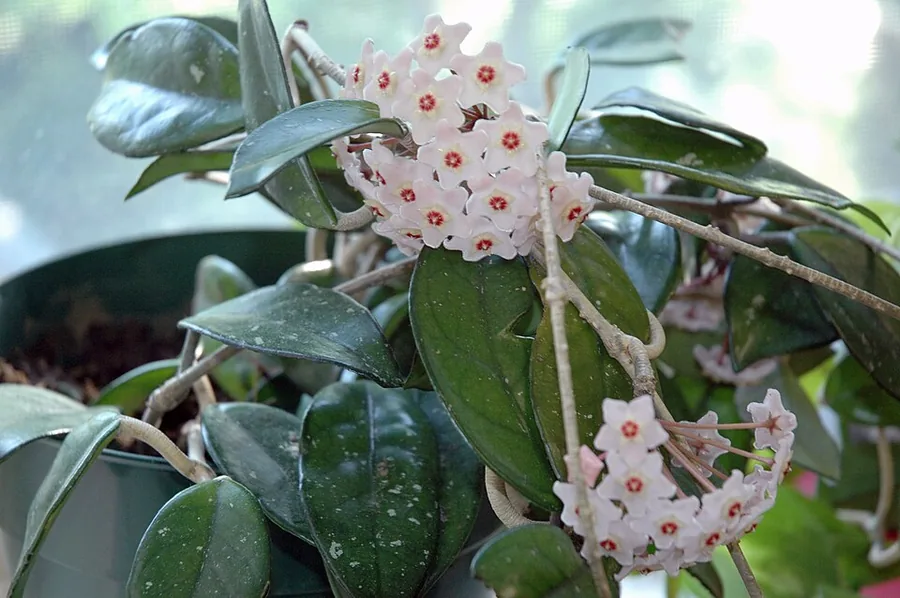
The Hindu rope hoya is a wax plant valued for its distinctive foliage, whose leaves curl and fold back on themselves to form thick, rope-like trails. It originated as a naturally occurring mutation of the common Hoya carnosa, which is why it retains the parent's undemanding constitution while presenting a wholly different form. The pendent stems are best displayed in a hanging pot or on a high shelf where they can cascade.
Growth is slow, and that slow pace correlates with the plant's longevity. Specimens persist for years in a single pot, and mature, established plants produce clusters of star-shaped, sweetly scented flowers. Those inflorescences arise from short woody spurs that the plant retains and reuses, so flowering recurs at the same points season after season.
The cultivar is easy to grow once its physiology is understood. The twisted leaves function as water-storage organs, which makes the plant resilient yet prone to rot under generous watering. Bright light, a fast-draining substrate, and minimal disturbance at the roots account for the greater part of its requirements.
Care
The short version: bright indirect light with a little direct sun, a fast-draining mix, and irrigation only after the substrate has dried. Feed monthly during active growth, hold it warm and humid, and leave the old flower spurs undisturbed.
Light
Provide bright indirect light with some direct sun, since that light level is what induces flowering. The plant tolerates partial sun or partial shade, but a dim position yields slow growth and few, if any, blooms. Screen it from harsh midday sun, which scorches the leaf surface.
Water
Allow the mix to dry out between waterings and err toward underwatering rather than over. Because the dense leaves already hold a water reserve, saturated soil overloads the roots and drives rot, so reduce watering further in winter as growth slows.
Soil
Use a loose, fast-draining mix that is loam-based and high in organic matter, such as potting soil amended with orchid bark and perlite. The plant is tolerant of pH across the range 6.0 to 8.0. Rapid drainage is the property that matters most.
Temperature
Hold it within 50°F to 75°F (10°C to 24°C), the ordinary indoor range of most homes. It is intolerant of cold drafts, so position it away from chilled windows and doorways in winter.
Humidity
The plant prefers high humidity, above the level typical of a heated home. A tray of damp gravel beneath the pot or placement in a humid bathroom supplies it, and the raised moisture concurrently suppresses spider mites.
Feeding
Feed monthly from spring through autumn during active growth with a dilute liquid fertilizer. A feed weighted toward nitrogen and potassium, such as a 2:1:2 or 3:1:2 NPK ratio, promotes flowering.
Pruning
The plant requires almost no pruning and responds poorly to hard cutting, so restrict work to removing weak or crowded shoots in late winter or early spring. Critically, do not cut off the bare flower spurs after blooming, since the plant reflowers from those same persistent stalks.
Repotting
Repot infrequently, as the plant resents root disturbance and tolerates the same pot for years. Act only on clear rootbound signs such as roots emerging from the drainage holes, arrested growth, or the pot drying out unusually fast after watering.
Size & spacing
The trailing stems attain 1.5 to 3 feet (50 to 100 cm) over many years of slow extension, with a spread of 4 to 20 inches (10 to 50 cm). Allow the growth to hang from an elevated pot or shelf so the rope-like habit develops fully.
Troubleshooting
The majority of problems with a Hindu rope resolve to a fault in either watering or light. Because the thick leaves buffer both drought stress and excess moisture, the early signals are easy to miss, so read the following symptoms promptly and correct the cause before it progresses through the plant.
Soft, blackening stems with mushy roots
These symptoms indicate root rot, and this cultivar reaches it quickly because the thick, water-storing leaves already carry an internal reserve, so a waterlogged mix leaves the roots with excess moisture they cannot use. Withhold water and let the mix dry, then unpot the plant, excise all brown, soft roots, and repot into fresh fast-draining mix. Where the rot is advanced, take several healthy cuttings as insurance against total loss.
Fix:
- Stop watering and let the soil dry out
- Unpot, cut away rotted roots, and repot into fresh fast-draining mix
- Take healthy stem cuttings as insurance if rot is advanced
Cottony masses, sticky film, or fine webbing on the plant
The tightly folded leaves create sheltered crevices that harbor mealybugs, scale, and spider mites, so inspect the undersides and folds where they concentrate. Spot-treat cottony mealybugs and bumpy scale with a cotton swab of isopropyl alcohol, then apply insecticidal soap or neem oil across the whole plant and repeat until control is achieved. Because spider mites are favored by dry air, raising the humidity suppresses them directly.
Fix:
- Dab mealybugs/scale with a cotton swab dipped in isopropyl alcohol
- Treat with insecticidal soap or neem oil, repeating as needed
- For spider mites, use insecticidal soap/neem and raise humidity
Vegetative growth continues but no flowers appear
The limiting factor is nearly always inadequate light, because the plant needs bright light with some direct sun to trigger flowering. A second cause is the loss of the bare flower spurs, since the plant reflowers from those same persistent structures and cutting them removes next season's blooms. Provide brighter light, retain every spur, and allow for maturity, as many specimens will not flower until they reach two or three years old.
Fix:
- Move to a brighter spot with bright indirect light plus some direct sun, but avoid scorching midday sun
- Stop removing the bare flower stalks - leave all spurs/peduncles in place
- Be patient with young plants until they mature
Leaves become shriveled, wrinkled, or limp
Softening and wrinkling of the curled leaves signals that the mix has been bone dry for too long and the leaf reserves have been drawn down. A thorough watering until it drains from the holes rehydrates the tissue, and the leaves refill within a day or two. Maintain steady watering through the growing season rather than alternating between saturation and drought.
Fix:
- Water thoroughly until it drains, then resume letting the top dry between waterings
- Keep watering consistent through the growing season
Toxicity
For households with animals, the assessment is favorable: the Hindu rope hoya is non-toxic and safe to keep. The ASPCA and NC State Extension both classify the wax plant as non-toxic to cats, dogs, and horses, so an incidental nibble presents no toxicological concern. The milky sap is only mildly sticky, so wash your hands after pruning.
Safe for
People · Cats · Dogs · Horses · Rabbits · Livestock · Birds
Cats None
The ASPCA classifies this wax plant as non-toxic to cats, so a nibble carries no poisoning risk. Ingestion of a large quantity of any houseplant may bring transient gastrointestinal upset, but the plant itself is not harmful.
Dogs None
The same ASPCA non-toxic rating extends to dogs. The most a substantial mouthful is likely to produce is mild, self-limiting stomach upset.
Horses None
NC State Extension records Hoya carnosa as non-toxic to horses, so grazing presents no toxicological hazard.
Rabbits None
No toxic compounds are documented for this plant, so a rabbit may sample a leaf without injury. As with any rich foliage, limit intake to keep the gut settled.
Livestock None
The wax plant poses no toxicity to grazing stock. Its thick, waxy leaves are poor forage and remain safe even when browsed.
Birds None
Pet birds may perch on and pick at the plant with no toxic consequence. It contains nothing that would harm a bird that takes a bite.
People None
The plant is not poisonous to people, though it is cultivated ornamentally rather than for consumption. Its milky sap is mildly sticky, so hand washing after pruning is advisable.
Non-toxic, but ingestion of any houseplant can occasionally cause mild GI upset; the sap is mildly sticky/milky
Varieties
The Hindu rope is a single named cultivar of the wax plant rather than a collection of forms, so only one entity concerns the grower.
Hoya carnosa 'Compacta'
This is the Hindu rope plant itself, a naturally occurring mutation of Hoya carnosa in which the leaves curl and fold on themselves into rope-like strands borne on a slow-growing vine.
How to propagate
The Hindu rope propagates readily by two methods: rooting a detached cutting, or layering a trailing stem in situ.
Stem cuttingsEasy
Spring or early summer · Roots in about 2-3 weeks
Take semi-ripe stem or tip cuttings in spring or early summer, ensuring each retains at least one node, and root them in water or moist mix, where they establish in about 2 to 3 weeks. The stems also produce adventitious roots along their length, so a section can be pinned down and layered while still attached to the parent.
Myths
Cut off the bare flower stalks once the blooms have faded.
The bare stalks, correctly termed spurs or peduncles, are the perennial structures from which the next flush of flowers develops. Leave every spur intact, because removing them discards the plant's future blooms.
The Hindu rope plant is its own species called Hoya compacta.
Kew's plant database treats Hoya compacta as a synonym, not an accepted species. The Hindu rope is properly the cultivar Hoya carnosa 'Compacta', a naturally occurring mutation of the parent wax plant.